
Decision Framework
The 2026 AI Agent Trends Report: What Enterprises Need to Know
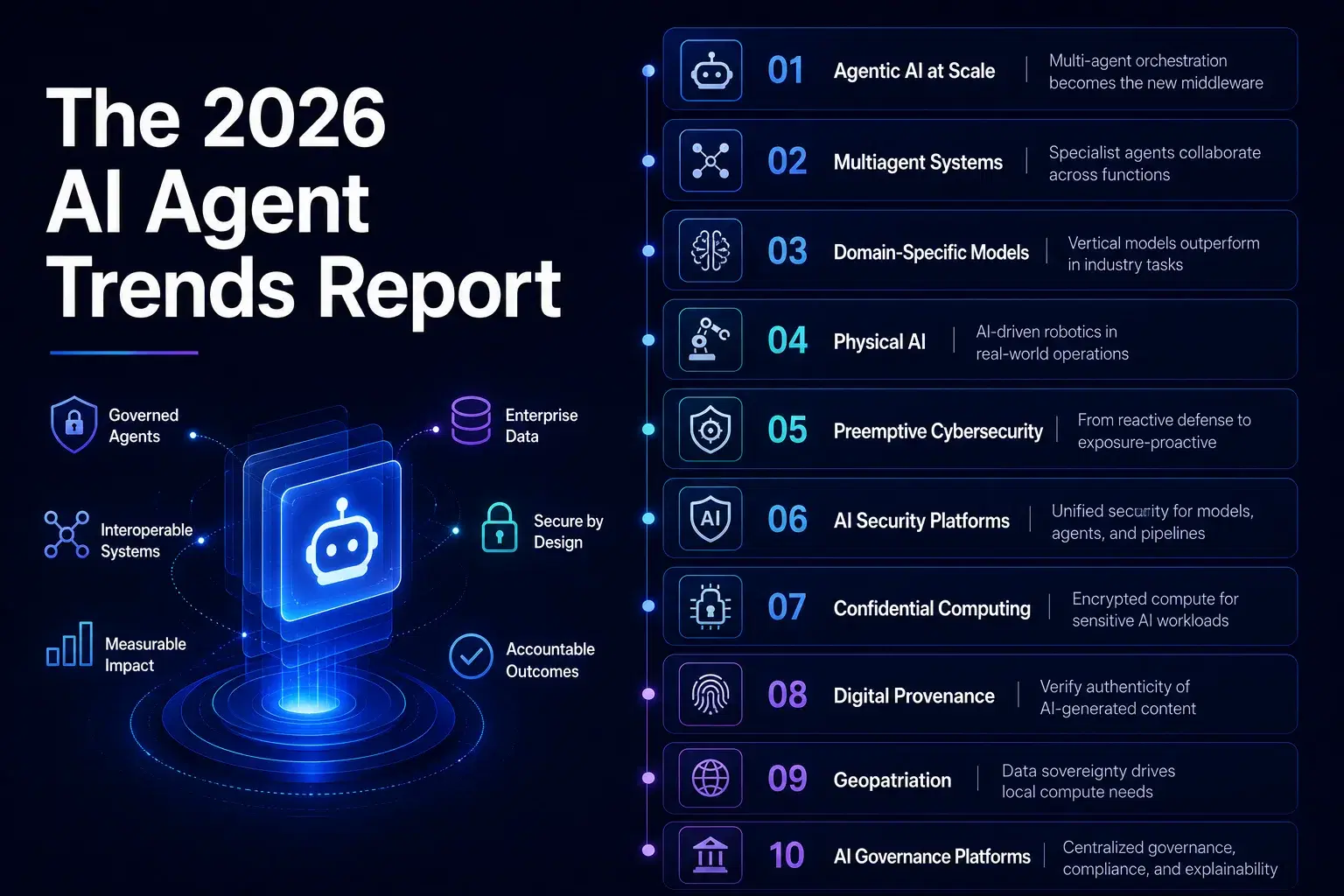
Agents are becoming the default interaction layer for complex work—but only organizations that govern data, workflows, and accountability will capture the upside.
Related work
Production builds that connect to this topic—open a case study or jump to our portfolio.

Enterprise AI in 2026 is less about whether to use agents and more about how to deploy them without creating new categories of operational and security risk. This trend summary integrates Gartner's Top 10 Strategic Technology Trends for 2026 alongside patterns we see across regulated industries and high-scale SaaS: where budgets go, what architecture standards are winning, and what leadership should prioritize beyond vendor roadmaps.
Gartner's Top 10 Strategic Technology Trends for 2026 (enterprise implications)
| Gartner Trend | Core implication | Enterprise priority |
|---|---|---|
| Agentic AI at scale | Multi-agent orchestration becomes the new middleware | Agent governance, tool security, evaluation harnesses |
| Multiagent systems | Specialist agents collaborate to handle cross-functional tasks | Agent-to-agent (A2A) protocols, orchestration platforms |
| Domain-specific foundation models | Vertical LLMs outperform general models on industry tasks | Fine-tuning strategy, proprietary data moats |
| Physical AI (robotics + AI) | AI-driven robots enter manufacturing, logistics, and healthcare | OT/IT convergence, digital twin integration |
| Preemptive cybersecurity | Shift from detection-reactive to exposure-proactive defense | CTEM programs, automated attack simulation |
| AI security platforms | Unified platforms securing AI models, pipelines, and agents | AI firewall, model access control, output filtering |
| Confidential computing | Encrypted compute for sensitive AI workloads | Regulated industries: finance, healthcare, government |
| Digital provenance | Verifying AI-generated content authenticity | Content watermarking, deepfake detection, audit trails |
| Geopatriation | Data sovereignty pushes local compute requirements | Regional deployment, compliance with AI localization laws |
| AI governance platforms | Centralized tooling for AI accountability and explainability | Model registries, bias audits, regulatory documentation |
Trend 1: Agents as the default service interface
Customer service, internal IT, and operations teams increasingly expect conversational and task-oriented interfaces that can retrieve context, take actions via tools, and escalate cleanly. The differentiator is not the chat widget—it is reliable resolution rate, auditability, and integration depth with CRM, ticketing, and knowledge bases.
Trend 2: Interoperability beats isolated assistants
Enterprises run multiple AI surfaces. Standards-oriented tool exposure (including MCP-style servers) and explicit orchestration layers reduce bespoke integration debt. The goal is composable capabilities with centralized policy—not twenty disconnected bots with overlapping permissions.
Trend 3: Vertical AI over generic horizontal chat
Horizontal assistants help individuals draft email. Vertical solutions win budgets when they encode domain objects, compliance rules, and integrations that generic tools cannot reach. Expect more industry-specific agents with evaluation suites tied to real workflows—not generic Q&A accuracy.
Trend 4: Workforce readiness is the bottleneck
Tools spread faster than skills. Organizations that invest in prompt literacy, data hygiene, and role clarity get more ROI than those that buy seats without change management. The ‘AI-ready workforce’ is partly training—and partly fixing processes that should not exist.
Trend 5: Security and governance move earlier in the lifecycle
Procurement, legal, and security teams are involved earlier for agent deployments that touch customer data and financial systems. Vendor claims are tested against penetration testing, data processing agreements, and kill switches for runaway tool use.
| Implication | Action |
|---|---|
| Higher integration surface | Invest in API quality and observability |
| More regulated scrutiny | Document decisions, versions, and approvals |
| Skill gaps | Pair tooling with training and process fixes |
How we help
Silicon Tech Solutions builds production AI systems and platforms for startups and enterprises. If you are translating trends into a roadmap, we can help you prioritize what to fund first based on your constraints—not the hype cycle.
Frequently asked questions
Related articles
Strategic Foundations
The Hyperautomation Playbook: Combining RPA, AI Agents, and Process Mining
Hyperautomation is not a product—it is a discipline. Organizations that combine process mining, RPA, and AI agents under a governance model consistently outperform those deploying tools in isolation.
15 min read · Enterprise AI & Automation
Decision Framework
Calculating the ROI of AI Agents: Beyond Headcount Reduction
ROI framed only as ‘fewer people’ invites resistance and misses the point. The defensible story is faster cycle times, higher throughput, and fewer errors on work that already exists.
12 min read · Enterprise AI & Automation
Strategic Foundations
The Economic Reality: What AI Agents Actually Cost at Scale
Transparency builds trust. Here is a practical cost model for AI agents at scale—plus the LaTeX-style ROI framing CFOs expect in 2026.
12 min read · Enterprise AI & Automation
Strategic Foundations
Solving the Integration Crisis: Connecting AI Agents to Legacy ERPs (SAP/Oracle)
Enterprise AI fails in the integration layer. Here is a practical approach to ERP-connected agents: boundaries, middleware discipline, and secure access to systems of record.
15 min read · Enterprise AI & Automation
Strategic Foundations
Transitioning from Traditional RPA to Autonomous AI Agent Workflows
RPA excels at deterministic repetition; AI agents excel when rules are fuzzy, context shifts, and exceptions are the norm—if you engineer reliability on top.
13 min read · Enterprise AI & Automation
Plan your next build with us
Book a working session to review workflows, integrations, or AI architecture—or send a message and we'll respond within one business day.