
Vertical Deep-Dives
AI Agents for Customer Success: Reducing Churn and Scaling Retention
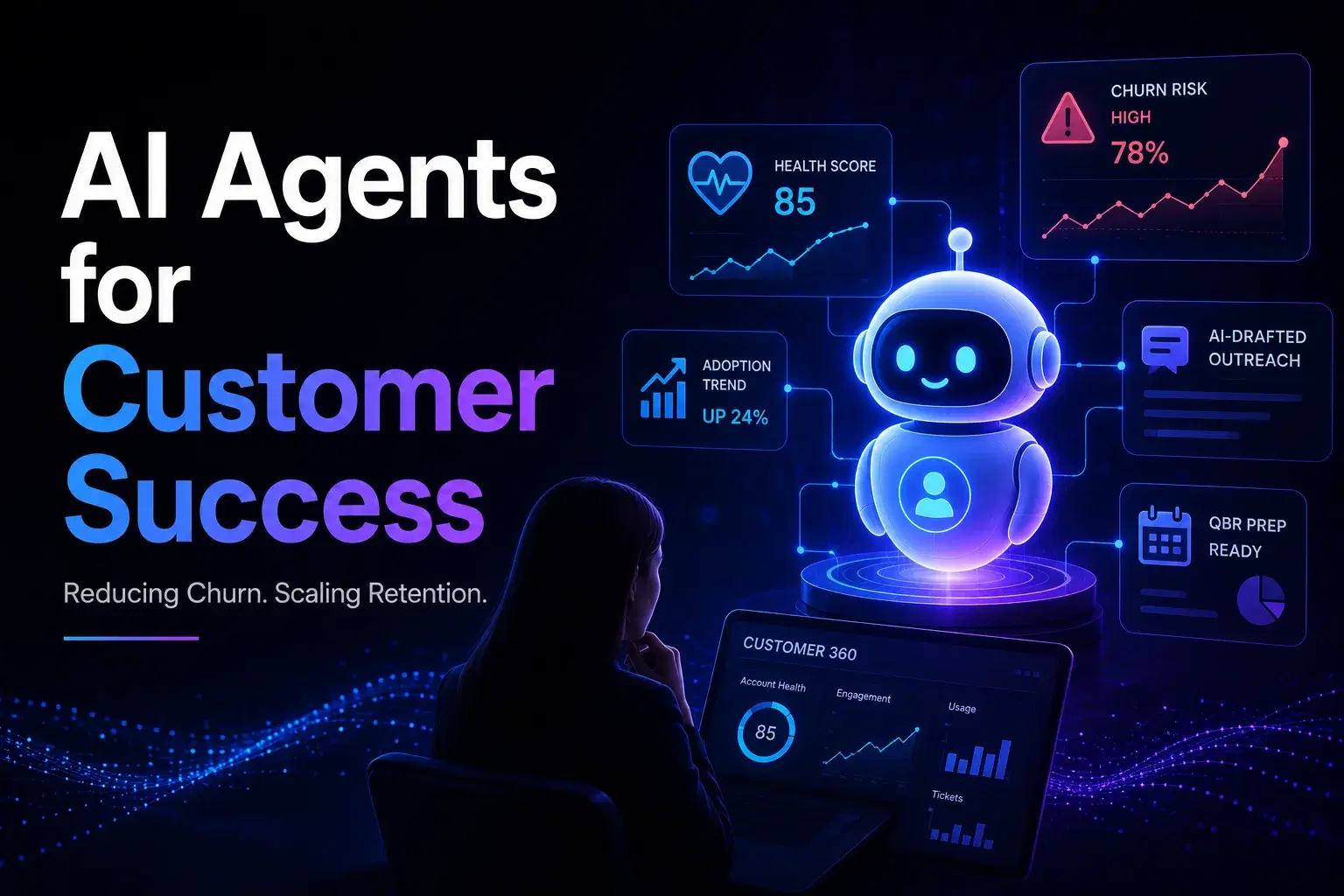
Customer success teams are buried in reactive work. AI agents that predict churn, automate health scoring, and draft proactive outreach let CSMs focus on the relationships and decisions that only humans can handle.
Related work
Production builds that connect to this topic—open a case study or jump to our portfolio.

SaaS customer success managers are outnumbered. Enterprise CSMs routinely own 40–80 accounts, each with its own product adoption pattern, business objective, and churn risk profile. At that ratio, proactive engagement is impossible without automation. AI agents change the economics: churn prediction models flag at-risk accounts before humans would notice, health score agents update automatically from product usage data, and outreach drafting agents prepare personalized touchpoints that CSMs can review and send in minutes.
Customer success AI entity definitions
- Customer health score: a composite metric aggregating product usage, support ticket volume, NPS/CSAT scores, contract value, payment history, and engagement signals into a 0–100 risk indicator.
- Churn prediction model: an ML model that estimates probability of non-renewal or cancellation within a defined window (30, 60, 90 days), enabling prioritized intervention before churn occurs.
- Proactive outreach agent: an AI that drafts personalized customer communications based on health score changes, feature adoption gaps, or approaching renewal milestones—queued for CSM review and send.
- QBR (Quarterly Business Review): the strategic account review meeting where CS teams present value delivered, adoption analysis, and roadmap alignment. AI can automate the data assembly and draft the presentation structure.
Building a churn prediction model that works
Most SaaS churn prediction models fail not because of algorithmic complexity, but because of feature engineering. The signals that actually predict churn vary significantly by product category, deal size, and customer segment. The foundation is a feature matrix that combines: product usage signals (DAU/MAU ratio, feature adoption breadth, last login recency), support signals (ticket volume trends, severity, time-to-resolution), contract signals (renewal date proximity, payment delays, discount depth), relationship signals (NPS trajectory, executive sponsor changes, expansion vs. contraction), and comparison signals (relative usage vs. similar cohort at same contract age).
| Feature category | Key signals | Typical importance | Data source |
|---|---|---|---|
| Product usage | DAU/MAU, feature adoption, time-in-product | High | Product analytics (Amplitude, Mixpanel, Segment) |
| Support activity | Ticket volume trend, negative sentiment | Medium-High | Zendesk, Intercom, Salesforce Service |
| Contract signals | Days to renewal, payment delays | High (near renewal) | CRM, billing system |
| Relationship quality | NPS, exec sponsor tenure, CSM meeting frequency | Medium | CRM, survey tools |
| Expansion signals | Seat growth, feature upsell adoption | High (health indicator) | CRM, product data |
Automating customer health scores
Manual health scoring by CSMs is subjective, inconsistent, and only updated when the CSM remembers. Automated health scores pull from all data sources daily, apply consistent weighting, and surface changes proactively. The architecture is: data pipeline (product analytics → CRM → support system → data warehouse) → scoring engine that runs nightly → health score API that feeds the CRM and CS platform → alert triggers when score drops below threshold or changes significantly week-over-week.
Proactive outreach agents: from reactive to predictive CS
The proactive outreach agent workflow: (1) health score drops below threshold or renewal date is T-90 days → (2) agent pulls account context from CRM, product data, last interaction notes → (3) agent drafts personalized email or meeting agenda addressing the specific risk signal → (4) CSM reviews in 2 minutes, edits if needed, sends. The goal is not autonomous communication—it is removing the blank-page problem for busy CSMs who own 60 accounts simultaneously.
QBR automation: data assembly to slide deck in minutes
QBR preparation consumes 4–8 hours per account for most CS teams: pulling usage data, comparing to benchmarks, summarizing support trends, identifying expansion opportunities. An AI QBR agent automates the data assembly: pulls metrics from product analytics, CRM, and support systems; generates charts and tables; drafts the slide narrative; and identifies 2–3 expansion conversation topics based on feature gaps relative to similar successful customers. The CSM's time shifts from data assembly to relationship and strategy.
| Workflow | Before AI | After AI | CSM value shift |
|---|---|---|---|
| Account health scoring | Monthly manual update, subjective | Daily automated, consistent | Respond faster to at-risk signals |
| Churn risk identification | Intuition + lagging indicators | Predictive model, 90-day advance warning | Earlier intervention, higher save rate |
| QBR preparation | 4–8 hours data assembly | 30 min review + edit AI draft | More strategic conversation time |
| Renewal outreach | CSM drafts from memory | AI draft from account history | Personalized at scale |
| Expansion opportunity ID | Ad hoc discovery calls | AI surfaces gap analysis vs. peer accounts | Structured upsell conversations |
CRM integration: making AI visible where CS teams work
CS AI only works if the insights live where CSMs already spend time—inside Salesforce, HubSpot, Gainsight, or ChurnZero. The integration pattern: health scores and churn probability as custom CRM fields, AI-generated outreach as CRM email templates attached to renewal opportunities, QBR slides exported as linked assets on the account record, and alert notifications routed via the CRM task system or Slack integration. Avoiding context-switching is as important as the AI quality.
How Silicon Tech Solutions helps
We build customer success AI platforms: churn prediction models, health score automation, proactive outreach agents, QBR automation, and CRM integrations (Salesforce, HubSpot, Gainsight). Our solutions connect product analytics, support data, and contract systems into a unified customer intelligence layer. If you want to reduce churn and scale your CS team's impact without proportional headcount growth, book a scoping session with our team.
Frequently asked questions
Related articles
Why Most Founders Underestimate...
Why Enterprise Customers Ask for Features You Never Planned (And How to Architect for Them Early)
Enterprise buyers rarely reject SaaS products over core workflow features. Deals stall over compliance, security, and identity infrastructure. Learn how to architect for enterprise readiness from day one.
13 min read · SaaS & Product Engineering
Engineering Decisions That Become Expensive Later
Why Most SaaS Products Become Hard to Scale (And It's Usually Not Because of Traffic)
When software velocity hits a brick wall, founders blame infrastructure. But true scalability bottlenecks are hidden inside your database schemas, hardcoded permissions, and tightly coupled business logic.
14 min read · SaaS & Product Engineering
MVP & Product Architecture
The Hard Parts of Building an MVP: Decisions That Become Expensive Later
We’ve watched dozens of products grow. The catastrophic failures rarely happen because of bad business ideas; they happen because early, unchecked tech decisions trap your velocity right when you land your first enterprise pilot.
14 min read · SaaS & Product Engineering
Strategic Foundations
The Great AI SaaS Pricing Crisis: Seats vs. Agents
AI agents are breaking the old SaaS pricing equation. When one autonomous workflow can replace a five-person ops squad, founders need pricing models based on usage, outcomes, and value created—not seats.
9 min read · SaaS & Product Engineering
Strategic Foundations
AI-First MVP Development: How Startups Ship Agentic Products in 8 Weeks
Eight weeks is enough to validate an AI product hypothesis—if you make the right scope decisions from day one. This guide covers the architecture, sprint model, and production gates that separate shipped MVPs from eternal prototypes.
13 min read · SaaS & Product Engineering
Decision Framework
AI SaaS vs. Custom Development: Which Path to Digitalization?
Build-everything and buy-everything are both extremes. Most enterprises need a portfolio: SaaS for commodity surfaces, custom for defensible workflows and regulated data.
13 min read · SaaS & Product Engineering
Plan your next build with us
Book a working session to review workflows, integrations, or AI architecture—or send a message and we'll respond within one business day.