
Vertical Deep-Dives
Legal and Compliance Digitalization: AI Agents for Contract Lifecycle Management
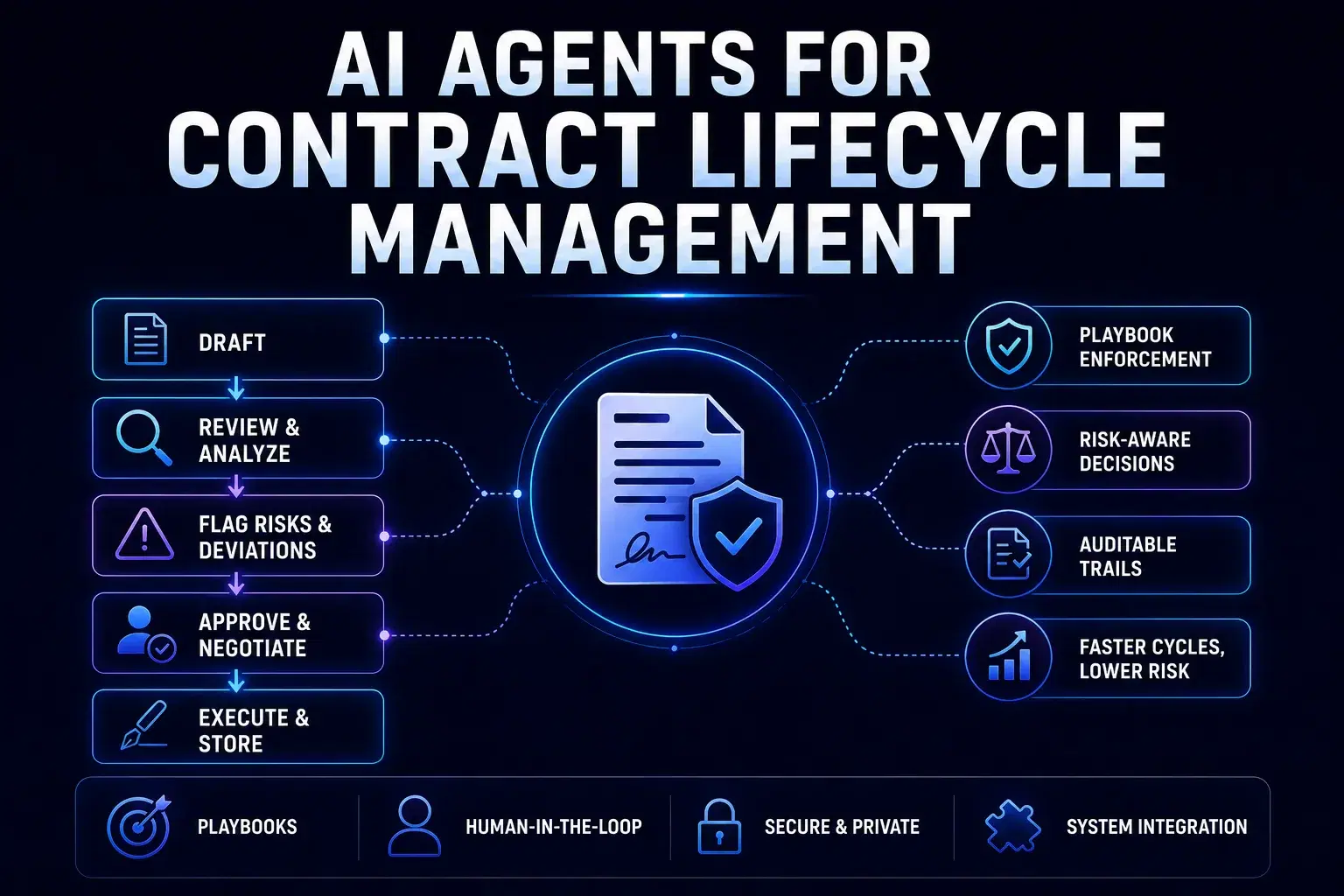
Legal teams drown in volume. AI can surface non-standard terms, compare drafts to playbooks, and preserve defensible audit trails—when deployment is scoped, supervised, and integrated with your CLM.
Related work
Production builds that connect to this topic—open a case study or jump to our portfolio.

Contract lifecycle management (CLM) is a coordination problem across sales, procurement, finance, and legal. Artificial intelligence does not replace counsel; it compresses review cycles by highlighting deviations from approved templates, flagging high-risk clauses, and assembling comparisons that would take hours manually. The organizations that succeed treat AI as an assistant to standardized playbooks—not as autonomous decision-making for signing authority.
Entity definitions
- CLM: repository plus workflow for drafting, negotiation, approval, execution, and renewal.
- Playbook: approved positions and fallback language by contract type and counterparty tier.
- Clause identification: detecting sections like limitation of liability, indemnity, confidentiality, and governing law.
- Human-in-the-loop: lawyers approve exceptions; the system learns which patterns recur for process improvement—not unsupervised model self-training on privileged text without governance.
High-risk clauses teams watch closely
Unlimited liability, one-sided indemnities, uncapped IP assignments, and non-standard data processing terms frequently require escalation. AI can accelerate detection and route to the right approver based on thresholds—provided the playbook encodes your policy, jurisdiction, and risk appetite explicitly.
| Clause family | Typical risk | Automation posture |
|---|---|---|
| Limitation of liability | Exposure beyond insurance | Flag + compare to standard cap |
| Indemnification | Scope and carve-outs | Highlight asymmetry |
| Data protection | Subprocessors, transfers | Checklist vs policy library |
| Termination | Convenience vs cause | Escalate non-standard exit terms |
Audit trails and defensibility
Regulators, auditors, and counterparties may ask what was agreed and who approved deviations. Systems should record versions, redlines, approver identity, timestamps, and model/version identifiers where AI suggestions were used. Privilege and confidentiality require careful storage boundaries—especially if third-party models process text.
Integration: CRM, procurement, and finance
CLM value increases when obligations connect to reality: payment milestones in finance, renewal notices in customer success, and vendor performance in procurement. Integration work—metadata, object IDs, and workflow triggers—is often harder than the NLP model selection.
Rollout sequence that avoids “pilot purgatory”
- Start with one contract family and a frozen playbook v1.
- Measure cycle time, escalation rate, and rework—not “accuracy” in a vacuum.
- Expand clause coverage after lawyers trust redlines and overrides are easy.
- Add multilingual and jurisdictional variants only when governance keeps pace.
How we help
Silicon Tech Solutions builds secure workflows, integrations, and internal tools for complex operations. If you are digitalizing legal and compliance processes around contracts, we can help you connect CLM, data, and policy in production—not slide decks.
Frequently asked questions
Related articles
Strategic Foundations
EU AI Act Compliance for SaaS Companies: A Practical 2026 Checklist
The EU AI Act is law—not a roadmap. SaaS companies shipping AI to EU markets in 2026 face real obligations: risk classification, documentation, transparency, and human oversight mechanisms.
16 min read · LegalTech & Compliance
Strategic Foundations
Managing “Shadow AI”: From Compliance Risk to Competitive Advantage
Employees will adopt fast AI tools with or without IT. The winning strategy is not prohibition—it is an authorized environment that is safer and more productive.
12 min read · LegalTech & Compliance
Plan your next build with us
Book a working session to review workflows, integrations, or AI architecture—or send a message and we'll respond within one business day.