
Technical Implementation
Cybersecurity in the Age of Bots: Automating Incident Response and Triage
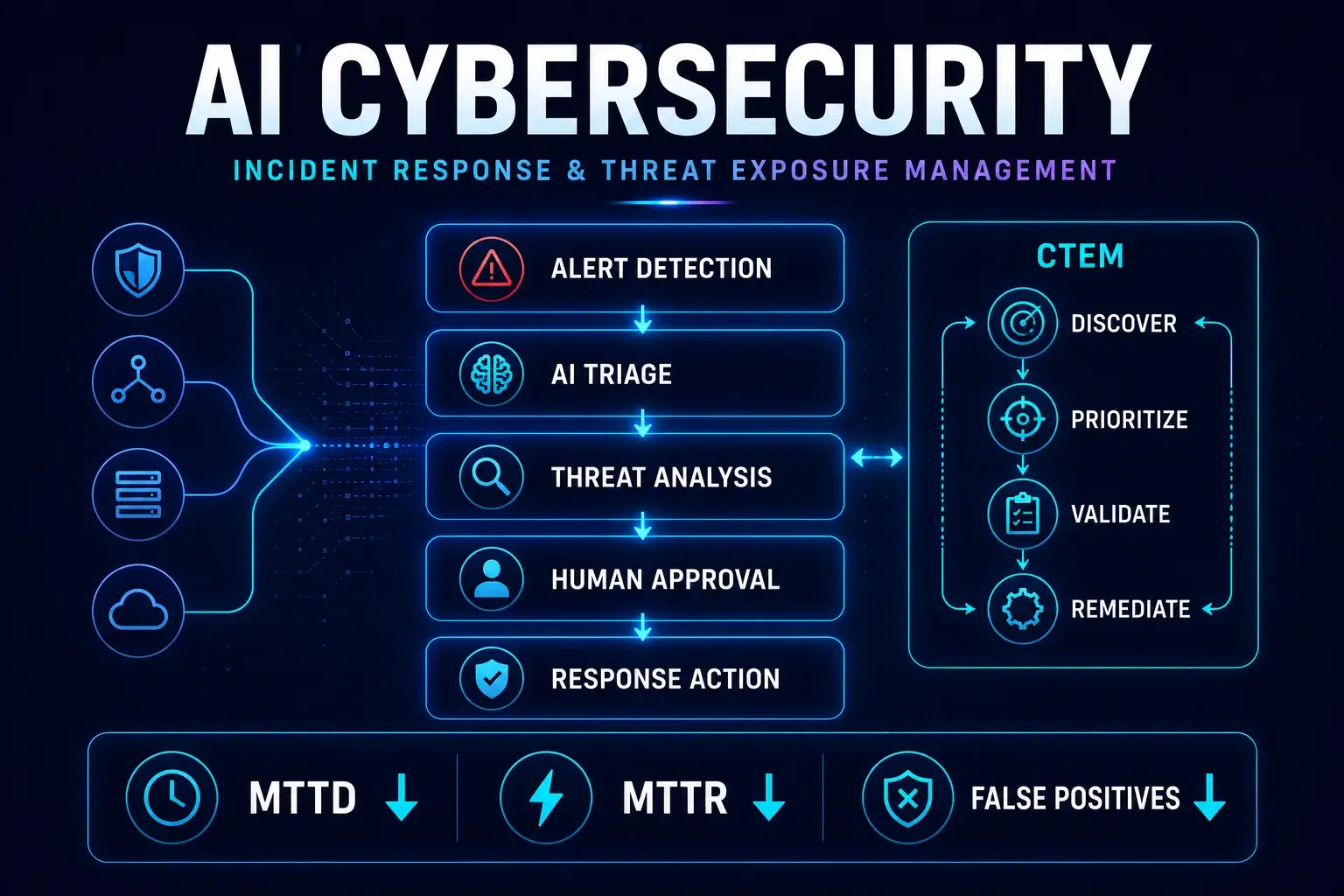
Defenders now compete at machine speed. The goal is not autonomous chaos—it is ranked alerts, faster context, and repeatable response actions with full audit trails.
Related work
Production builds that connect to this topic—open a case study or jump to our portfolio.

Security operations centers drown in alerts—many benign, some critical, all expensive to investigate manually. AI can help prioritize, enrich, and suggest next steps, but production deployments must respect change control: containment actions can disrupt business, and models must not become new exfiltration channels. The winning pattern combines automation for volume with human authority for irreversible moves.
Scope: triage vs. full autonomous response
Triage means ranking and summarizing: correlating signals across EDR, network, identity, and cloud logs to produce a concise timeline. Autonomous response means executing playbooks—isolate host, disable user session, block IP—within policy. Most enterprises start with triage assistance and gated automation for well-tested scenarios.
Reducing false positives without hiding true positives
Machine learning can cluster noisy alerts and highlight outliers, but ground truth requires analyst feedback labels. Programs should measure precision/recall per use case and track analyst time saved—not only alert counts closed.
| Tier | Example action | Typical control |
|---|---|---|
| L0 enrichment | Summarize entity and related alerts | Read-only |
| L1 assisted | Suggested query packs and runbooks | Analyst approval |
| L2 gated | Isolate endpoint on high-confidence signal | Dual approval or policy-bound |
Playbooks, SOAR, and auditability
Security orchestration ties tools together: ticketing, messaging, firewall APIs, identity systems. Every automated step should log actor (system vs. human), inputs, outputs, and rollback options. Regulators and insurers increasingly ask for demonstrable incident response—not screenshots of dashboards.
Preemptive cybersecurity: Gartner's 2026 strategic imperative
Gartner named preemptive cybersecurity as one of its Top 10 Strategic Technology Trends for 2026. The shift is from reactive detection (find and contain after breach) to proactive exposure management: continuously mapping your attack surface, simulating adversary moves, and remediating exploitable paths before attackers find them. Continuous Threat Exposure Management (CTEM) programs combine automated asset discovery, exploit-path analysis, and prioritized remediation—reducing the window of vulnerability without requiring constant human analyst involvement.
Metrics that matter
- Mean time to detect (MTTD) and mean time to respond (MTTR) for priority incidents.
- Analyst minutes per alert for top categories.
- Repeat incident rate after containment (did we fix the root cause?).
How we help
Silicon Tech Solutions builds secure platforms and integrations for regulated and high-stakes environments. If you are modernizing SOC workflows with AI assistance, we can help you implement controls-first automation—not science experiments on production networks.
Frequently asked questions
Plan your next build with us
Book a working session to review workflows, integrations, or AI architecture—or send a message and we'll respond within one business day.