
Vertical Deep-Dives
Financial Services 2.0: Automating KYC and Fraud Triage with Agentic AI
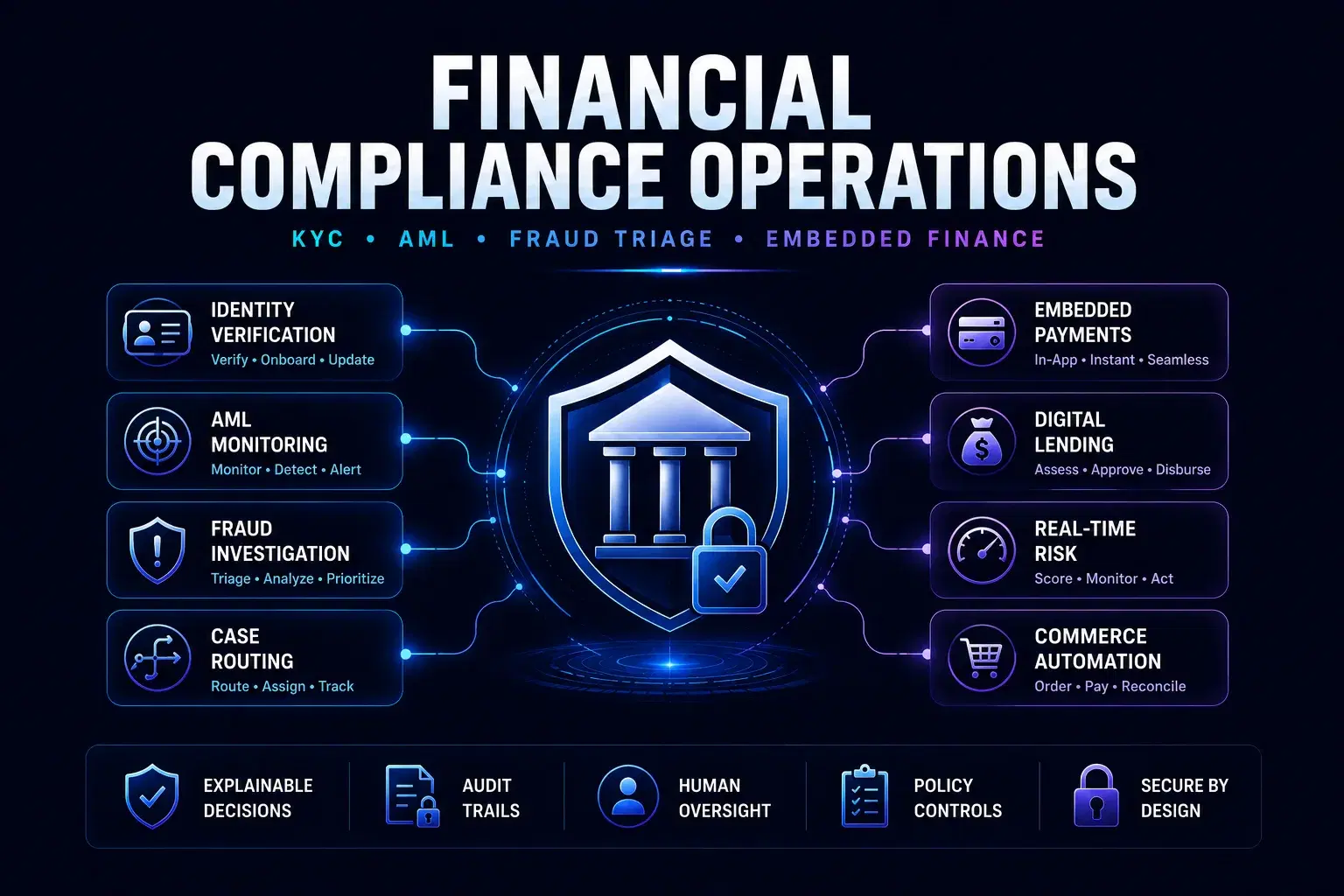
Banks and fintechs need speed and scrutiny at once. The winning stack pairs anomaly detection with explainable workflows, immutable logs, and humans who set policy—not click every alert.
Related work
Production builds that connect to this topic—open a case study or jump to our portfolio.

Financial services compliance is a throughput problem disguised as a technology problem. Know Your Customer (KYC) onboarding, anti-money laundering (AML) monitoring, and fraud triage generate enormous alert volume—while regulators expect defensible decisions, reproducible models, and clear accountability. Agentic AI can help when it is constrained: policy-bound workflows, explainable outputs, and humans who approve exceptions—not when it is an ungoverned chatbot touching customer money.
Definitions: KYC, AML, and “agentic” in this context
- KYC: verifying identity and risk profile for new and existing customers per jurisdictional rules.
- AML: monitoring transactions and counterparties for suspicious patterns; filing reports where required.
- Fraud triage: prioritizing alerts from cards, wires, account takeover, and scams with evidence packages.
- Agentic AI (regulated): systems that retrieve customer context, apply rules + models, draft case summaries, and route work—within explicit permissions and logging.
Why agent-style automation fits compliance operations
A strong investigator workflow is cross-system: core banking, case management, document stores, watchlists, and ticketing. Agents can assemble a coherent case file—timeline, risk factors, similar past cases—faster than manual tab-hopping. The value is consistency and speed, not removing humans from material decisions.
Human-in-the-loop: who decides what
Production designs separate policy (what must always happen) from judgment (where humans add nuance). Examples: auto-escalate when amount thresholds breach; require analyst approval for adverse media hits; never auto-file a regulatory report without review unless explicitly approved by legal and modeled as deterministic rules.
Architecture patterns that survive scrutiny
- Feature stores and entity resolution: one customer view across aliases and accounts.
- Model governance: versioning, drift monitoring, and change control tied to approvals.
- Segregation of duties: builders vs validators vs production operators.
- Data minimization: collect and retain only what policy allows; encrypt and redact by role.
| Use case | AI contribution | Human owner |
|---|---|---|
| Alert summarization | Narrative + evidence bundle for analysts | Investigator |
| Duplicate / near-duplicate cases | Clustering and routing | Team lead |
| Document-heavy KYC | Extraction + checklist completion | Compliance officer |
| Transaction scoring | Ranking and segmentation | AML officer |
Metrics that matter
Measure investigation time per case, false positive rates by segment, SLA adherence, and regulatory filing timeliness—not raw alert volume. A program that “opens fewer tickets” but misses suspicious activity is a failure; so is one that buries teams in noise.
Embedded finance and agentic commerce: the 2026 fintech frontier
Beyond core compliance, the most disruptive fintech opportunity in 2026 is embedded finance: integrating financial services (payments, lending, insurance, KYC) directly into non-financial applications. An e-commerce platform that offers instant buy-now-pay-later underwriting, a logistics SaaS that initiates supplier payments on delivery confirmation, or an HR platform that provides earned wage access—these are all embedded finance plays. Agentic AI is the enabler: agents that can verify identity, assess credit risk, execute payment rails, and reconcile transactions without a human in every step of the loop.
| Embedded finance product | AI role | Compliance touch-point |
|---|---|---|
| Instant BNPL at checkout | Real-time credit decisioning model | Consumer credit regulation, data consent |
| B2B invoice financing | Invoice authenticity + buyer credit risk | KYB, AML, sectoral limits |
| Earned wage access (EWA) | Payroll data parsing + risk model | Wage law, advance limits, rollover rules |
| In-app insurance | Risk scoring from behavioral signals | Actuarial review, product licensing |
How we help
Silicon Tech Solutions builds regulated fintech systems: risk engines, KYC/AML pipelines, embedded finance integrations, and secure platforms for banks, neobanks, and fintech SaaS. If you are automating KYC, fraud triage, or building an embedded finance product, we can help you ship workflows that balance speed with auditability.
Frequently asked questions
Related articles
The Hard Parts of Building...
The Hard Parts of Building FinTech Products: Compliance, Payments, Security & Scale
In FinTech software engineering, there is zero tolerance for eventual consistency or soft errors. Learn how to architect financial platforms for strict compliance, ledger integrity, and immutable audit trails.
15 min read · Fintech & Banking
Vertical Deep-Dives
AI-Powered Financial Close: Automating Month-End for Finance Teams
Finance teams lose 3–5 days every month to manual reconciliations and journal entry preparation that could be automated. AI agents close that gap—if the data architecture and controls are right.
14 min read · Fintech & Banking
Vertical Deep-Dives
Building an AI-Native Neobank: Architecture, Compliance, and Scale
Neobanks that win in 2026 are not 'apps on top of legacy rails'—they are AI-native systems where credit decisions, fraud detection, and customer service run autonomously within governed frameworks.
15 min read · Fintech & Banking
Vertical Deep-Dives
Embedded Finance and Agentic Payments: Building Fintech Infrastructure in 2026
Embedded finance is no longer a banking add-on—it is a product strategy. In 2026, agentic AI makes real-time credit decisions, initiates payments, and manages compliance without manual intervention.
16 min read · Fintech & Banking
Plan your next build with us
Book a working session to review workflows, integrations, or AI architecture—or send a message and we'll respond within one business day.