
Vertical Deep-Dives
Building an AI-Native Neobank: Architecture, Compliance, and Scale
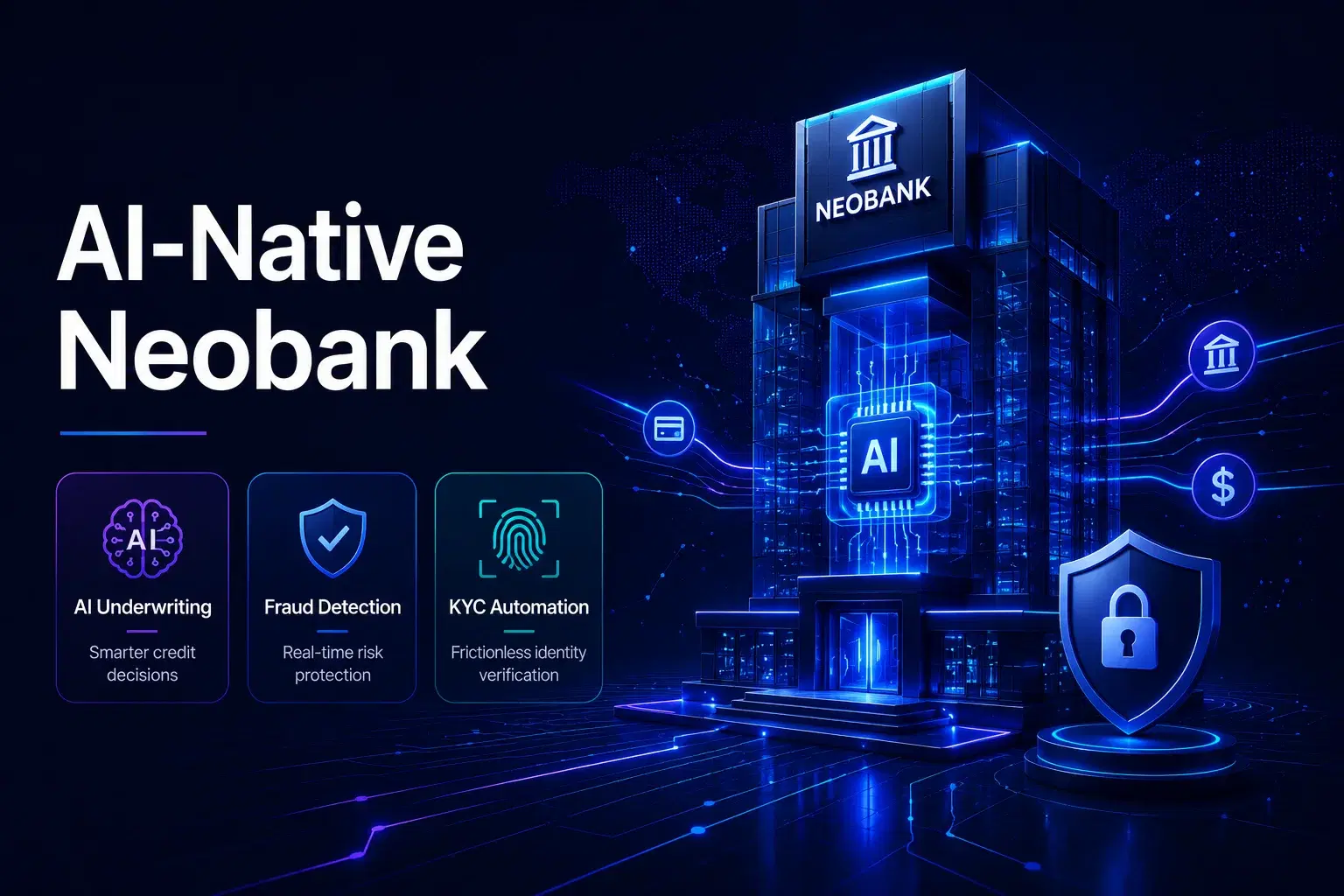
Neobanks that win in 2026 are not 'apps on top of legacy rails'—they are AI-native systems where credit decisions, fraud detection, and customer service run autonomously within governed frameworks.
Related work
Production builds that connect to this topic—open a case study or jump to our portfolio.


The first wave of neobanks (2015–2022) competed on user experience: no fees, instant notifications, clean apps. The second wave is competing on intelligence: AI that personalizes product offers, predicts churn before it happens, and makes real-time underwriting decisions with rejection rates that improve as the data flywheel spins. Building an AI-native neobank in 2026 means designing the intelligence layer into the core architecture—not bolting a chatbot onto a legacy system.
Architecture components and entity definitions
- Core banking system: the ledger for accounts, balances, transactions, and interest—the non-negotiable system of record. Modern options are API-first and cloud-native (Thought Machine Vault, Mambu, 10x Banking, regional equivalents).
- AI decisioning layer: models and agents that handle credit scoring, fraud detection, AML alerting, and personalization—consuming core banking events in real time.
- Product layer: loan origination system (LOS), BNPL engine, card management, FX module—each calling the AI layer for risk decisions.
- Compliance layer: KYC/KYB orchestration, regulatory reporting, PII vault, audit trail system.
The 2026 AI-native neobank tech stack
| Layer | Component | 2026 technology approach |
|---|---|---|
| Core banking | Ledger + accounts API | Cloud-native CBS (Mambu, Vault, or regional equivalent) + event streaming (Kafka) |
| Identity & KYC | Onboarding + eKYC | AI document extraction + liveness check + watchlist API (Onfido, Jumio, or local eKYC provider) |
| Credit | Scoring + decisioning | Custom ML model on behavioral + bureau + alternative data; explainable AI for adverse action |
| Fraud | Real-time detection | Graph neural networks + rule engine; agent-triggered MFA or block within 200ms |
| AML | Transaction monitoring | Behavioral clustering + supervised models; human review queue for SARs |
| Customer AI | Personalization + support | RAG-based knowledge agent + product recommendation model + churn prediction |
| Payments | Orchestration + settlement | Multi-rail (local RTP, SWIFT, card) with ISO 20022 formatting and reconciliation agent |
| Compliance | Reporting + audit | Automated regulatory reporting pipeline + immutable audit log + GDPR/local data residency controls |
AI credit scoring for neobanks: beyond bureau scores
Traditional credit bureaus exclude thin-file customers—the primary market for many neobanks, especially in emerging markets where bureau coverage is below 40%. AI-native neobanks build proprietary alternative credit models that score on: transaction history (spending patterns, income regularity), behavioral signals (app engagement, repayment timing), social and device data (with consent and regulatory permission), and psychographic indicators where local law permits. The data flywheel advantage is compounding: more loans originated → more repayment data → better models → lower default rates → lower pricing → more customers.
AI-powered KYC onboarding: from 72 hours to 3 minutes
Traditional bank onboarding takes 3–10 business days of manual document review. AI-native onboarding uses document OCR and extraction, liveness detection (anti-spoofing), watchlist screening (OFAC, UN, local PEP lists), and address verification APIs to complete identity verification in under 3 minutes for 80%+ of applicants. The remaining 20%—complex names, foreign documents, high-risk segments—route to human review with an AI-assembled case file that eliminates most manual lookup work.
Real-time fraud: the 200ms window
Card authorization decisions happen in 200–300ms. AI fraud models must complete scoring, context enrichment, and rule evaluation within that window or cause false declines that destroy customer experience. Modern architectures use in-memory feature stores that pre-compute rolling behavioral statistics (last 24h spend, merchant category mix, geolocation velocity) so the model call only needs to score against pre-built features—not query databases at decision time.
Regulatory compliance across key markets
| Market | Regulator | Key AI compliance requirements |
|---|---|---|
| European Union | National competent authorities (ECB, FCA equivalent) | GDPR automated decision rights, EU AI Act high-risk classification for credit, PSD2 open banking |
| Indonesia | OJK (Otoritas Jasa Keuangan) | POJK fintech lending rules, data localization, Bahasa Indonesia disclosures |
| Singapore | MAS | FEAT principles (Fairness, Ethics, Accountability, Transparency for AI in finance) |
| United Kingdom | FCA | Consumer Duty, SMCR accountability for AI decisions, Consumer Credit Act notices |
| Middle East (UAE) | CBUAE / DFSA | Digital banking licensing, AML/CFT requirements, data sovereignty |
How Silicon Tech Solutions helps
We have built and scaled fintech backends across Southeast Asia, the Middle East, and Europe—from neobank MVPs to production-grade credit engines and compliance automation systems. If you are building a digital bank or adding lending/payments to an existing product, we can help you architect for AI-nativeness from day one and navigate the regulatory path in your target markets.
Frequently asked questions
Related articles
The Hard Parts of Building...
The Hard Parts of Building FinTech Products: Compliance, Payments, Security & Scale
In FinTech software engineering, there is zero tolerance for eventual consistency or soft errors. Learn how to architect financial platforms for strict compliance, ledger integrity, and immutable audit trails.
15 min read · Fintech & Banking
Vertical Deep-Dives
AI-Powered Financial Close: Automating Month-End for Finance Teams
Finance teams lose 3–5 days every month to manual reconciliations and journal entry preparation that could be automated. AI agents close that gap—if the data architecture and controls are right.
14 min read · Fintech & Banking
Vertical Deep-Dives
Embedded Finance and Agentic Payments: Building Fintech Infrastructure in 2026
Embedded finance is no longer a banking add-on—it is a product strategy. In 2026, agentic AI makes real-time credit decisions, initiates payments, and manages compliance without manual intervention.
16 min read · Fintech & Banking
Vertical Deep-Dives
Financial Services 2.0: Automating KYC and Fraud Triage with Agentic AI
Banks and fintechs need speed and scrutiny at once. The winning stack pairs anomaly detection with explainable workflows, immutable logs, and humans who set policy—not click every alert.
14 min read · Fintech & Banking
Plan your next build with us
Book a working session to review workflows, integrations, or AI architecture—or send a message and we'll respond within one business day.