
Vertical Deep-Dives
Embedded Finance and Agentic Payments: Building Fintech Infrastructure in 2026
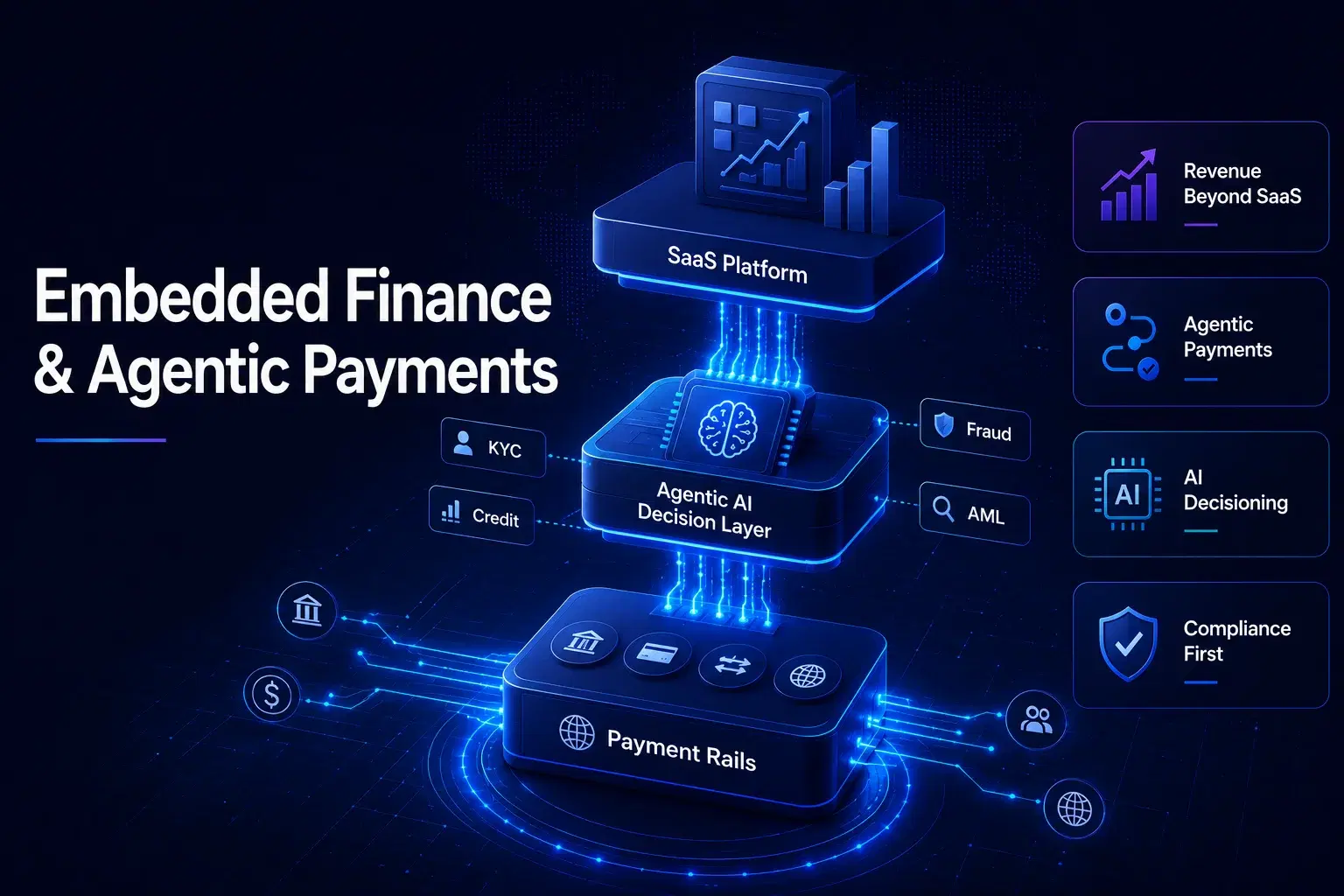
Embedded finance is no longer a banking add-on—it is a product strategy. In 2026, agentic AI makes real-time credit decisions, initiates payments, and manages compliance without manual intervention.
Related work
Production builds that connect to this topic—open a case study or jump to our portfolio.

Embedded finance is the convergence of financial services and non-financial software: the BNPL checkout on an e-commerce platform, the real-time credit line inside an ERP, the instant supplier payment triggered by a delivery confirmation. In 2026, agentic AI makes this architecture viable at scale—not by replacing compliance, but by automating the decision loops (identity verification, credit scoring, transaction monitoring) that previously required expensive specialist headcount for every new fintech product.
Entity definitions: BaaS, embedded finance, and agentic payments
- Banking as a Service (BaaS): regulated banking infrastructure (account ledgers, card issuance, payment rails) exposed via API to non-bank software companies.
- Embedded finance: the integration of financial products (payments, lending, insurance, FX) into non-financial applications—a logistics SaaS offering invoice factoring, an HR platform offering earned wage access.
- Agentic payments: AI agents that can autonomously initiate, route, and reconcile transactions within policy-defined thresholds—human approval required above configurable limits.
- Payment orchestration: a layer that routes transactions across multiple payment processors and acquirers based on cost, approval rate, and regulatory geography.
Why embedded finance is the 2026 revenue model for SaaS
Pure SaaS businesses face subscription fatigue and intensifying competition on features. Embedded finance unlocks transaction-based revenue: take-rate on payments processed, interest on credit extended, commission on insurance placed. The strategic advantage is that financial products increase switching costs—a customer who processes $2M in monthly payments through your platform is not churning to a cheaper competitor over a UI preference.
| Embedded product | Host platform type | Revenue model | Key AI use case |
|---|---|---|---|
| BNPL / instalment credit | E-commerce, marketplace | Interest + origination fee | Real-time underwriting agent |
| Earned Wage Access (EWA) | HR / payroll SaaS | Fee per advance | Payroll data parsing + risk model |
| B2B invoice financing | Supply chain / ERP SaaS | Factor rate on invoice value | Invoice authenticity + buyer KYB |
| In-app insurance | Logistics / real estate SaaS | Commission on premium | Risk scoring from behavioral signals |
| Multi-currency FX | Global commerce / travel SaaS | Spread or flat fee | Optimal routing + exposure hedging agent |
The technical architecture: what you actually build
Most embedded finance products are three-layer systems: (1) a fintech infrastructure layer—BaaS provider, card network access, payment rails—delivered via licensed partner or own license; (2) a product layer—your underwriting logic, product terms, customer experience; (3) an AI layer—agents that handle KYC/KYB, credit decisions, fraud scoring, and reconciliation. The risk boundary between layers two and three must be explicit: agents automate, but humans own policy.
- Choose the regulated entity: own a license, use a BaaS partner (e.g., Railsbank, Synapse successors, regional equivalents), or operate in a sandbox jurisdiction.
- Define data contracts: what identity data, transaction history, and behavioral signals feed the credit model.
- Build the AI decision layer: underwriting agent with explainability output (FCRA/GDPR-compliant adverse action notices).
- Implement payment orchestration: choose processors, failover logic, FX hedging, and reconciliation pipelines.
- Add compliance automation: AML screening on payer/payee, SAR filing workflow, regulatory reporting hooks.
Agentic payments: where AI executes, not just assists
In 2026, the most sophisticated embedded finance deployments use AI agents to run the full payment lifecycle: detect trigger event (invoice approved, delivery confirmed) → verify counterparty identity and sanctions screening → calculate amount (FX conversion, fees) → route payment via optimal rail (SWIFT, SEPA Instant, local RTP) → post to ledger → reconcile against ERP. The human is in the loop for exceptions and high-value transactions above configurable thresholds—not every payment.
Open banking APIs: the data fuel for embedded finance AI
PSD2 in Europe and equivalent frameworks in other markets require banks to expose account data and payment initiation via standardized APIs with customer consent. For embedded finance builders, open banking is the source of real-time cash flow data that powers better credit models, instant bank account verification (replacing manual micro-deposits), and account-to-account payments that bypass card network fees entirely. Agentic finance applications consume these APIs within consented data access windows, refreshing signals continuously rather than relying on stale credit bureau snapshots.
Risk and compliance: what cannot be automated away
- Adverse action notices: when credit is declined, regulations (FCRA/ECOA in the US, GDPR in the EU) require explainable reasons—model explainability is a legal requirement, not an engineering nice-to-have.
- AML and KYB: Know Your Business verification for B2B products requires document extraction, registry verification, and beneficial ownership confirmation—agents accelerate but humans must review flagged cases.
- Data residency: financial data localization laws in Indonesia (OJK), India (RBI), and the EU restrict where customer financial data can be stored and processed.
- Consumer protection: interest rate caps, cooling-off periods, and marketing restrictions vary by jurisdiction and product type.
How Silicon Tech Solutions helps
We build embedded finance platforms, fintech SaaS backends, and AI decision layers for regulated financial products. Our work spans payment orchestration, KYC/KYB automation, lending engines, and open banking integrations for clients in Southeast Asia, the Middle East, and Europe. If you are building an embedded finance product or adding payment capabilities to your SaaS, book a scoping session to discuss regulatory path, architecture, and timeline.
Frequently asked questions
Related articles
The Hard Parts of Building...
The Hard Parts of Building FinTech Products: Compliance, Payments, Security & Scale
In FinTech software engineering, there is zero tolerance for eventual consistency or soft errors. Learn how to architect financial platforms for strict compliance, ledger integrity, and immutable audit trails.
15 min read · Fintech & Banking
Vertical Deep-Dives
AI-Powered Financial Close: Automating Month-End for Finance Teams
Finance teams lose 3–5 days every month to manual reconciliations and journal entry preparation that could be automated. AI agents close that gap—if the data architecture and controls are right.
14 min read · Fintech & Banking
Vertical Deep-Dives
Building an AI-Native Neobank: Architecture, Compliance, and Scale
Neobanks that win in 2026 are not 'apps on top of legacy rails'—they are AI-native systems where credit decisions, fraud detection, and customer service run autonomously within governed frameworks.
15 min read · Fintech & Banking
Vertical Deep-Dives
Financial Services 2.0: Automating KYC and Fraud Triage with Agentic AI
Banks and fintechs need speed and scrutiny at once. The winning stack pairs anomaly detection with explainable workflows, immutable logs, and humans who set policy—not click every alert.
14 min read · Fintech & Banking
Plan your next build with us
Book a working session to review workflows, integrations, or AI architecture—or send a message and we'll respond within one business day.