
Strategic Foundations
EU AI Act Compliance for SaaS Companies: A Practical 2026 Checklist
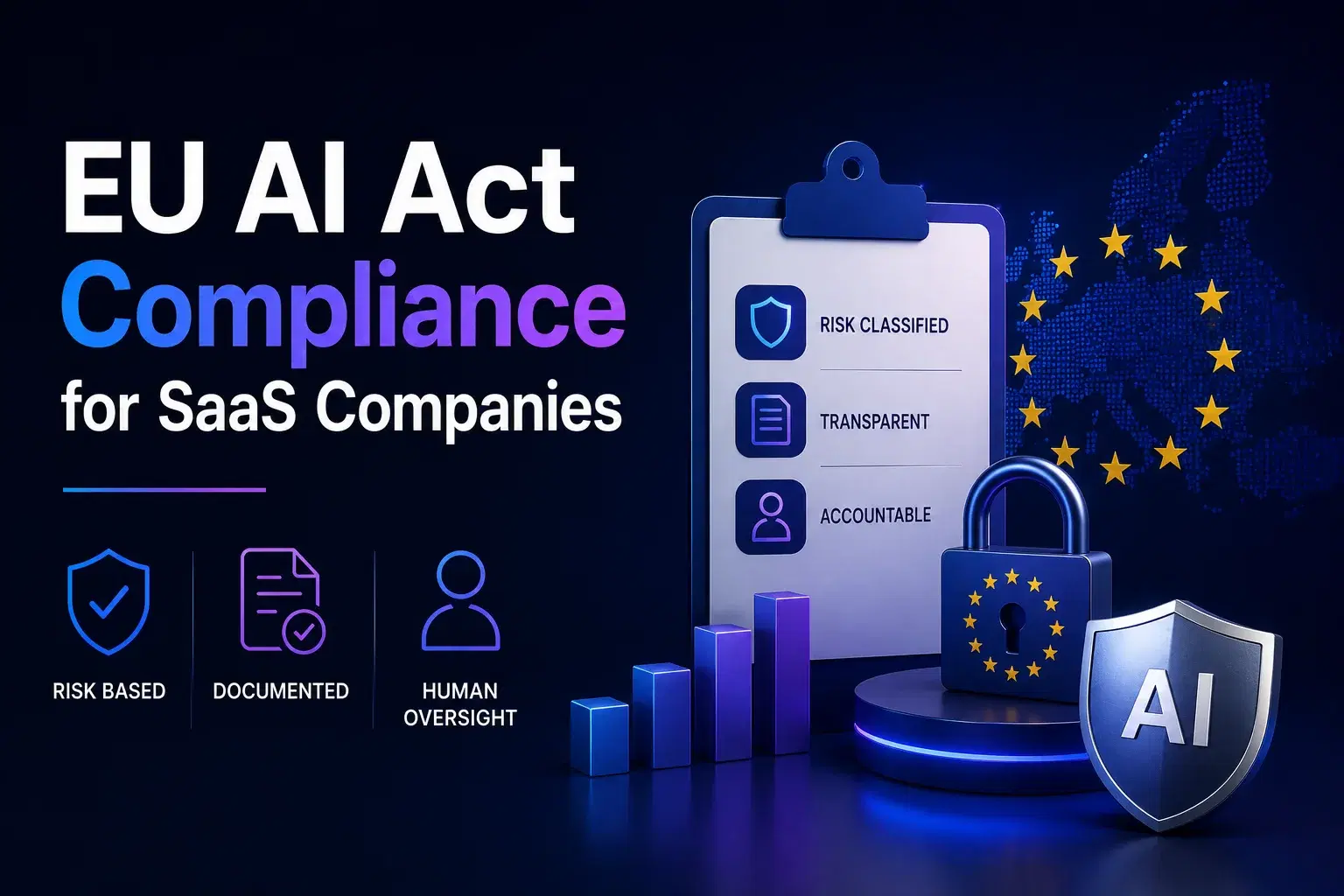
The EU AI Act is law—not a roadmap. SaaS companies shipping AI to EU markets in 2026 face real obligations: risk classification, documentation, transparency, and human oversight mechanisms.
Related work
Production builds that connect to this topic—open a case study or jump to our portfolio.

The EU AI Act entered into force on 1 August 2024, with obligations phasing in through 2026 and beyond. For SaaS companies shipping AI features to EU-based customers—whether your HQ is in Berlin, London, Singapore, or San Francisco—the Act creates real legal obligations that vary based on how your AI is classified. This guide provides a practical compliance checklist for technology companies, focused on what engineering, product, and legal teams need to do now.
EU AI Act implementation timeline: what's in force in 2026
| Date | What comes into force |
|---|---|
| Aug 2024 | Act enters into force; 6-month window begins |
| Feb 2025 | Prohibited AI practices banned (Article 5)—no exceptions |
| Aug 2025 | GPAI (General-Purpose AI) model rules apply; EU AI Office fully operational |
| Aug 2026 | High-risk AI system requirements fully applicable; notified body assessments available |
| Aug 2027 | High-risk AI embedded in regulated products (medical devices, vehicles) must comply |
| 2030 | Existing high-risk AI systems must be brought into compliance |
Step 1: Classify your AI system
The EU AI Act uses a risk-based pyramid. Your compliance obligations depend entirely on which tier your AI falls into. Start by asking: what decisions does your AI influence, and who is affected?
- Unacceptable risk (BANNED as of Feb 2025): real-time biometric surveillance in public spaces; AI that manipulates people through subliminal techniques; social scoring by governments; AI exploiting vulnerabilities of children or persons with disabilities.
- High risk: AI in hiring and employment, creditworthiness assessment, education, law enforcement, migration control, medical devices, critical infrastructure, and administration of justice. Requires conformity assessment, registration in EU database, human oversight, and extensive documentation.
- General-Purpose AI (GPAI): foundation models and LLMs with systemic risk (>10^25 FLOPs training compute) face additional obligations including adversarial testing, incident reporting, and cybersecurity requirements.
- Limited risk: chatbots and AI-generated content—must disclose to users that they are interacting with AI.
- Minimal risk: most productivity tools, spam filters, AI-powered recommendation engines—no mandatory requirements beyond GDPR.
Step 2: If you are high-risk, complete the technical checklist
- Technical documentation (Article 11): document the AI system's purpose, capabilities, limitations, accuracy metrics, training data description, and risk management measures.
- Risk management system (Article 9): establish an ongoing process to identify, analyze, estimate, evaluate, and mitigate foreseeable risks—documented throughout the product lifecycle.
- Data governance (Article 10): document training, validation, and testing data—sources, selection criteria, known limitations, potential biases, and measures to address them.
- Human oversight mechanisms (Article 14): build technical measures that allow natural persons to override, interrupt, or correct AI outputs. This must be a product feature, not just a policy statement.
- Accuracy, robustness, and cybersecurity (Article 15): define accuracy metrics for your use case; implement measures against adversarial manipulation and model poisoning.
- Conformity assessment (Article 43): for most high-risk systems, self-assessment with documented technical file; for some categories (biometrics, critical infrastructure), notified body assessment required.
- EU database registration (Article 49): register in the EU public database before placing the system on the EU market.
- Post-market monitoring (Article 61): implement logging, incident detection, and a process to report serious incidents to market surveillance authorities.
GPAI obligations: what changes if you use or build foundation models
If your SaaS uses a GPAI model (any LLM or multi-modal model) as a component, you are a deployer under the Act—you inherit some obligations from the model provider but also have independent duties. If you fine-tune or provide a GPAI model as a service, you become a provider with fuller obligations. The EU AI Office (operational from 2025) oversees GPAI compliance and can require access to model documentation and test results for systemic-risk models.
| Actor | GPAI obligation |
|---|---|
| GPAI model provider (builds/trains LLM) | Technical documentation, copyright policy, transparency info for downstream providers |
| GPAI with systemic risk (>10^25 FLOPs) | Above + adversarial testing, incident reporting, cybersecurity measures, energy efficiency reporting |
| SaaS that integrates GPAI API | Ensure downstream use stays compliant; cannot use GPAI for prohibited practices |
| SaaS that fine-tunes GPAI | Provider obligations for modified model components |
EU AI Act and GDPR: overlapping obligations
The EU AI Act does not replace GDPR—it adds to it. AI systems that process personal data must comply with both frameworks. Key intersections: GDPR Article 22 (automated decision-making rights) overlaps with AI Act high-risk human oversight requirements; GDPR data minimization principles constrain training data collection for AI; GDPR DPIAs (Data Protection Impact Assessments) should be combined with AI Act risk management documentation for high-risk AI that processes personal data.
How Silicon Tech Solutions helps
We help SaaS companies implement responsible AI governance: EU AI Act risk classification, technical documentation frameworks, human oversight feature design, and compliance-grade audit logging. Our engineering work is designed to satisfy regulatory review—not just ship features. If you are navigating EU AI Act compliance for your product, book a scoping session to discuss classification, documentation requirements, and implementation timeline.
Frequently asked questions
Related articles
Vertical Deep-Dives
Legal and Compliance Digitalization: AI Agents for Contract Lifecycle Management
Legal teams drown in volume. AI can surface non-standard terms, compare drafts to playbooks, and preserve defensible audit trails—when deployment is scoped, supervised, and integrated with your CLM.
13 min read · LegalTech & Compliance
Strategic Foundations
Managing “Shadow AI”: From Compliance Risk to Competitive Advantage
Employees will adopt fast AI tools with or without IT. The winning strategy is not prohibition—it is an authorized environment that is safer and more productive.
12 min read · LegalTech & Compliance
Plan your next build with us
Book a working session to review workflows, integrations, or AI architecture—or send a message and we'll respond within one business day.