
Strategic Foundations
Managing “Shadow AI”: From Compliance Risk to Competitive Advantage
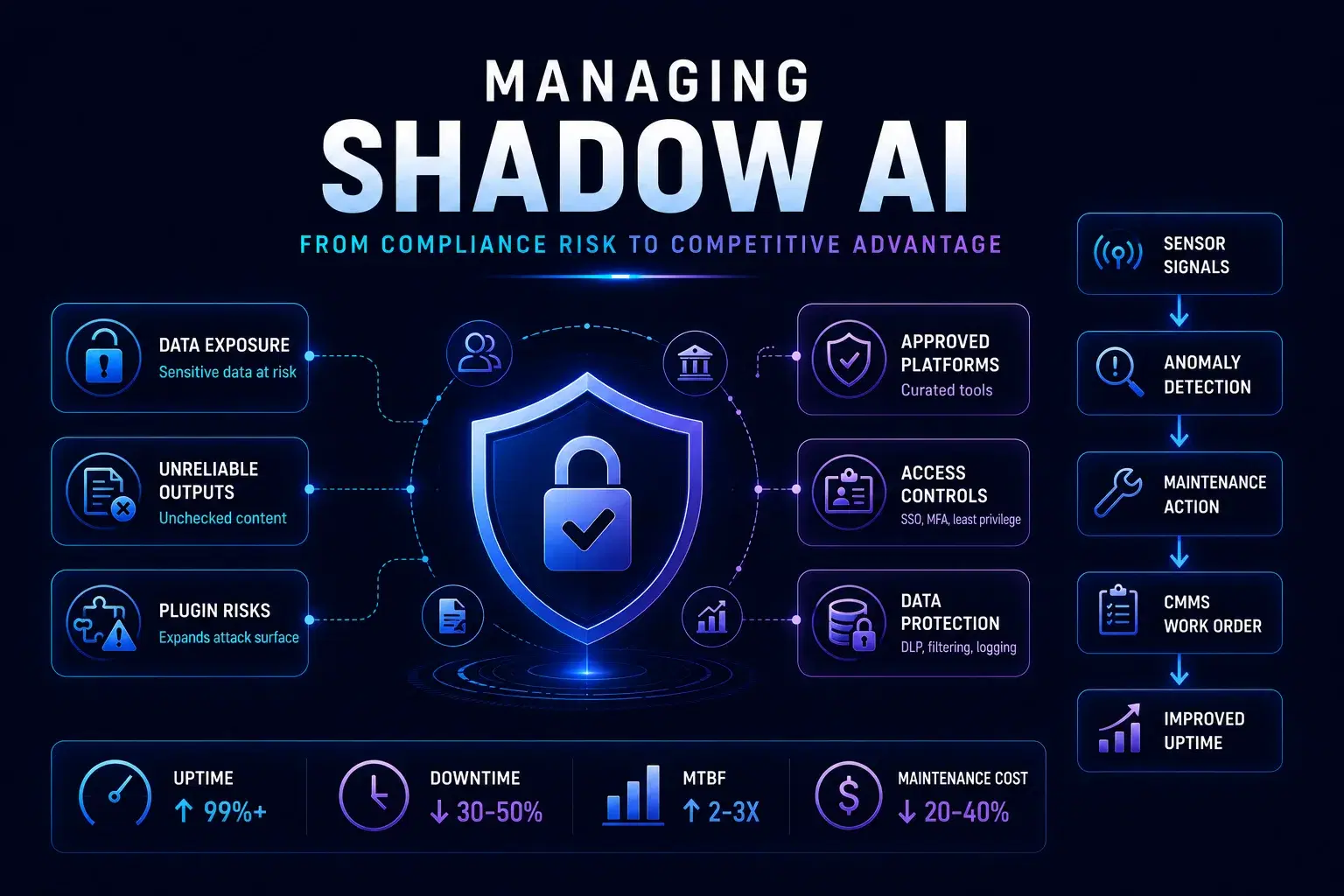
Employees will adopt fast AI tools with or without IT. The winning strategy is not prohibition—it is an authorized environment that is safer and more productive.
Related work
Production builds that connect to this topic—open a case study or jump to our portfolio.


Shadow AI—employees using unapproved assistants, browser extensions, and third-party tools with sensitive data—is not a “people problem” alone. It is a signal that official workflows are too slow, too rigid, or too opaque. In 2026, the best enterprises respond with a pragmatic stack: approved platforms, clear data classification, least-privilege access, and an internal AI operating model that makes the safe path faster than the risky one.
What actually breaks in shadow AI scenarios
- Data exfiltration: pasting customer PII or financials into unmanaged tools.
- Non-deterministic outputs used as facts: unchecked content in customer-facing channels.
- Plugin ecosystems: third-party capabilities that expand attack surface (supply-chain and prompt-injection paths).
- Retention and subprocessors: unclear where prompts/logs are stored and for how long.
A modern enterprise AI compliance program (lightweight, enforceable)
- Classify data: what can never leave the boundary, what can be redacted, what can be summarized.
- Publish an approved tool list + approved use cases; update it monthly as vendors evolve.
- Enforce SSO, MFA, and workspace policies; block unsanctioned extensions where realistic.
- Add technical controls: DLP, logging, prompt/PII filtering, and escalation for edge cases.
- Train teams on safe workflows: what to share, how to verify outputs, and when to stop.
From risk to advantage: what “good” looks like
Compliance becomes an advantage when it accelerates delivery: developers get approved patterns, security gets observability, and legal gets auditability. The objective is not zero creativity—it is bounded creativity with measurable controls. Self-hosted or VPC deployments can be the right answer for regulated workloads; managed services can be right for speed—often you need both, split by data class.
| Workload | Typical posture | Why |
|---|---|---|
| Public marketing drafts | Managed assistant + brand guidelines | Speed; lower sensitivity |
| Customer support with account context | Approved enterprise tool + retrieval + redaction | PII risk; needs traceability |
| Finance/legal workflows | Strong access control + HITL approvals | Material risk; correctness requirements |
The AI operating model: ownership and metrics
Shadow AI shrinks when three roles are clear: a business owner for outcomes, a security/architecture owner for controls, and a product/engineering owner for shipping improvements. Metrics should include adoption of approved tools, incident counts, time-to-resolution, and business KPIs—not only block rates.
The goal is not to win a policy battle. The goal is to make the compliant workflow the easiest workflow.
The EU AI Act and what it means for enterprise AI deployment
The EU AI Act's general-purpose AI requirements took effect in August 2025, with obligations for high-risk systems phasing through 2026. For enterprises deploying AI in HR, credit scoring, biometrics, or critical infrastructure, the classification threshold determines documentation burden. High-risk AI systems require conformity assessments, detailed technical documentation, human oversight mechanisms, and audit trails that can be produced on demand.
- Unacceptable risk (banned): real-time biometric surveillance in public spaces, social scoring, and manipulative subliminal AI.
- High risk: AI in recruitment, creditworthiness, medical devices, critical infrastructure, and law enforcement—requires registration, conformity assessment, and post-market monitoring.
- Limited risk: chatbots and synthetic content generators—transparency obligations (disclose AI).
- Minimal risk: most productivity tools—no additional obligations beyond GDPR.
How we help
Silicon Tech Solutions designs secure AI deployment patterns for real enterprises: identity-aware agents, integration with systems of record, and engineering practices that satisfy security reviews. If you are navigating shadow AI today, we can help you build an authorized path that preserves innovation and reduces risk.
Frequently asked questions
Related articles
Strategic Foundations
EU AI Act Compliance for SaaS Companies: A Practical 2026 Checklist
The EU AI Act is law—not a roadmap. SaaS companies shipping AI to EU markets in 2026 face real obligations: risk classification, documentation, transparency, and human oversight mechanisms.
16 min read · LegalTech & Compliance
Vertical Deep-Dives
Legal and Compliance Digitalization: AI Agents for Contract Lifecycle Management
Legal teams drown in volume. AI can surface non-standard terms, compare drafts to playbooks, and preserve defensible audit trails—when deployment is scoped, supervised, and integrated with your CLM.
13 min read · LegalTech & Compliance
Plan your next build with us
Book a working session to review workflows, integrations, or AI architecture—or send a message and we'll respond within one business day.