
Strategic Foundations
The Economic Reality: What AI Agents Actually Cost at Scale
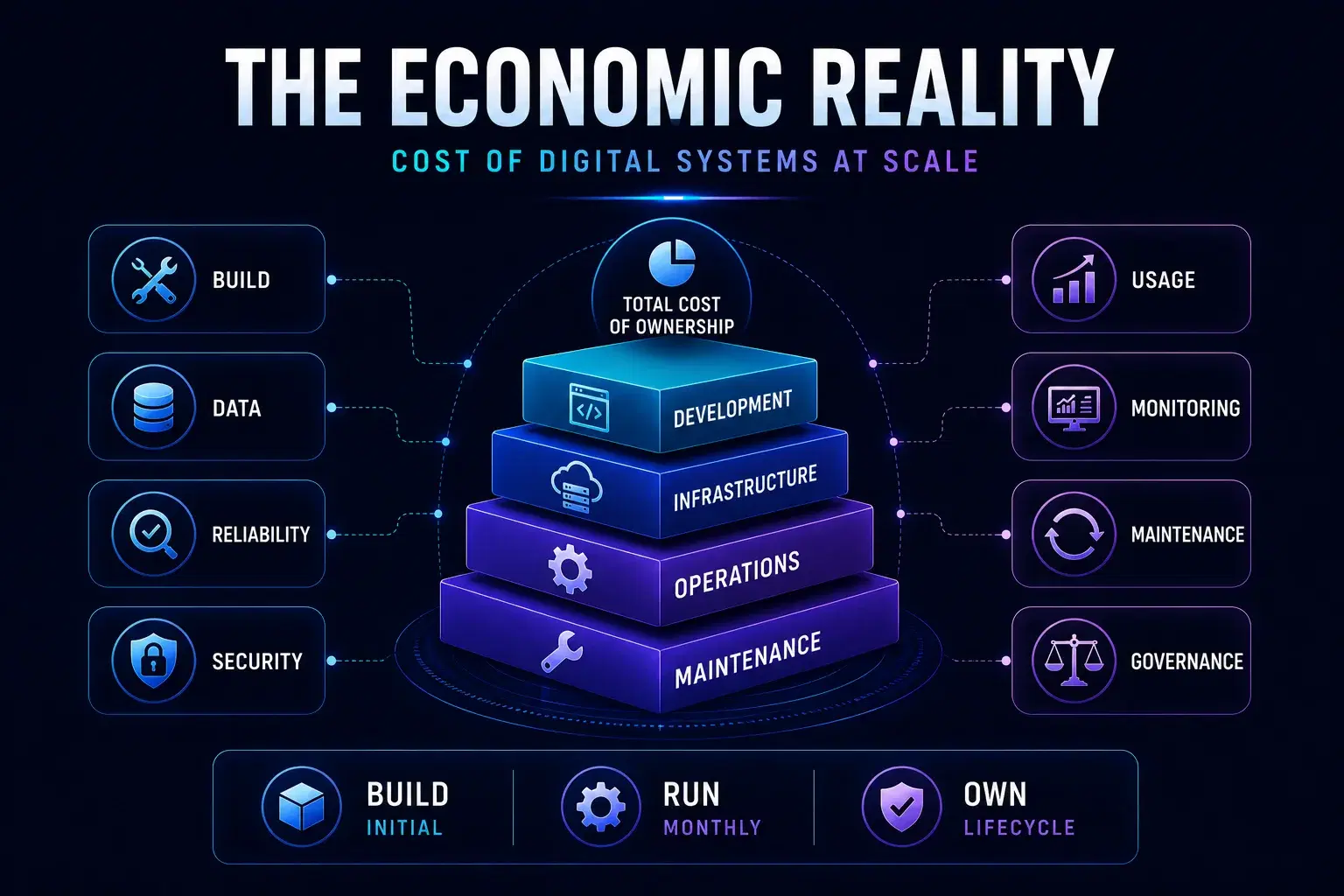
Transparency builds trust. Here is a practical cost model for AI agents at scale—plus the LaTeX-style ROI framing CFOs expect in 2026.
Related work
Production builds that connect to this topic—open a case study or jump to our portfolio.


Budgeting for AI agents is where optimistic roadmaps collide with reality. Models are billed in tokens, agents add orchestration and observability overhead, and the long-term cost center is rarely the initial prototype—it is maintenance: changing policies, drifting documents, new edge cases, and security reviews. This article gives leadership teams a pragmatic way to estimate build spend, run-rate inference costs, and the operational work required to keep systems trustworthy.
What drives cost (beyond “the model”)
- Product engineering: workflows, UX, permissions, admin tooling, and release management.
- Data platforms: ingestion, chunking, embeddings, vector stores, and access-controlled retrieval.
- Reliability: evaluations, monitoring, incident response, and regression testing for tools.
- Security/compliance: PII handling, red teaming basics, logging, and vendor risk management.
Illustrative build ranges (planning anchors—not quotes)
These ranges are useful for annual planning conversations. Actual bids depend on scope, integrations, compliance depth, and whether you are shipping a narrow internal tool versus a multi-tenant SaaS surface. Treat them as orders of magnitude, not guarantees.
| Initiative type | What it typically includes | Indicative build range (USD) |
|---|---|---|
| Chatbot / assistant (guided, limited tools) | Retrieval + policy + basic integrations | ≈ $8k–$25k depending on content and auth complexity |
| Task agent (tool-heavy, operational workflow) | Multi-step execution, approvals, ERP/ITSM integrations | ≈ $10k–$45k+ depending on environments and test coverage |
| Multi-agent system (specialists + orchestration) | Routing, critics/verifiers, observability, higher QA burden | ≈ $25k–$75k+ for serious production scope |
ROI: a CFO-friendly framing (with LaTeX precision)
Enterprises increasingly evaluate automation on throughput and quality—not vanity accuracy scores. A simple planning identity is to compare annualized benefits to total cost of ownership (TCO), including maintenance. One common formulation:
\mathrm{ROI\_year} = \frac{\mathrm{Benefits\_year} - \mathrm{TCO\_year}}{\mathrm{TCO\_year}}, \quad \mathrm{TCO} = \mathrm{build} + \mathrm{run\_inference} + \mathrm{maintenance} + \mathrm{risk\_controls}.If you want a payback horizon, compute months-to-payback as: build + migration divided by monthly net benefit—explicitly including maintenance from month one, not “after launch.”
Benchmarks to anchor benefits (use your own baselines)
Across industries, teams often track operational metrics like: reduced handle time for support, faster invoice processing, fewer expedited shipments, and improved schedule adherence. The right benchmark is always your baseline—before/after on the same volume and seasonality.
How to make the budget defensible
- Define one workflow end-to-end with KPIs and guardrails.
- Model TCO with monthly inference + fixed engineering support.
- Ship a pilot that measures business outcomes, not demo scores.
- Create an operational owner: someone accountable for failures and drift.
Need a grounded estimate?
Silicon Tech Solutions helps teams translate agent ideas into phased investments: what to build first, what to buy, and how to integrate safely with legacy systems. If you are preparing an enterprise AI budget for 2026, we can help you align technical scope with financial reality.
Frequently asked questions
Related articles
Strategic Foundations
The Hyperautomation Playbook: Combining RPA, AI Agents, and Process Mining
Hyperautomation is not a product—it is a discipline. Organizations that combine process mining, RPA, and AI agents under a governance model consistently outperform those deploying tools in isolation.
15 min read · Enterprise AI & Automation
Decision Framework
The 2026 AI Agent Trends Report: What Enterprises Need to Know
Agents are becoming the default interaction layer for complex work—but only organizations that govern data, workflows, and accountability will capture the upside.
11 min read · Enterprise AI & Automation
Decision Framework
Calculating the ROI of AI Agents: Beyond Headcount Reduction
ROI framed only as ‘fewer people’ invites resistance and misses the point. The defensible story is faster cycle times, higher throughput, and fewer errors on work that already exists.
12 min read · Enterprise AI & Automation
Strategic Foundations
Solving the Integration Crisis: Connecting AI Agents to Legacy ERPs (SAP/Oracle)
Enterprise AI fails in the integration layer. Here is a practical approach to ERP-connected agents: boundaries, middleware discipline, and secure access to systems of record.
15 min read · Enterprise AI & Automation
Strategic Foundations
Transitioning from Traditional RPA to Autonomous AI Agent Workflows
RPA excels at deterministic repetition; AI agents excel when rules are fuzzy, context shifts, and exceptions are the norm—if you engineer reliability on top.
13 min read · Enterprise AI & Automation
Plan your next build with us
Book a working session to review workflows, integrations, or AI architecture—or send a message and we'll respond within one business day.