
Strategic Foundations
Solving the Integration Crisis: Connecting AI Agents to Legacy ERPs (SAP/Oracle)
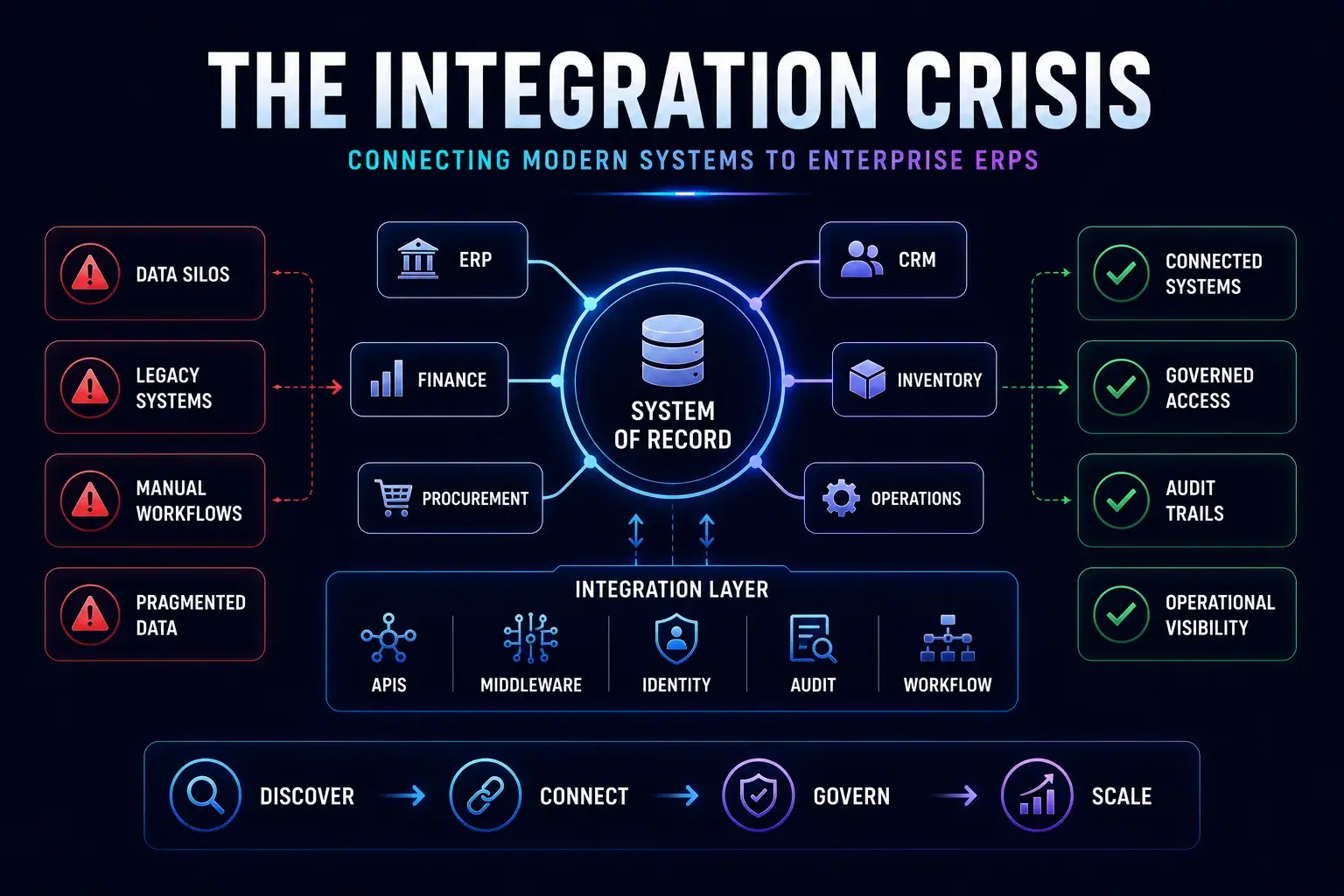
Enterprise AI fails in the integration layer. Here is a practical approach to ERP-connected agents: boundaries, middleware discipline, and secure access to systems of record.
Related work
Production builds that connect to this topic—open a case study or jump to our portfolio.


Most enterprise AI initiatives do not die because the model is “not smart enough.” They die because the organization cannot safely connect intelligence to the systems where work is recorded—SAP S/4HANA, ECC landscapes, Oracle Fusion Cloud ERP, NetSuite, and the long tail of custom databases. The integration crisis is not solved by another chatbot; it is solved by architecture: clear boundaries, governed access, and incremental embedding alongside legacy ERP investments.
Define the entities before you integrate
- System of record: the authoritative application for a given object (vendor master, purchase order, invoice, asset, work order).
- Sidecar architecture: an AI/automation layer that sits beside legacy ERPs, orchestrating actions through APIs and approved interfaces—rather than replacing core modules overnight.
- Middleware: integration services that normalize identities, errors, retries, and observability across heterogeneous systems.
Why ERP + AI is hard (and what good looks like)
Enterprises routinely need data from many sources to make a decision: inventory in one place, contracts in another, emails and tickets in a third. Agents amplify both value and risk: a fast wrong posting is worse than a slow manual one. A strong program defines non-negotiables: least-privilege service accounts, immutable audit trails, segregation of duties, and human approvals for financially material actions.
Integration patterns that survive audits
- Start from business capabilities: procure-to-pay, order-to-cash, record-to-report—not from “AI features.”
- Prefer official APIs and supported connectors; treat screen scraping as a last resort with explicit operational ownership.
- Centralize identity and entitlements: agents should inherit roles, not bypass them.
- Make failures observable: trace IDs across agent steps, ERP responses, and human approvals.
- Design idempotency: finance and inventory workflows must tolerate retries safely.
SAP and Oracle: what changes with embedded intelligence
Major ERP vendors continue shipping assistant experiences and tooling aimed at developers and process owners. Regardless of brand names and release timelines, the principle remains: enterprise AI succeeds when it is embedded in workflows users already trust, with controls that map to SOX, ITGC, and industry regulations. Your job is to align agent actions to the ERP’s contract for correctness—posting rules, validations, tax logic, and inventory movements—not to bypass them.
MCP-style thinking: standardized access without “custom spaghetti”
Standardized tool interfaces help teams expose ERP operations as well-scoped capabilities: create a purchase requisition, fetch vendor terms, attach a document to a case. Whether you adopt MCP literally or borrow its design ideas, the goal is the same: reduce one-off integrations, enforce authorization consistently, and make agent behavior testable the way APIs are testable.
| Phase | Outcome | Typical deliverables |
|---|---|---|
| Discovery | Aligned scope + KPIs | Integration inventory, risk review, data dictionary |
| Pilot | Measured automation with controls | Read-heavy workflows, HITL approvals, logging |
| Scale | Operational excellence | SLOs, incident playbooks, regression tests for tools/prompts |
ERP AI automation services: what we deliver
Silicon Tech Solutions builds production-grade integrations for AI SaaS and internal platforms: secure connectors, workflow orchestration, and engineering practices that satisfy security reviews. If you are searching for ERP AI automation services with a bias toward shipping—not slideware—tell us which system landscape you need to connect first.
Frequently asked questions
Related articles
Strategic Foundations
The Hyperautomation Playbook: Combining RPA, AI Agents, and Process Mining
Hyperautomation is not a product—it is a discipline. Organizations that combine process mining, RPA, and AI agents under a governance model consistently outperform those deploying tools in isolation.
15 min read · Enterprise AI & Automation
Decision Framework
The 2026 AI Agent Trends Report: What Enterprises Need to Know
Agents are becoming the default interaction layer for complex work—but only organizations that govern data, workflows, and accountability will capture the upside.
11 min read · Enterprise AI & Automation
Decision Framework
Calculating the ROI of AI Agents: Beyond Headcount Reduction
ROI framed only as ‘fewer people’ invites resistance and misses the point. The defensible story is faster cycle times, higher throughput, and fewer errors on work that already exists.
12 min read · Enterprise AI & Automation
Strategic Foundations
The Economic Reality: What AI Agents Actually Cost at Scale
Transparency builds trust. Here is a practical cost model for AI agents at scale—plus the LaTeX-style ROI framing CFOs expect in 2026.
12 min read · Enterprise AI & Automation
Strategic Foundations
Transitioning from Traditional RPA to Autonomous AI Agent Workflows
RPA excels at deterministic repetition; AI agents excel when rules are fuzzy, context shifts, and exceptions are the norm—if you engineer reliability on top.
13 min read · Enterprise AI & Automation
Plan your next build with us
Book a working session to review workflows, integrations, or AI architecture—or send a message and we'll respond within one business day.