
Decision Framework
Calculating the ROI of AI Agents: Beyond Headcount Reduction
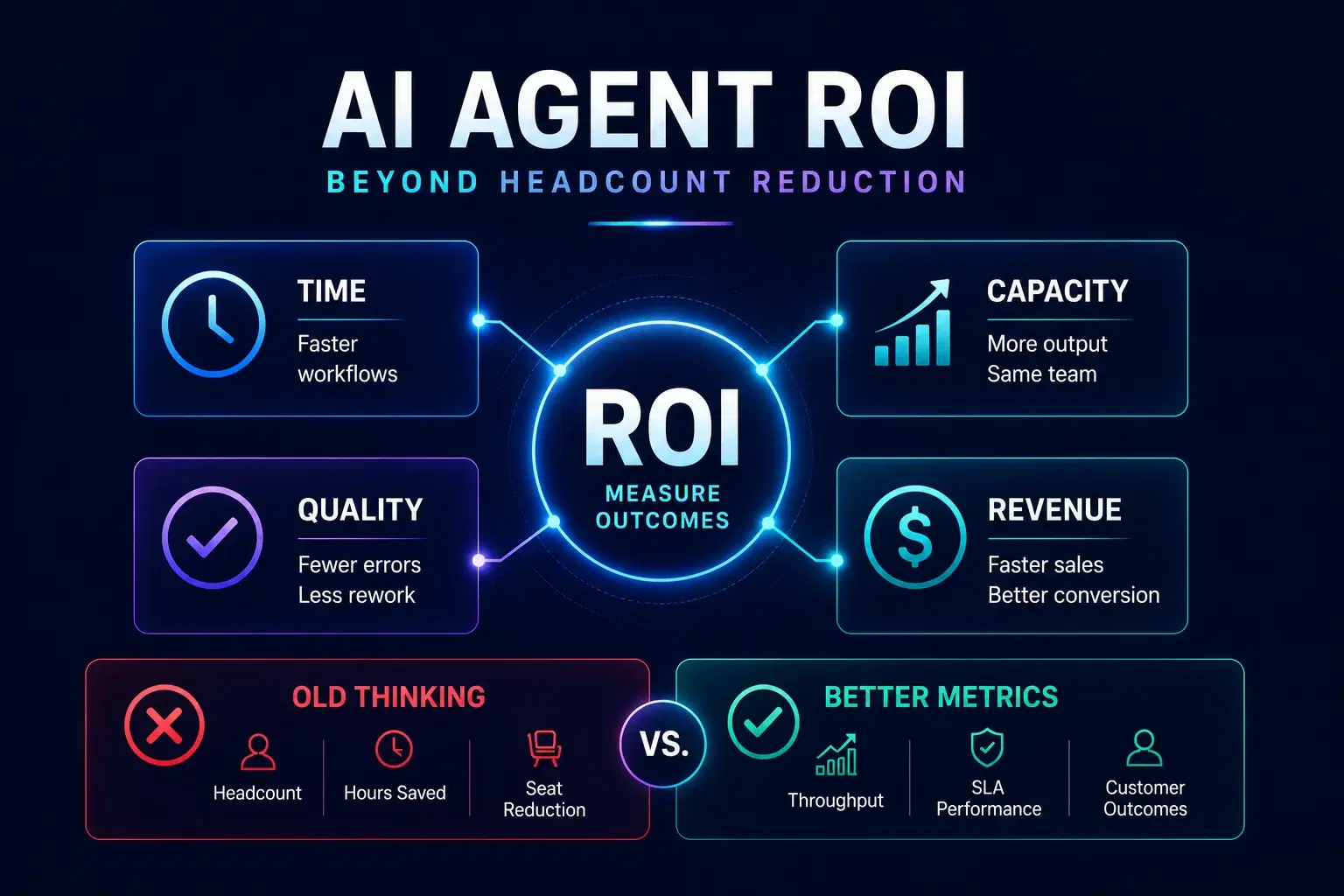
ROI framed only as ‘fewer people’ invites resistance and misses the point. The defensible story is faster cycle times, higher throughput, and fewer errors on work that already exists.
Related work
Production builds that connect to this topic—open a case study or jump to our portfolio.


Executives fund initiatives that improve throughput, customer outcomes, and risk—not slide decks about ‘AI transformation.’ Return on investment for agent automation should connect to measurable operational metrics: time to complete a workflow, exception rates, SLA performance, and revenue supported per employee. Headcount reduction can be an outcome in some contexts, but it is neither the only path nor the easiest politically; capacity reallocation to higher-value work is often the honest story.
A better ROI framing: time, quality, capacity
- Time: minutes saved per case × cases per month.
- Quality: reduction in rework, refunds, or compliance findings.
- Capacity: same team handles higher volume without proportional hiring.
- Revenue: faster quotes, shorter sales cycles, improved conversion—where credible.
A simple ROI identity
For annual planning, compare benefits to total cost of ownership (TCO), including build, inference, maintenance, and risk controls:
\mathrm{ROI} = \frac{\mathrm{Annual\_benefits} - \mathrm{TCO}}{\mathrm{TCO}}, \qquad \mathrm{TCO} = C_{\mathrm{build}} + C_{\mathrm{run}} + C_{\mathrm{maint}} + C_{\mathrm{risk}}.Benchmarks: use as hypotheses, not promises
Cross-industry anecdotes often cite large reductions in handle time for routine support work or faster processing for document-heavy workflows. Your baseline is what matters: measure before/after on the same volume, seasonality, and quality standards.
| Function | What to measure | Example direction |
|---|---|---|
| Customer support | Handle time, first-contact resolution | Lower handle time with stable CSAT |
| Back office | Transactions per FTE, error rate | Higher throughput, fewer defects |
| Sales ops | Quote cycle time | Faster turnaround on qualified deals |
Governance: ROI includes risk
Include expected cost of incidents, rework, and compliance review in TCO. A cheap system that generates regulatory findings or customer harm is negative ROI—even if labor hours look ‘saved.’
How we help
Silicon Tech Solutions partners with teams to define KPIs, ship pilots with honest measurement, and scale what works. If you need an ROI narrative your CFO and operators can defend, we can help you tie agents to numbers—not slogans.
Frequently asked questions
Related articles
Strategic Foundations
The Hyperautomation Playbook: Combining RPA, AI Agents, and Process Mining
Hyperautomation is not a product—it is a discipline. Organizations that combine process mining, RPA, and AI agents under a governance model consistently outperform those deploying tools in isolation.
15 min read · Enterprise AI & Automation
Decision Framework
The 2026 AI Agent Trends Report: What Enterprises Need to Know
Agents are becoming the default interaction layer for complex work—but only organizations that govern data, workflows, and accountability will capture the upside.
11 min read · Enterprise AI & Automation
Strategic Foundations
The Economic Reality: What AI Agents Actually Cost at Scale
Transparency builds trust. Here is a practical cost model for AI agents at scale—plus the LaTeX-style ROI framing CFOs expect in 2026.
12 min read · Enterprise AI & Automation
Strategic Foundations
Solving the Integration Crisis: Connecting AI Agents to Legacy ERPs (SAP/Oracle)
Enterprise AI fails in the integration layer. Here is a practical approach to ERP-connected agents: boundaries, middleware discipline, and secure access to systems of record.
15 min read · Enterprise AI & Automation
Strategic Foundations
Transitioning from Traditional RPA to Autonomous AI Agent Workflows
RPA excels at deterministic repetition; AI agents excel when rules are fuzzy, context shifts, and exceptions are the norm—if you engineer reliability on top.
13 min read · Enterprise AI & Automation
Plan your next build with us
Book a working session to review workflows, integrations, or AI architecture—or send a message and we'll respond within one business day.