
Strategic Foundations
Transitioning from Traditional RPA to Autonomous AI Agent Workflows
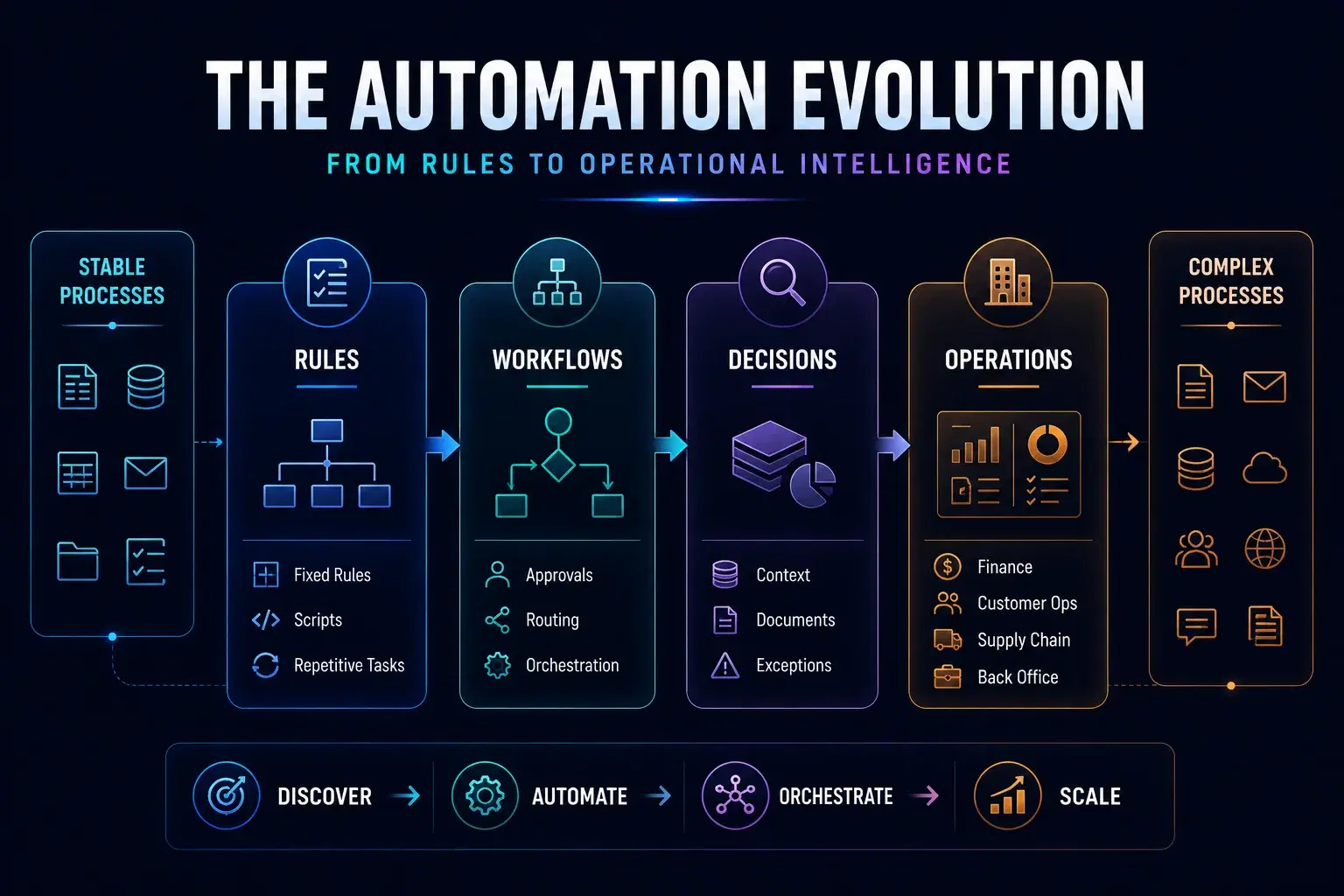
RPA excels at deterministic repetition; AI agents excel when rules are fuzzy, context shifts, and exceptions are the norm—if you engineer reliability on top.
Related work
Production builds that connect to this topic—open a case study or jump to our portfolio.


Robotic Process Automation (RPA) transformed shared services by scripting stable, high-volume tasks. But many “automated” processes still collapse under messy data, changing vendor portals, and ambiguous instructions—the kind of work that humans quietly handle every day. AI agents (tool-using systems that plan, retrieve, act, and verify) are not a universal replacement for RPA; they are a different tool class for a different failure mode.
Definitions: RPA, agents, and semantic reasoning
- RPA: deterministic automation that mimics UI or API steps with explicit rules. Strong when inputs are structured and stable.
- AI agent workflow: an orchestrated loop that can retrieve context, choose tools, take actions, and escalate when confidence is low.
- Semantic reasoning: using language understanding and domain context to interpret intent, match entities across messy text, and decide next steps—beyond fixed selectors.
When RPA still wins
Keep RPA (or traditional integration) when your process is stable, exceptions are rare, and compliance demands deterministic behavior. Examples include scheduled extracts, well-defined ERP postings with fixed validations, and high-frequency transactions with unchanged vendor UIs.
When agentic workflows become the better lever
Agents tend to pay off when: (1) instructions are natural language or vary by customer, (2) documents are semi-structured, (3) triage requires context across systems, or (4) the process changes frequently enough that brittle scripts constantly break. The economic goal is not “replace humans”—it is to reduce cycle time and exception queues while keeping humans in control for high-risk decisions.
| Topic | RPA | Agentic workflow |
|---|---|---|
| Determinism | High: same inputs → same steps | Lower: stochastic components require guardrails and evaluation |
| Change tolerance | Low: UI shifts break bots | Higher: can adapt with retrieval + tool policies (not magic—still needs maintenance) |
| Best evidence | Logs of stable repetitive runs | Eval suites + human review queues + business metrics |
| Typical risk | Brittleness and maintenance debt | Over-trust: wrong action at scale without controls |
AI agent workflow integration: what “production” requires
A demo that completes 80% of tasks is not close to production-ready for finance, logistics, or customer-critical workflows. Production integration usually includes: explicit authorization boundaries, structured outputs, idempotent actions, monitoring, and escalation paths. Many teams implement a “critic” pattern—one component proposes actions, another checks policy/facts, and humans approve edge cases.
A sane migration path from RPA to hybrid automation
- Inventory bots and classify failure modes: brittle UI, data quality, exceptions, seasonality.
- Keep deterministic paths deterministic—do not “LLM” what rules can solve.
- Introduce agents at the edges: intake, triage, document understanding, and case summarization.
- Measure end-to-end KPIs: throughput, rework rate, SLA breaches—not token counts.
- Consolidate under governance: approved tools, logging, and access control.
What teams evaluate in 2026 (tools are only part of the story)
The market includes everything from self-hosted automation experiments to vendor “collaborator” experiences embedded in productivity suites. The right question is not which brand wins Twitter—whether your architecture can enforce data boundaries, reproduce issues, and ship improvements weekly without breaking compliance.
Hyperautomation: the umbrella that combines RPA, AI, and process mining
Gartner coined hyperautomation to describe the disciplined approach of identifying, vetting, and automating as many processes as possible using a combination of tools: RPA bots handle rule-based repetition, AI agents handle judgment and exceptions, and process mining surfaces bottlenecks that teams did not know existed. The strategic value is that each layer reinforces the others—process mining identifies where RPA breaks down, agents fill those gaps, and the feedback loop continuously improves automation coverage.
| Layer | Primary tool | Best for |
|---|---|---|
| Structured repetition | RPA | Stable UI/API-based tasks, batch processing |
| Exception handling | AI agents | Messy data, ambiguous instructions, context switching |
| Process discovery | Process/task mining | Finding automation candidates and measuring actual cycle time |
| Orchestration | Workflow engines + BPMS | Cross-system coordination, approvals, audit trails |
Work with Silicon Tech Solutions
We help organizations modernize operational efficiency with realistic automation strategy: where to use RPA, where to use agents, and how to integrate both into your systems of record without boiling the ocean. If you are evaluating AI agent workflow integration, start with a focused workflow audit and a measurable pilot.
Frequently asked questions
Related articles
Strategic Foundations
The Hyperautomation Playbook: Combining RPA, AI Agents, and Process Mining
Hyperautomation is not a product—it is a discipline. Organizations that combine process mining, RPA, and AI agents under a governance model consistently outperform those deploying tools in isolation.
15 min read · Enterprise AI & Automation
Decision Framework
The 2026 AI Agent Trends Report: What Enterprises Need to Know
Agents are becoming the default interaction layer for complex work—but only organizations that govern data, workflows, and accountability will capture the upside.
11 min read · Enterprise AI & Automation
Decision Framework
Calculating the ROI of AI Agents: Beyond Headcount Reduction
ROI framed only as ‘fewer people’ invites resistance and misses the point. The defensible story is faster cycle times, higher throughput, and fewer errors on work that already exists.
12 min read · Enterprise AI & Automation
Strategic Foundations
The Economic Reality: What AI Agents Actually Cost at Scale
Transparency builds trust. Here is a practical cost model for AI agents at scale—plus the LaTeX-style ROI framing CFOs expect in 2026.
12 min read · Enterprise AI & Automation
Strategic Foundations
Solving the Integration Crisis: Connecting AI Agents to Legacy ERPs (SAP/Oracle)
Enterprise AI fails in the integration layer. Here is a practical approach to ERP-connected agents: boundaries, middleware discipline, and secure access to systems of record.
15 min read · Enterprise AI & Automation
Plan your next build with us
Book a working session to review workflows, integrations, or AI architecture—or send a message and we'll respond within one business day.