
Vertical Deep-Dives
AI-Powered Financial Close: Automating Month-End for Finance Teams
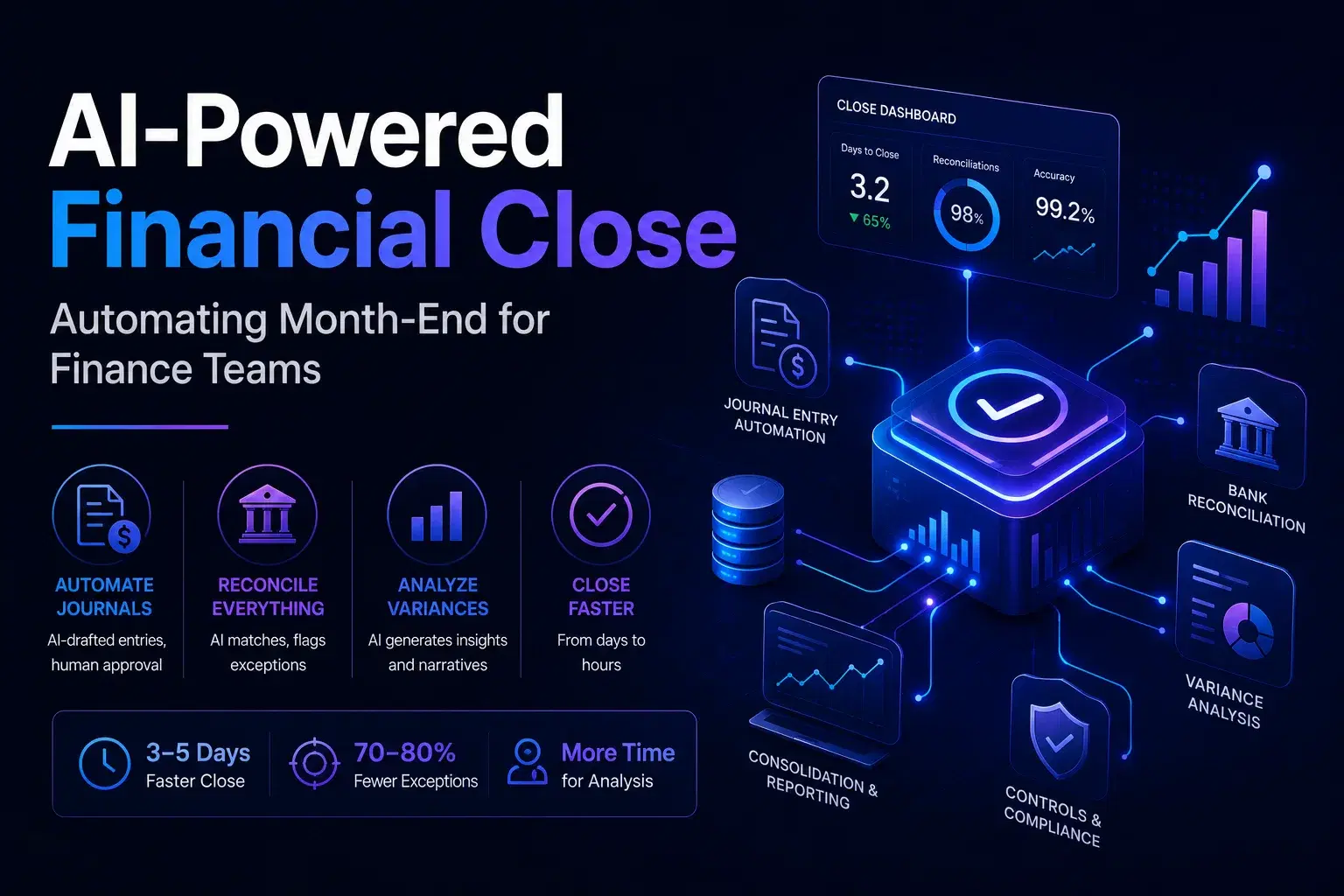
Finance teams lose 3–5 days every month to manual reconciliations and journal entry preparation that could be automated. AI agents close that gap—if the data architecture and controls are right.
Related work
Production builds that connect to this topic—open a case study or jump to our portfolio.


The financial close cycle—record-to-report—remains one of the most labor-intensive processes in enterprise finance. Month-end and quarter-end close routinely consumes 5–10 business days, involves hundreds of manual journal entries, and produces reconciliation spreadsheets that break when formulas reference wrong sheets. AI agents can compress this cycle materially—but only when implemented with the data quality, ERP integration, and control framework that finance compliance requires.
Entity definitions for finance automation
- Record-to-report (R2R): the end-to-end process from transaction recording through period-end close, consolidation, and external financial reporting.
- Journal entry automation: AI-generated or AI-suggested journal entries for recurring accruals, allocations, reclassifications, and corrections—human approval required for material entries.
- Account reconciliation: matching subledger balances to general ledger balances (or bank statements to GL) with AI handling matching logic and flagging exceptions.
- Continuous close: moving from a big-bang monthly close to daily or weekly sub-close activities—enabled by automation removing the bottleneck of manual processing at period end.
Where AI creates the most value in the close process
| Close activity | Current manual pain | AI automation opportunity | Human oversight needed |
|---|---|---|---|
| Accrual journal entries | Manually calculated from contracts/estimates | AI drafts based on prior periods + contract data | Controller review and approval |
| Bank reconciliation | Transaction matching in spreadsheets | AI matches 95%+ of transactions automatically; flags unmatched | Accountant resolves exceptions |
| Intercompany reconciliation | Email chains across subsidiaries | AI matches intercompany transactions; surfaces mismatches proactively | Shared services team + entities |
| Expense accruals | Estimated from invoices not yet received | AI estimates from PO commitments + receipt data | Business unit review |
| Variance analysis | Manually assembled commentary | AI generates first-draft variance narrative from actuals vs budget | Finance manager review and edit |
| Consolidation | Manual elimination entries across entities | AI-assisted elimination logic from intercompany data | Group controller approval |
ERP integration: where the automation actually runs
Financial close automation runs in and around ERP systems—SAP S/4HANA, Oracle Fusion Cloud Financials, NetSuite, Microsoft Dynamics 365 Finance. The integration pattern is: AI agents connect to ERP via official APIs (SAP OData/SOAP services, Oracle REST APIs, NetSuite SuiteScript), read transaction data and open items, perform matching and analysis externally, and post approved journal entries back via the same API surfaces—maintaining full audit trail in the ERP.
Toward continuous close: what the architecture looks like
Continuous close shifts the close from a sprint at period-end to steady-state daily processing. The architecture requires: (1) real-time or near-real-time subledger feeds into the GL—no batch jobs that create 'catch-up' reconciliation at month-end; (2) automated matching rules that run nightly on bank feeds, intercompany transactions, and expense reports; (3) rolling variance analysis so finance business partners see actuals vs. budget updated daily, not only on day 5 of close; (4) exception management workflows that route unmatched items to the responsible owner automatically.
The ROI: time, accuracy, and staff reallocation
Finance automation ROI in the close process is measurable: the primary metric is days-to-close (the number of calendar days from period-end to management accounts available). Organizations that implement full close automation typically reduce days-to-close from 10–15 days to 3–5 days. Secondary metrics include: reconciliation exceptions requiring manual investigation (target: reduce by 70–80%), journal entry error rate, and controller hours spent on mechanical tasks vs. analysis.
\text{Annual value} = (\text{Days saved} \times \text{Close staff FTEs} \times \text{Daily cost}) + (\text{Error rate reduction} \times \text{Average restatement cost})Implementation sequence: start with reconciliation, not journal entries
- Start with bank reconciliation: highest data quality, clearest matching rules, fastest ROI, lowest risk.
- Add intercompany reconciliation: large time sink; AI-assisted matching reduces cross-subsidiary email volume dramatically.
- Introduce AI-drafted accruals: generate based on prior periods and contract data; controller reviews and posts.
- Build variance analysis automation: AI narrative generation from actuals vs. budget data, templates per GL account group.
- Achieve continuous close: real-time subledger feeds, daily matching runs, rolling forecasts instead of point-in-time.
How Silicon Tech Solutions helps
We build financial close automation systems: ERP API integrations (SAP, Oracle, NetSuite), reconciliation engines, AI-assisted journal entry workflows, and finance data pipelines. Our solutions are designed for audit-readiness and SOX compliance—not just technical efficiency. If you are looking to compress your close cycle and free your finance team from mechanical work, book a scoping session with our team.
Frequently asked questions
Related articles
The Hard Parts of Building...
The Hard Parts of Building FinTech Products: Compliance, Payments, Security & Scale
In FinTech software engineering, there is zero tolerance for eventual consistency or soft errors. Learn how to architect financial platforms for strict compliance, ledger integrity, and immutable audit trails.
15 min read · Fintech & Banking
Vertical Deep-Dives
Building an AI-Native Neobank: Architecture, Compliance, and Scale
Neobanks that win in 2026 are not 'apps on top of legacy rails'—they are AI-native systems where credit decisions, fraud detection, and customer service run autonomously within governed frameworks.
15 min read · Fintech & Banking
Vertical Deep-Dives
Embedded Finance and Agentic Payments: Building Fintech Infrastructure in 2026
Embedded finance is no longer a banking add-on—it is a product strategy. In 2026, agentic AI makes real-time credit decisions, initiates payments, and manages compliance without manual intervention.
16 min read · Fintech & Banking
Vertical Deep-Dives
Financial Services 2.0: Automating KYC and Fraud Triage with Agentic AI
Banks and fintechs need speed and scrutiny at once. The winning stack pairs anomaly detection with explainable workflows, immutable logs, and humans who set policy—not click every alert.
14 min read · Fintech & Banking
Plan your next build with us
Book a working session to review workflows, integrations, or AI architecture—or send a message and we'll respond within one business day.