
Vertical Deep-Dives
AI-Native Predictive Maintenance: Digitalizing Manufacturing Operations
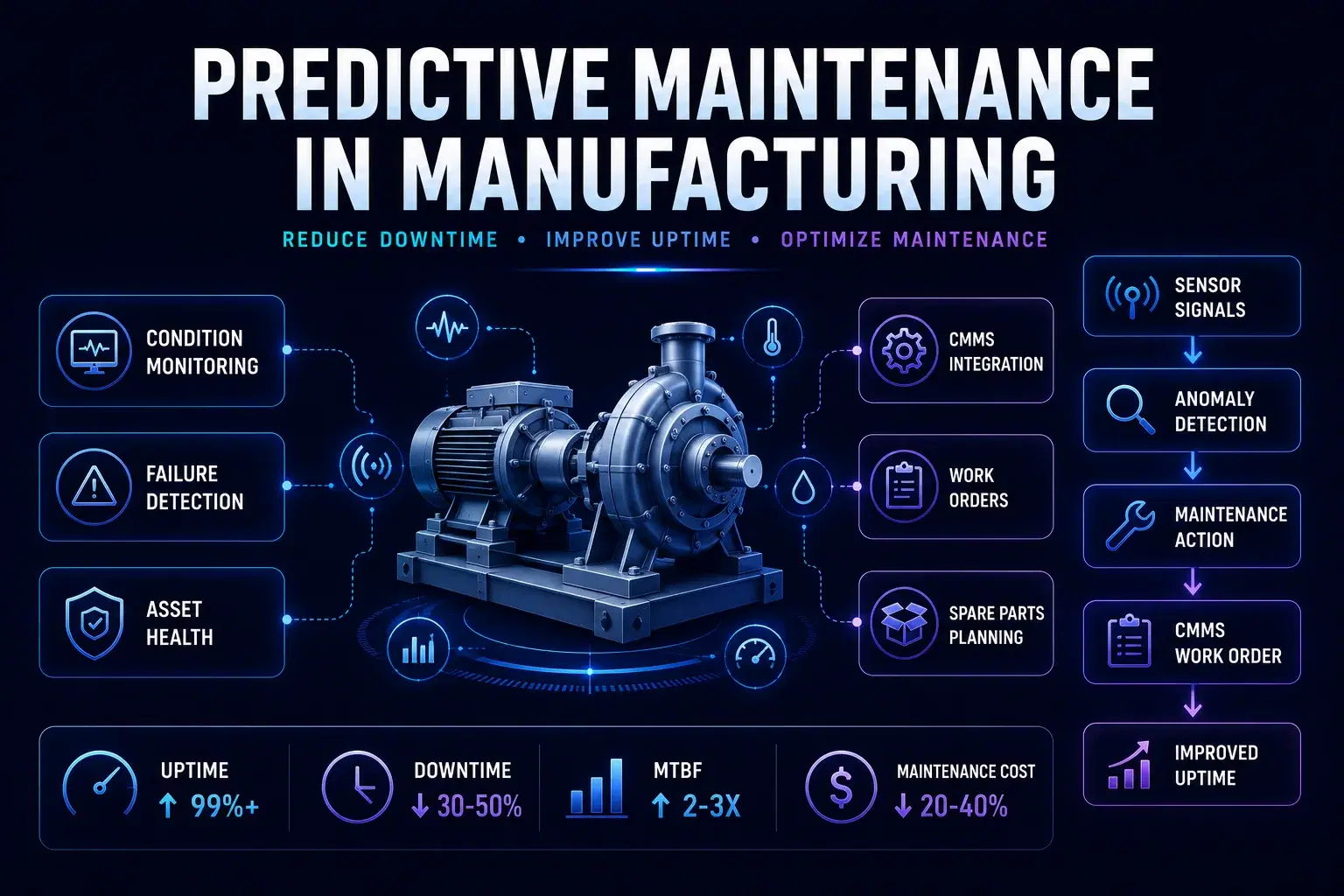
Unplanned downtime is measured in six figures per hour. Modern maintenance combines IoT signals, CMMS integration, and AI that turns anomalies into work orders before failure.
Related work
Production builds that connect to this topic—open a case study or jump to our portfolio.

Manufacturing leaders do not buy “AI” as a slogan—they buy uptime, yield, and predictable maintenance spend. Predictive maintenance uses sensors, historical work orders, and operational context to estimate when an asset is trending toward failure, then triggers the right action: inspection, spare ordering, or controlled shutdown. In 2026, the differentiator is not a single model; it is the closed loop from signal → decision → CMMS/ERP execution with human oversight where risk demands it.
Key entities (for clarity and citations)
- CMMS: computerized maintenance management system—work orders, asset registry, spare parts, technician schedules.
- Condition monitoring: continuous streams (vibration, temperature, current, acoustic) compared to baselines.
- Predictive maintenance AI: models and rules that estimate remaining useful life (RUL) or failure risk windows.
- Agentic loop: detect anomaly → enrich with context → recommend or create work order → track resolution and feed back labels.
The money metric: downtime and maintenance cost
Unplanned outages cascade into missed shipments, overtime, expedited freight, and safety exposure. Teams often anchor programs on hours of downtime avoided, maintenance cost per unit produced, and mean time between failures (MTBF). Industry benchmarks frequently cite meaningful reductions in unplanned downtime and maintenance spend when programs combine better data with disciplined execution—not algorithms alone.
| Metric | Why it matters | Typical data sources |
|---|---|---|
| Unplanned downtime (hours) | Direct revenue and SLA impact | MES, CMMS, line logs |
| PM vs reactive ratio | Workforce and spares efficiency | CMMS work-order types |
| False alarm rate | Technician trust and adoption | Alert logs vs confirmed faults |
| Spare inventory turns | Working capital | ERP + storeroom |
Signals that actually predict failure
Strong programs combine physics and data: vibration spectra for rotating equipment, thermal imaging for electrical panels, motor current signatures for pumps, and oil analysis where applicable. The goal is not to collect every sensor—it is to instrument high-impact assets first, align sampling rates with failure modes, and label events when failures or near-failures occur so models can learn domain-specific patterns.
CMMS integration: where insight becomes action
A prediction without a work order is a dashboard decoration. Production-grade systems write structured recommendations to the CMMS: asset ID, suggested priority, evidence (charts, thresholds exceeded), and links to procedures. Human-in-the-loop approval is common for first-line teams until trust is established; later, low-risk categories can auto-create work orders within policy bounds.
Agentic workflows on the shop floor
Beyond one-off predictions, agents can orchestrate multi-step responses: open a work order, check spare availability, schedule a window with production, and notify suppliers if a long-lead part is needed. Reliability engineering still owns the physics; software owns repeatability, audit trails, and integration hygiene.
A pragmatic rollout sequence
- Pick 5–15 critical assets with known pain (not every line on day one).
- Establish data pipelines and baseline labeling with maintenance SMEs.
- Ship alerts with mandatory feedback loops (true/false alarm) to improve models.
- Integrate CMMS and ERP for parts and approvals; measure downtime impact monthly.
- Expand only after technicians trust alerts and leadership sees ROI.
Industry 4.0 context: where predictive maintenance fits the bigger picture
Industry 4.0 is the convergence of operational technology (OT) and information technology (IT): sensors on machines talking to cloud platforms, ERP integrations surfacing real-time asset health, and AI turning raw IoT streams into operational decisions. Predictive maintenance is often the first Industry 4.0 use case because the ROI is tangible and the data footprint is bounded. Digital twins—virtual representations of physical assets—extend this further, enabling 'what-if' simulations of maintenance schedules without stopping the line.
How we help
Silicon Tech Solutions designs and builds data pipelines, integrations, and AI-assisted workflows for operations-heavy businesses. If you are digitalizing manufacturing maintenance, we can help you connect signals, systems, and teams without boiling the ocean.
Frequently asked questions
Related articles
Plan your next build with us
Book a working session to review workflows, integrations, or AI architecture—or send a message and we'll respond within one business day.