
Decision Framework
AI SaaS vs. Custom Development: Which Path to Digitalization?
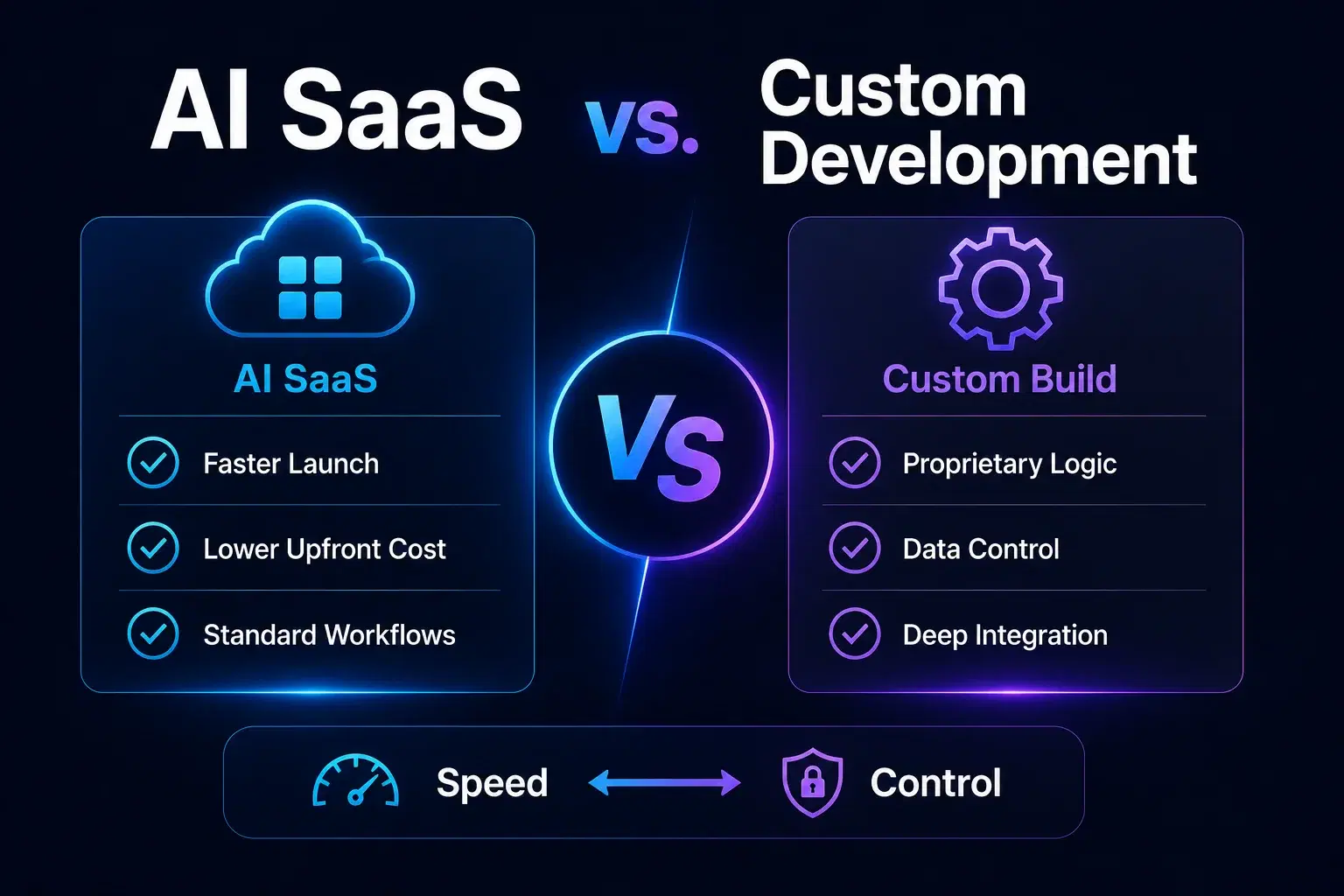
Build-everything and buy-everything are both extremes. Most enterprises need a portfolio: SaaS for commodity surfaces, custom for defensible workflows and regulated data.
Related work
Production builds that connect to this topic—open a case study or jump to our portfolio.

Digitalization decisions are really risk decisions: speed vs. control, standardization vs. differentiation, and operating expense vs. capitalized build. Off-the-shelf AI SaaS can accelerate time-to-value for generic workflows—summarization, basic assistants, and vendor-managed models. Custom development earns its cost when you need deep integration with systems of record, strict data boundaries, proprietary workflows, or vertical differentiation competitors can copy from a catalog.
When AI SaaS (or embedded vendor AI) is the rational choice
- The problem is common and undifferentiated: generic knowledge work assistance with low integration depth.
- Vendor SLAs, security reviews, and roadmaps meet your bar; you are not the first regulated customer.
- Total cost of ownership—including seats, overage, and migration risk—beats a multi-year build for the same scope.
When custom (or hybrid) development wins
- Workflows are core IP: pricing engines, risk models, scheduling logic tied to your operations.
- Data cannot leave a boundary: VPC, on-prem, or country-specific residency requirements.
- Integration surface is large and specific: many internal APIs, legacy ERPs, bespoke policies.
- You need a moat: proprietary data flywheel and execution quality competitors cannot license.
TCO: count everything
For SaaS, include per-seat growth, API overages, professional services, and exit costs. For custom, include engineering, inference, maintenance, security reviews, and opportunity cost of delayed features. DIY pilots that linger in limbo often cost more than disciplined vendor adoption—because organizational attention is finite.
| Topic | SaaS bias | Custom bias |
|---|---|---|
| Time to first value | Often faster for standard use cases | Slower upfront, faster where SaaS cannot fit |
| Differentiation | Low unless you configure deeply | High when workflow is unique |
| Lock-in | Contractual and data export risk | You own code—ops burden shifts to you |
How we help
Silicon Tech Solutions delivers custom AI and product engineering where off-the-shelf tools stop short—and we integrate with the SaaS you already run. If you are weighing build vs. buy, we can help you make the decision with TCO, timeline, and risk spelled out.
Frequently asked questions
Related articles
Why Most Founders Underestimate...
Why Enterprise Customers Ask for Features You Never Planned (And How to Architect for Them Early)
Enterprise buyers rarely reject SaaS products over core workflow features. Deals stall over compliance, security, and identity infrastructure. Learn how to architect for enterprise readiness from day one.
13 min read · SaaS & Product Engineering
Engineering Decisions That Become Expensive Later
Why Most SaaS Products Become Hard to Scale (And It's Usually Not Because of Traffic)
When software velocity hits a brick wall, founders blame infrastructure. But true scalability bottlenecks are hidden inside your database schemas, hardcoded permissions, and tightly coupled business logic.
14 min read · SaaS & Product Engineering
MVP & Product Architecture
The Hard Parts of Building an MVP: Decisions That Become Expensive Later
We’ve watched dozens of products grow. The catastrophic failures rarely happen because of bad business ideas; they happen because early, unchecked tech decisions trap your velocity right when you land your first enterprise pilot.
14 min read · SaaS & Product Engineering
Strategic Foundations
The Great AI SaaS Pricing Crisis: Seats vs. Agents
AI agents are breaking the old SaaS pricing equation. When one autonomous workflow can replace a five-person ops squad, founders need pricing models based on usage, outcomes, and value created—not seats.
9 min read · SaaS & Product Engineering
Vertical Deep-Dives
AI Agents for Customer Success: Reducing Churn and Scaling Retention
Customer success teams are buried in reactive work. AI agents that predict churn, automate health scoring, and draft proactive outreach let CSMs focus on the relationships and decisions that only humans can handle.
13 min read · SaaS & Product Engineering
Strategic Foundations
AI-First MVP Development: How Startups Ship Agentic Products in 8 Weeks
Eight weeks is enough to validate an AI product hypothesis—if you make the right scope decisions from day one. This guide covers the architecture, sprint model, and production gates that separate shipped MVPs from eternal prototypes.
13 min read · SaaS & Product Engineering
Plan your next build with us
Book a working session to review workflows, integrations, or AI architecture—or send a message and we'll respond within one business day.