
Vertical Deep-Dives
Digitalizing the Supply Chain: From Predictive Analytics to Autonomous Action
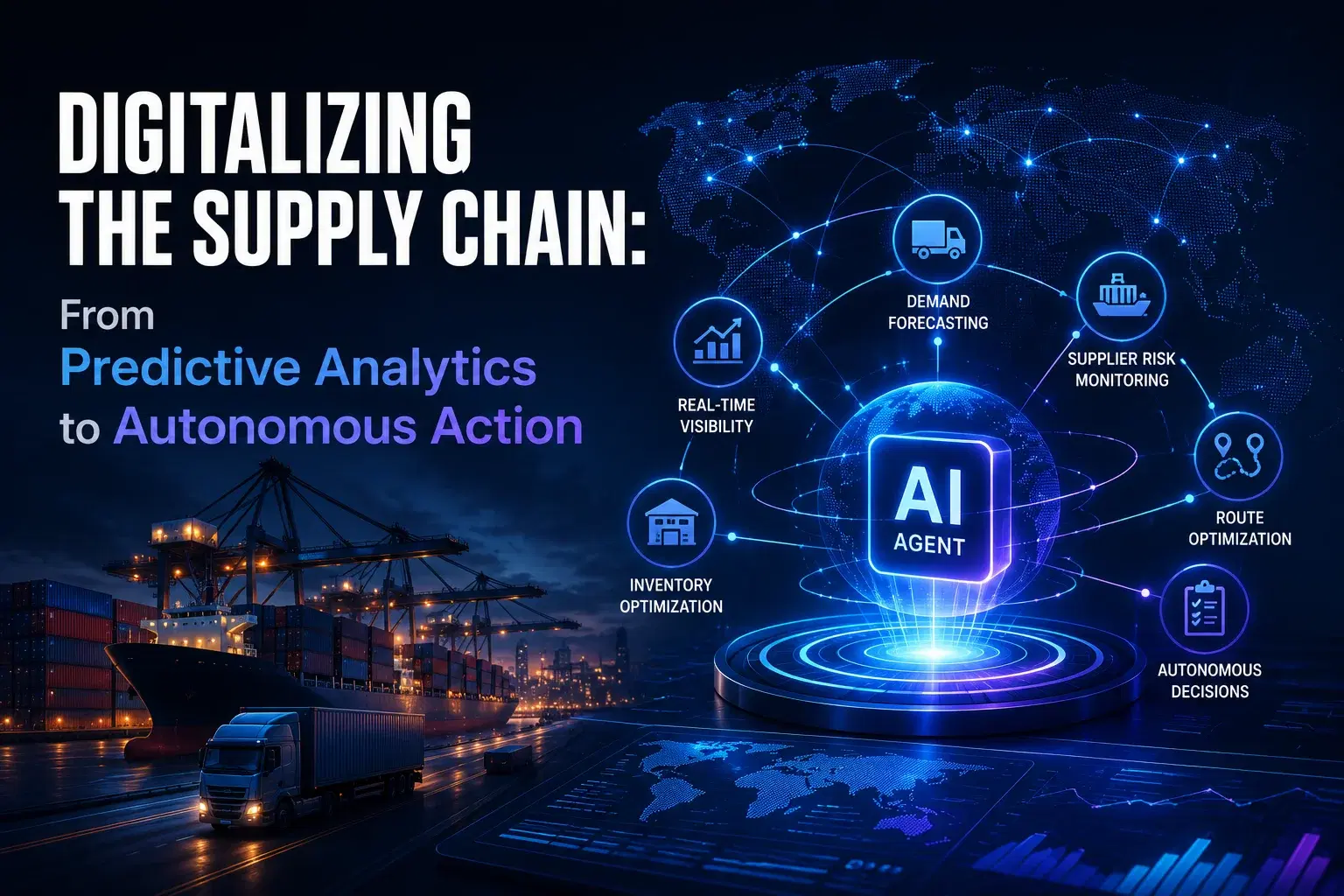
Legacy planning breaks when assumptions change daily. Modern supply chains pair forecasting with monitoring of disruption signals—and workflows that can recommend or execute the next best move under guardrails.
Related work
Production builds that connect to this topic—open a case study or jump to our portfolio.


Supply chain software has always promised optimization; reality is volatility—port delays, supplier insolvency, weather shocks, and demand spikes from channels you cannot fully control. Predictive analytics still matters for baseline planning, but competitive advantage increasingly comes from sensing disruption early and acting fast with clear governance: what can be automated, what requires approval, and what must stay manual.
What we mean by “autonomous action”
Autonomous does not mean unsupervised—and in 2026 the US market is shifting from an “AI replaces humans” story to augmented logistics. Agents and automation are best aimed at low-value, high-volume decisions (status triage, threshold-based reroutes, data assembly for exceptions) so planners and operators can focus on high-stakes strategy, customer relationships, and judgment calls regulators and boards still expect a person to own. Bounded autonomy still means: systems propose or execute decisions—expedite a shipment, reallocate inventory between nodes, re-sequence production—within policy thresholds, with logs and rollback paths. Full autonomy without guardrails is rarely acceptable for high-value or regulated cargo.
Three layers: forecast, monitor, orchestrate
- Forecast & plan: statistical models and ML for demand, seasonality, and promotion lift—grounded in clean master data.
- Monitor & detect: anomaly detection on lead times, fill rates, and external signals (news, weather, risk indices).
- Orchestrate & act: workflow engines and agents that assemble options, costs, and constraints, then route approvals.
Inventory and reorder: beyond static min/max
Static reorder points go stale. Better systems incorporate service-level targets, supplier reliability scores, and variability in demand—not just averages. AI can help prioritize SKUs where stockouts are expensive and overstock is wasteful, but master data hygiene remains the prerequisite: BOM accuracy, unit of measure, shelf life—and cross-border interoperability. For hubs like Singapore and the UAE, where operations span complex customs regimes, harmonized product classifications, HS codes, and party/location identifiers must align across ERP, TMS, and trade systems; otherwise analytics and agents amplify errors across borders, not just within a single plant.
| Signal | Example | Action |
|---|---|---|
| Carrier delay probability | Historical lane performance + weather | Re-route or split shipment |
| Supplier risk score | Financial health + on-time trends | Secondary sourcing |
| Demand spike | POS + channel feeds | Allocate scarce stock |
| Port congestion | Maritime indices + news | Shift mode or timing |
| Sustainability reporting (carbon intensity) | Scope 3–relevant emissions factors by lane, mode, and carrier; fused with shipment and SKU data (increasingly mandatory for US and UK disclosure) | Support ESG reporting; choose lower-intensity routes or modes within service constraints |
Where agentic workflows add value
Agents excel at cross-system synthesis: pulling inventory positions from ERP, carrier status from TMS, and customer commitments from CRM to recommend a mitigation plan. The win is fewer meetings spent reconciling spreadsheets—and faster execution when minutes matter.
Metrics that align teams
- Cash conversion cycle and inventory turns.
- Perfect order rate (on time, in full, damage-free).
- Cost to serve by channel and customer segment.
- Mean time to recover from disruption events.
How we help
Silicon Tech Solutions builds integrations, internal platforms, and AI-assisted workflows for operations-heavy businesses. If you are modernizing supply chain visibility and decision-making, we can help you connect data, policies, and execution.
Frequently asked questions
Related articles
Plan your next build with us
Book a working session to review workflows, integrations, or AI architecture—or send a message and we'll respond within one business day.