
Decision Framework
Case Study: Digitalizing a Legacy Manufacturing Operation in 60 Days
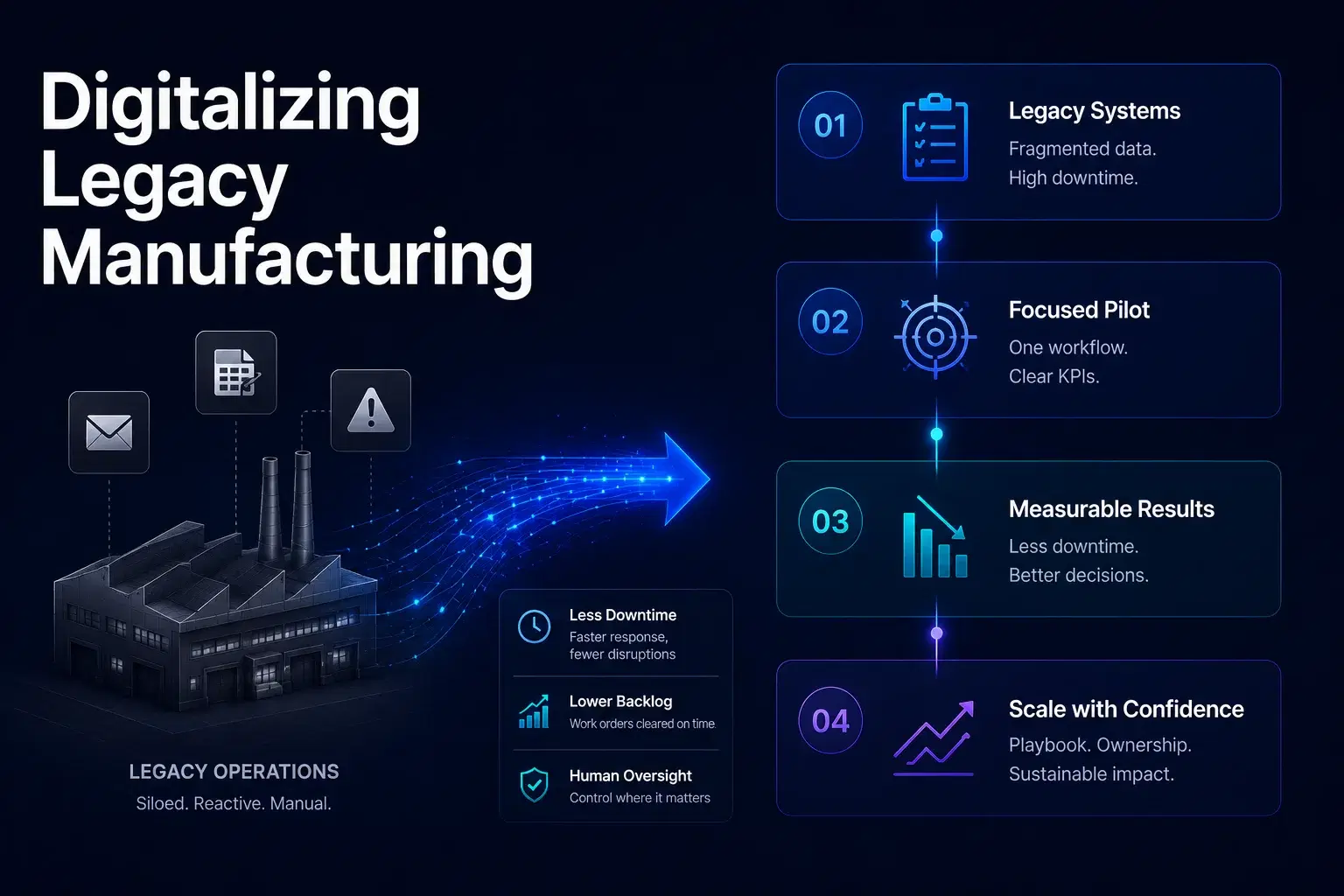
Sixty days is enough for a disciplined pilot—not a full factory transformation. This case study walks through a safer rollout model: one high-frequency workflow, clear KPIs, and human oversight at every risky step.
Related work
Production builds that connect to this topic—open a case study or jump to our portfolio.

This case study is a composite based on patterns we see in manufacturing digitalization programs: high-frequency operational pain, fragmented data, and leadership pressure to ‘do AI’ without a clear scope. Names and figures are illustrative; the structure—baseline, pilot, measurement, scale—is what teams can reuse. The goal is a safer rollout model, not a guarantee that every plant can transform in sixty calendar days.
Context: the business problem
A mid-sized manufacturer ran critical workflows across email, spreadsheets, and a legacy MES with limited APIs. Unplanned downtime and expedited maintenance spend were visible in financials, but root causes lived in operational detail: delayed work orders, inconsistent spare parts data, and slow communication between lineside teams and maintenance. Leadership aligned on a sixty-day window to prove measurable improvement on one workflow—not to ‘AI the factory.’
Week 0–2: Baseline metrics and scope
- Selected KPI: unplanned downtime minutes per line per week (primary), maintenance backlog age (secondary).
- Mapped data sources: CMMS export, shift logs, and sensor feeds where available.
- Chose one pilot: predictive alerts for three high-impact rotating assets with historical failure notes.
Week 2–4: Data preparation and orchestration design
Engineers labeled past incidents and near-misses so models could learn domain-specific patterns—not only generic vibration thresholds. Orchestration was explicit: alert → recommended action → CMMS draft work order → technician acknowledgment. No autonomous purchase orders; human approval remained mandatory for spend.
Week 4–8: Pilot rollout and daily feedback
Technicians rated alerts (true/false/nuisance) in the CMMS UI. False positives dropped week-over-week as thresholds tuned. Leadership reviewed a weekly dashboard: downtime minutes, alert precision, and time saved in triage—not model accuracy in isolation.
| Metric | Baseline (4-wk avg) | Pilot (4-wk avg) | Notes |
|---|---|---|---|
| Unplanned downtime (min/line/wk) | 120 | 78 | Early wins from faster triage |
| Mean backlog age (days) | 9.5 | 6.2 | Fewer stuck requests |
| Alert precision (tech-rated) | — | 72% | Improving with labels |
Day 60 and beyond: scale criteria
Scale only with a documented playbook: data contracts, on-call ownership, and regression tests for model/tool changes. The next tranche expanded to additional assets and integrated spare parts availability—incremental value without boiling the ocean.
Start with a workflow review
Silicon Tech Solutions helps teams ship operational digitalization with realistic scope: integrations, data pipelines, and AI where it earns its place. If you want a similar assessment for your environment, book a working session—we’ll focus on one workflow, baseline KPIs, and a path to measurable impact.
Frequently asked questions
Related articles
Plan your next build with us
Book a working session to review workflows, integrations, or AI architecture—or send a message and we'll respond within one business day.