
Strategic Foundations
The Hyperautomation Playbook: Combining RPA, AI Agents, and Process Mining
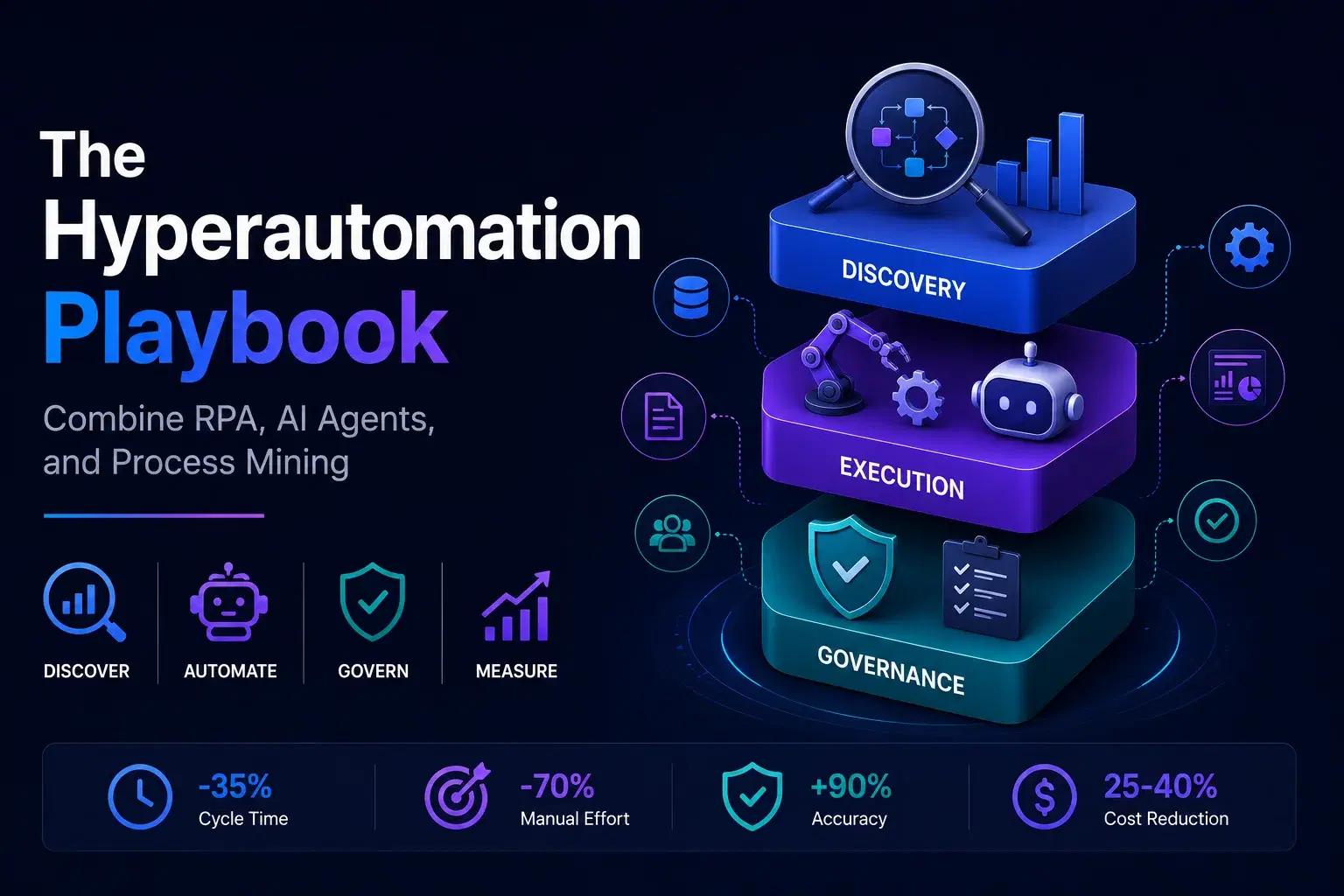
Hyperautomation is not a product—it is a discipline. Organizations that combine process mining, RPA, and AI agents under a governance model consistently outperform those deploying tools in isolation.
Related work
Production builds that connect to this topic—open a case study or jump to our portfolio.


Gartner projects the hyperautomation market will reach $26 billion by 2026, driven by organizations that finally move beyond deploying individual RPA bots toward a coordinated automation portfolio. Hyperautomation—Gartner's term for the disciplined, organization-wide identification and automation of as many business processes as possible—succeeds when it is a governance practice, not just a tool purchase. This playbook defines how to build the discipline, not just the tech stack.
What hyperautomation actually means (entity definitions)
- Hyperautomation: the strategic application of an integrated set of automation tools—RPA, AI, process mining, low-code, and APIs—across the enterprise, governed by a repeatable framework for identifying, prioritizing, and scaling automation.
- Process mining: AI-driven analysis of event log data from ERP, CRM, and BPM systems to surface actual process flows (as-is), identify deviations, and quantify automation opportunity.
- Task mining: video or interaction capture on employee desktops to map manual steps that do not appear in system logs—the 'last mile' of process discovery.
- Automation Center of Excellence (CoE): the organizational function that owns standards, tooling choices, governance, and capability building for automation initiatives across business units.
- Digital process automation (DPA): orchestration platforms that combine workflow, forms, rules, and integrations—higher level than RPA, lower integration complexity than custom development.
Why organizations fail at hyperautomation (and how to avoid it)
| Failure mode | Root cause | Fix |
|---|---|---|
| RPA bot maintenance debt | Bots built without stable APIs, brittle UI selectors | Prioritize API-first integrations; standardize bot architecture |
| AI pilots that never scale | No governance for production deployment, no evaluation harness | Define production checklist before pilot approval |
| Process mining insights ignored | Mining team and operations team operate in silos | Embed process analysts in business unit improvement sprints |
| Shadow automation | Business units build automations without IT oversight | Create a citizen developer program with guardrails |
| ROI measurement failure | No baseline KPIs before automation launch | Mandate baseline measurement as intake gate |
The three-layer hyperautomation architecture
Mature hyperautomation programs operate across three layers that reinforce each other: (1) Discovery layer—process and task mining surfaces automation opportunities from actual system event logs and desktop recording, without relying on self-reported pain points; (2) Execution layer—RPA handles deterministic UI/API automation, AI agents handle exception-heavy and judgment-required workflows, DPA platforms orchestrate multi-step approvals and forms; (3) Governance layer—automation portfolio management, ROI tracking, bot health monitoring, and CoE standards that keep the portfolio maintainable.
Building an Automation Center of Excellence
- Define the CoE mandate: intake process, tool governance, standards library, and escalation path—before approving any new automation.
- Staff for sustainability: developers, process analysts, a security/compliance lead, and an operations owner who monitors bot health in production.
- Create the automation pipeline: intake form → feasibility assessment (complexity, expected ROI, data requirements) → prioritized backlog.
- Standardize the tech stack: pick one RPA platform, one AI agent framework, one DPA tool—avoid per-department tool sprawl that destroys knowledge transfer.
- Measure what matters: operational KPIs (throughput, error rate, SLA adherence) per automated process, not bot run count.
Connecting RPA and AI agents: the handoff patterns
RPA and AI agents are complementary, not competitive. The most productive pattern is: RPA bots handle the stable, rules-based endpoints of a process (fetch the invoice from the portal, post the journal entry to ERP), while AI agents handle the dynamic middle (extract line items from a messy PDF, classify the vendor correctly, decide whether to route for approval or auto-approve within policy). The integration point is a clean API or message queue contract between the RPA orchestrator and the AI agent service.
| Stage | RPA role | AI agent role |
|---|---|---|
| Invoice processing | Download from portal, post to ERP | Extract fields from non-standard PDF, validate against PO, flag exceptions |
| Customer service | Update CRM record, send template email | Classify intent, draft personalized response, route to correct team |
| HR onboarding | Provision accounts in IT systems | Parse job offer document, fill onboarding forms, schedule induction sessions |
| Compliance checks | Pull regulatory reports from portals | Identify deviations from policy, generate draft exception report |
Measuring hyperautomation ROI: the right metrics
Gartner recommends measuring hyperautomation ROI on three dimensions: (1) efficiency—cycle time reduction, exception rate, manual effort avoided; (2) resilience—error rate, rework cost, SLA performance; (3) scale—automation coverage (percentage of total process volume handled by automation vs. humans). Aggregate these into a portfolio dashboard reviewed quarterly by CoE leadership—not just a per-bot runtime dashboard.
\text{Automation ROI} = \frac{(\text{Manual cost baseline} - \text{Automated cost}) - \text{Build + Maintain}}{\text{Build + Maintain}} \times 100\%How Silicon Tech Solutions helps
We design and implement hyperautomation programs for enterprises across manufacturing, financial services, logistics, and professional services: process mining engagements, RPA-to-AI migration strategies, CoE setup, and production-grade automation engineering. If you want a realistic roadmap from 'fragmented bots' to 'governed automation portfolio,' book a working session with our team.
Frequently asked questions
Related articles
Decision Framework
The 2026 AI Agent Trends Report: What Enterprises Need to Know
Agents are becoming the default interaction layer for complex work—but only organizations that govern data, workflows, and accountability will capture the upside.
11 min read · Enterprise AI & Automation
Decision Framework
Calculating the ROI of AI Agents: Beyond Headcount Reduction
ROI framed only as ‘fewer people’ invites resistance and misses the point. The defensible story is faster cycle times, higher throughput, and fewer errors on work that already exists.
12 min read · Enterprise AI & Automation
Strategic Foundations
The Economic Reality: What AI Agents Actually Cost at Scale
Transparency builds trust. Here is a practical cost model for AI agents at scale—plus the LaTeX-style ROI framing CFOs expect in 2026.
12 min read · Enterprise AI & Automation
Strategic Foundations
Solving the Integration Crisis: Connecting AI Agents to Legacy ERPs (SAP/Oracle)
Enterprise AI fails in the integration layer. Here is a practical approach to ERP-connected agents: boundaries, middleware discipline, and secure access to systems of record.
15 min read · Enterprise AI & Automation
Strategic Foundations
Transitioning from Traditional RPA to Autonomous AI Agent Workflows
RPA excels at deterministic repetition; AI agents excel when rules are fuzzy, context shifts, and exceptions are the norm—if you engineer reliability on top.
13 min read · Enterprise AI & Automation
Plan your next build with us
Book a working session to review workflows, integrations, or AI architecture—or send a message and we'll respond within one business day.