
Technical Implementation
Model Context Protocol (MCP) and the Future of Cross-Platform Agentic Workflows
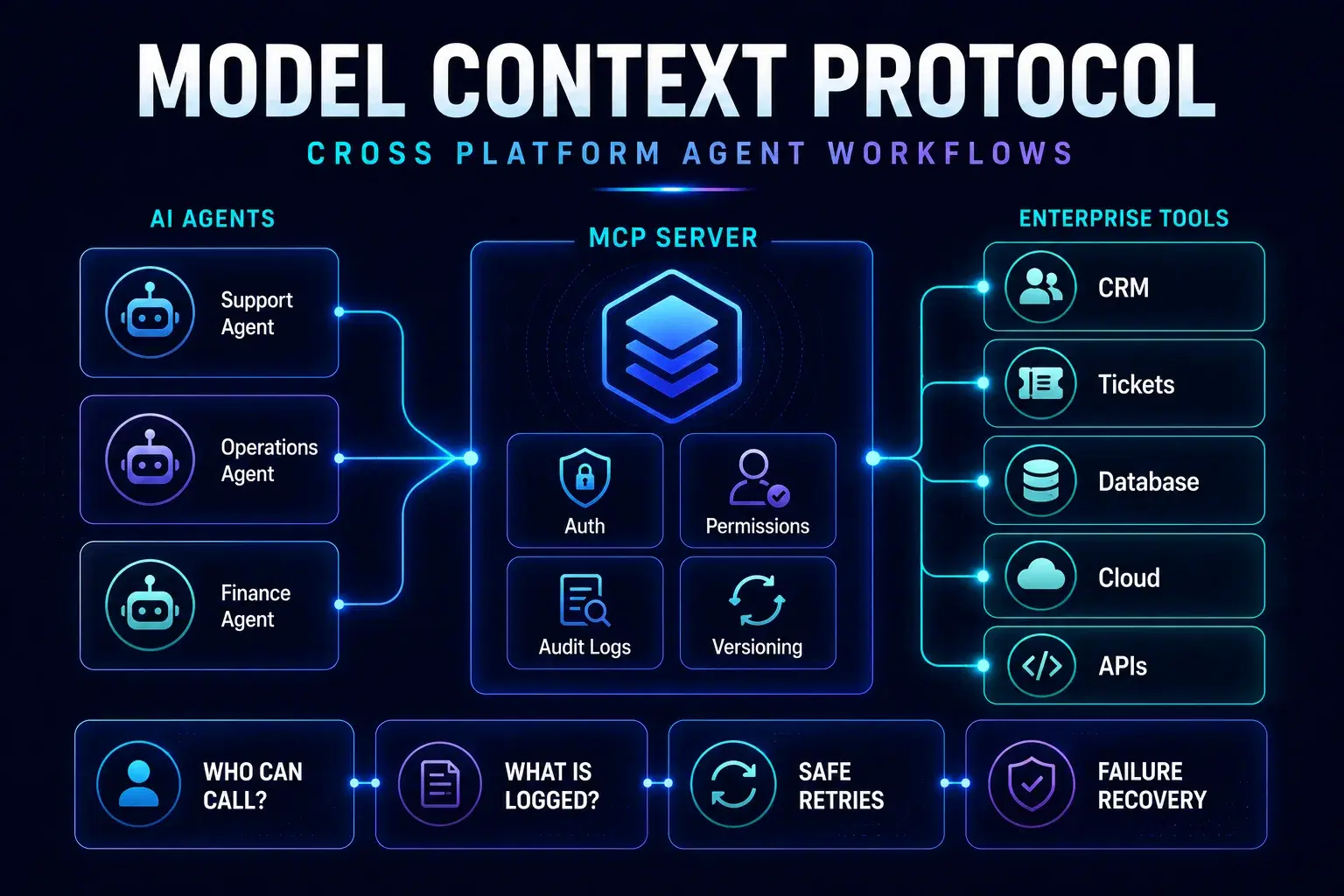
Agents need more than a model—they need governed access to systems of record. MCP-style standards are about composable, auditable connections instead of one-off integration spaghetti.
Related work
Production builds that connect to this topic—open a case study or jump to our portfolio.

Large language models do not magically know your tickets, orders, or databases. They need tools—and enterprises need those tools to be consistent, permissioned, and observable. The Model Context Protocol (MCP) has emerged as a practical pattern for exposing capabilities to agents in a structured way: think “USB-C for agent tools,” reducing bespoke glue code every time a new assistant ships.
What MCP solves (conceptually)
- A standard way to advertise tools, resources, and prompts to a host application.
- Separation between the model host and the integrations that perform side effects.
- A path to centralized security review: approve an MCP server once, reuse across workflows.
Enterprise MCP servers: what “good” looks like
Production servers enforce authentication, least privilege, rate limits, and structured error surfaces. They log who invoked which tool with which arguments—aligned to audit requirements. They are versioned like APIs: breaking changes require migration notes, not silent Friday surprises.
Security: agents amplify integration risk
Any tool that reads or writes business data is an attack surface—prompt injection can try to exfiltrate via tools, and over-powered credentials can enable mass export. Design with scoped tokens, human approvals for destructive operations, and output filtering when tools return sensitive fields.
Agent-to-agent (A2A) and orchestration
Cross-platform workflows often combine multiple agents and services: scheduling, retrieval, execution, verification. Clear contracts between agents—inputs, outputs, failure modes—matter more than the buzzword count. Orchestration layers should be explicit about state, retries, and where humans enter the loop.
| Question | Why it matters |
|---|---|
| Who may call this tool? | AuthZ boundaries |
| What is idempotent? | Safe retries |
| What is logged? | Audit and debugging |
| What happens on partial failure? | User trust and recovery |
How we help
Silicon Tech Solutions builds integrations and agent platforms for real enterprises. If you are standardizing how agents connect to your stack, we can help you design MCP-aware services with security and maintainability first.
Frequently asked questions
Related articles
Engineering Decisions That Become Expensive Later
Building Production Multi-Agent Systems: LangChain, LangGraph, and LangSmith Explained
Single prompt completions work for toy demos, but running multi-agent workflows in production requires deterministic state machines, durable checkpointers, and distributed tracing. Learn how the LangChain, LangGraph, and LangSmith triad powers reliable enterprise AI.
15 min read · AI Engineering & Architecture
Technical Implementation
Democratizing Data: Natural Language Queries for Business Intelligence
Letting everyone ‘ask anything’ without governance creates wrong answers at scale. The best programs pair natural language with metrics definitions, permissions, and validation—not raw database chat.
12 min read · AI Engineering & Architecture
Technical Implementation
The RAG Architecture Guide for Enterprise AI Search
RAG is not “dump documents into a vector DB.” It is information architecture: entities, freshness, permissions, and factual density so models retrieve the right evidence every time.
15 min read · AI Engineering & Architecture
Technical Implementation
Breaking the “Pilot Fallacy”: Scaling AI Agents from Sandbox to Production
An 80% success rate wins a demo and loses a production rollout. Scaling agents requires the same discipline as any mission-critical software—plus new tooling for nondeterminism and abuse.
14 min read · AI Engineering & Architecture
Plan your next build with us
Book a working session to review workflows, integrations, or AI architecture—or send a message and we'll respond within one business day.