
The Hard Parts of Building...
The Hard Parts of Building FinTech Products: Compliance, Payments, Security & Scale
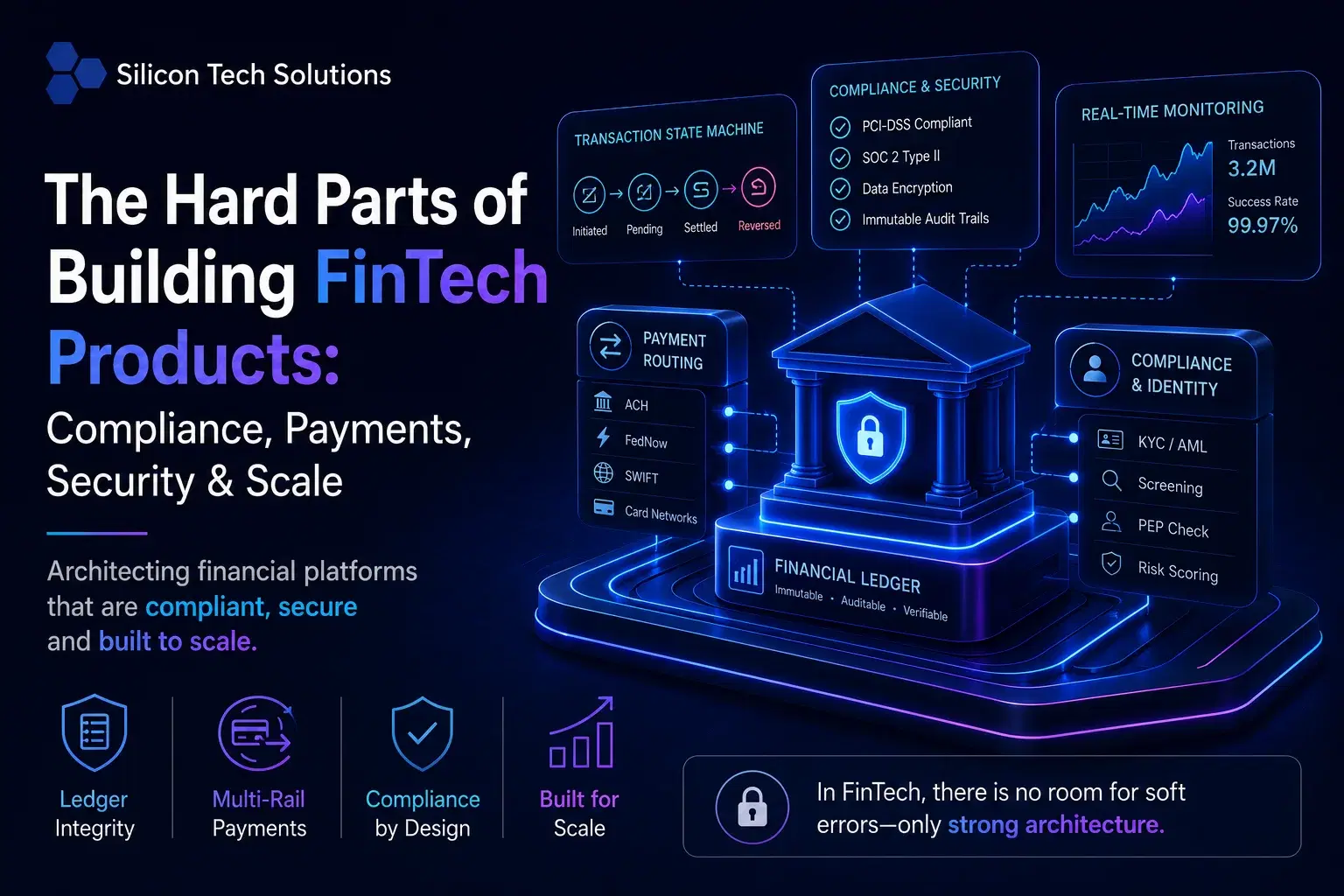
In FinTech software engineering, there is zero tolerance for eventual consistency or soft errors. Learn how to architect financial platforms for strict compliance, ledger integrity, and immutable audit trails.
Related work
Production builds that connect to this topic—open a case study or jump to our portfolio.


When building a standard SaaS product, an unexpected database deadlock or an unhandled edge case usually results in a refreshed page or a minor user inconvenience. In FinTech product engineering, an edge case results in lost capital, regulatory fines, revoked banking partner licenses, or irreversible ledger corruption.
Many early-stage founders assume FinTech development revolves around integrating payment processors like Stripe or Plaid. However, modern payment APIs have made moving money relatively simple. The hard part—the engineering domain that separates sustainable financial platforms from fragile wrappers—is managing state consistency, immutable record-keeping, multi-rail settlement delays, and strict regulatory isolation.
The Four Architectural Pillars of FinTech Engineering
To build a platform that survives enterprise security audits, due diligence, and high-volume transaction loads, engineering leadership must solve four interconnected architectural challenges from day one.
| Engineering Pillar | The Common Amateur Shortcut | The Enterprise Architecture Standard |
|---|---|---|
| Ledger Design | Updating a single `balance` column in a relational user record. | Immutable, append-only double-entry ledger with cryptographic verification. |
| Payment Routing | Synchronous API calls assuming instant finality on payment attempts. | Asynchronous state machines handling multi-stage pending, settled, and reversed states. |
| Compliance & Identity | Hardcoding third-party KYC vendor workflows directly into core auth endpoints. | Decoupled identity state pipelines with isolated PII tokenization vaults. |
| System Resilience | Standard database transactions without distributed locking or idempotency keys. | Deterministic idempotency layers combined with distributed lock managers (e.g., Redis/Redlock). |
1. Ledger Integrity: Why Simple Database Balances Fail
The most catastrophic technical debt in FinTech is storing account balances as a mutable scalar value (e.g., `account.balance = 500.00`). If two microservices attempt to debit the account simultaneously, race conditions inevitably corrupt the balance.
Enterprise financial products rely on immutable, append-only double-entry ledgers. In this model, balances are never directly updated. Every movement of value consists of at least one debit entry and one credit entry across distinct system accounts, where the total sum of debits must equal the total sum of credits ($$\sum \text{Debits} = \sum \text{Credits}$$).
2. Payments & Settlement: Managing Asynchronous Reality
Cards, ACH, FedNow, Wire, and SWIFT operate on vastly different settlement timetables. While a real-time rail may give instantaneous confirmation, traditional rails like ACH can take up to three business days to return a failure or chargeback.
To prevent double-spending and phantom balances, payment orchestrators must be structured as explicit Finite State Machines (FSM). Money must transition cleanly through states—such as `Initiated`, `Pending_Settlement`, `Settled`, `Failed`, and `Disputed`—with strict state locks preventing funds from being re-allocated prematurely.
- Are all payment webhook handlers enforcing strict idempotency keys to prevent duplicate processing?
- Does your system maintain pending ledger holds distinct from settled balances?
- Are out-of-order webhook notifications re-ordered deterministically via event timestamps?
- Is there automated reconciliation matching bank statement files (BAI2/MT940) against internal ledgers daily?
3. Security & Compliance: Engineering for SOC 2, PCI-DSS & KYC/AML
Enterprise financial buyers and partner banks will audit your data architecture before granting production API access. Scattering Personally Identifiable Information (PII) or raw payment data across standard database tables guarantees an audit failure.
High-performing teams decouple sensitive data into tokenized data vaults. The primary application database stores non-sensitive surrogate tokens, while the actual encrypted PII is isolated within a restricted, zero-trust microservice perimeter.
- Zero-Trust Data Vault
- An isolated architectural enclave designed to store sensitive customer data (SSNs, account numbers) using field-level encryption, where decryption keys are injected strictly at runtime under zero-trust authorization policies.
4. System Resilience & Idempotency: Handling Network Failure
In financial systems, a network timeout during an outbound banking API call is an ambiguous state: did the transaction fail to reach the server, or did it process successfully while the response dropped on the return path?
FinTech engineers solve this by designing idempotent systems end-to-end. Every transactional payload carries a unique client-generated idempotency key. If a client retries a timed-out request three times, the backend recognizes the key, suppresses duplicate execution, and returns the identical cached result of the initial operation.
Building financial software is not about preventing every network failure—it is about ensuring that when failures occur, the system safely defaults to a deterministic, fully auditable state.
Frequently asked questions
Related articles
Vertical Deep-Dives
AI-Powered Financial Close: Automating Month-End for Finance Teams
Finance teams lose 3–5 days every month to manual reconciliations and journal entry preparation that could be automated. AI agents close that gap—if the data architecture and controls are right.
14 min read · Fintech & Banking
Vertical Deep-Dives
Building an AI-Native Neobank: Architecture, Compliance, and Scale
Neobanks that win in 2026 are not 'apps on top of legacy rails'—they are AI-native systems where credit decisions, fraud detection, and customer service run autonomously within governed frameworks.
15 min read · Fintech & Banking
Vertical Deep-Dives
Embedded Finance and Agentic Payments: Building Fintech Infrastructure in 2026
Embedded finance is no longer a banking add-on—it is a product strategy. In 2026, agentic AI makes real-time credit decisions, initiates payments, and manages compliance without manual intervention.
16 min read · Fintech & Banking
Vertical Deep-Dives
Financial Services 2.0: Automating KYC and Fraud Triage with Agentic AI
Banks and fintechs need speed and scrutiny at once. The winning stack pairs anomaly detection with explainable workflows, immutable logs, and humans who set policy—not click every alert.
14 min read · Fintech & Banking
Plan your next build with us
Book a working session to review workflows, integrations, or AI architecture—or send a message and we'll respond within one business day.