
Engineering Decisions That Become Expensive Later
Building Production Multi-Agent Systems: LangChain, LangGraph, and LangSmith Explained
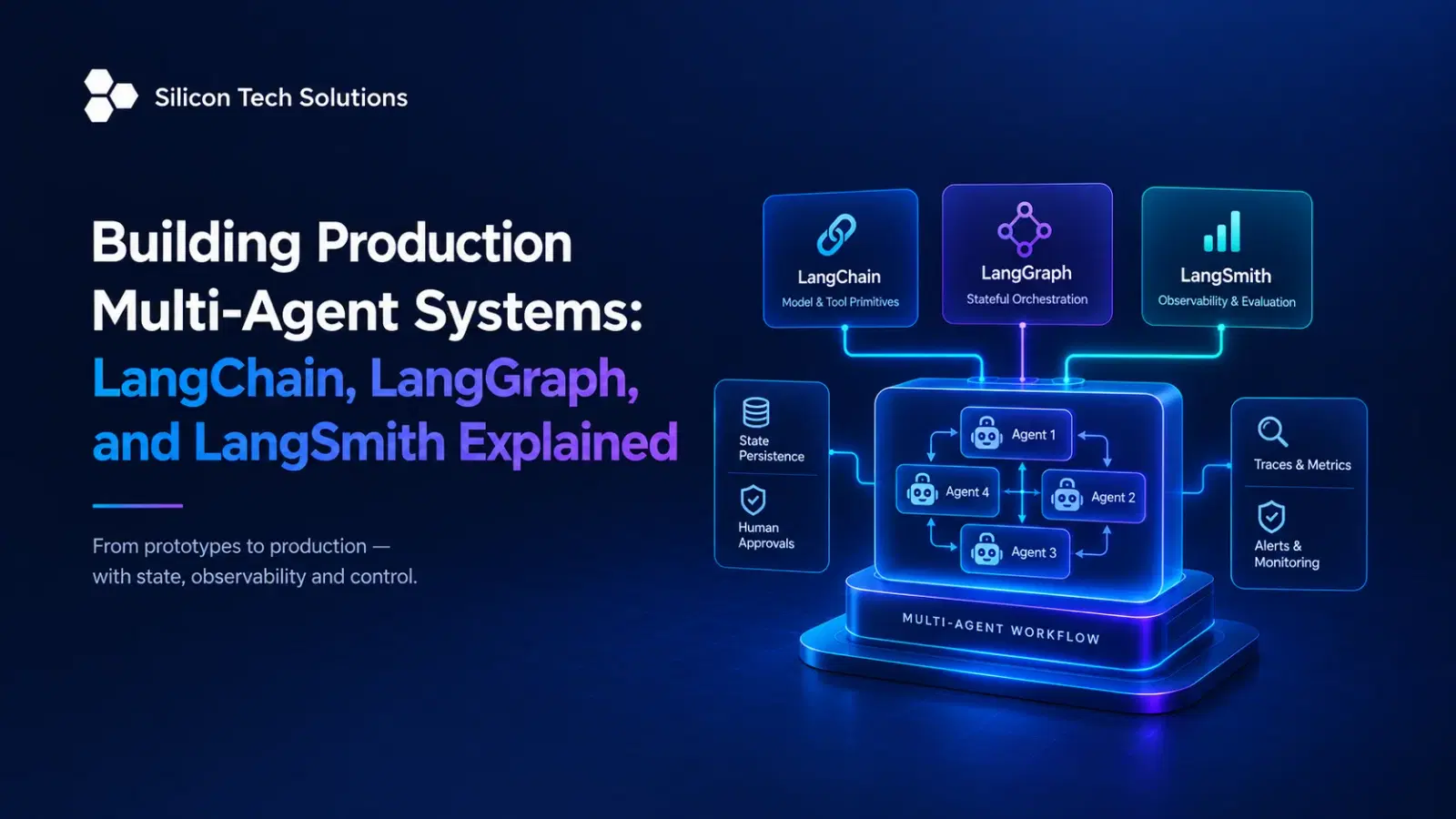
Single prompt completions work for toy demos, but running multi-agent workflows in production requires deterministic state machines, durable checkpointers, and distributed tracing. Learn how the LangChain, LangGraph, and LangSmith triad powers reliable enterprise AI.
Related work
Production builds that connect to this topic—open a case study or jump to our portfolio.

The initial wave of generative AI applications centered on a single pattern: format a prompt, fetch context via retrieval, call a completion endpoint, and display the output. For basic question-answering, this linear pattern delivers solid results. However, when engineering teams attempt to automate operational workflows—such as multi-stage financial analysis, automated loan underwriting, or insurance claim adjudication—linear chains fail.
Real enterprise operations require agentic loops: trying a task, inspecting the tool output, catching formatting errors, and retrying. They also demand hard governance: no autonomous system should execute bank transfers or email binding agreements without human sign-off. Moving beyond brittle demos requires an architectural triad: LangChain for primitives, LangGraph for state-machine orchestration, and LangSmith for deep observability.
The Compounding Error Trap in Multi-Agent Systems
When early-stage teams build autonomous multi-agent setups, they frequently let agents converse freely in unconstrained group chats. Without explicit boundaries, systems hit an unforgiving mathematical reality: if an individual agent executes its sub-task with an 85% success rate, chaining five unmonitored agents together drops end-to-end reliability to roughly 44% ($$0.85^5 \approx 0.44$$).
The Triad: Primitives, Orchestration, and Observability
Rather than competing libraries, LangChain, LangGraph, and LangSmith serve three distinct architectural roles in an enterprise AI system.
| Component | Mental Model | Primary Architectural Responsibility |
|---|---|---|
| LangChain | The Building Blocks | Unified LLM provider wrappers, prompt templates, structured output parsers, and tool schemas. |
| LangGraph | The Conductor | Cyclic state machines, strongly typed schemas, persistent checkpointers, and human-in-the-loop gates. |
| LangSmith | The Control Tower | Hierarchical parent-child tracing, step-level latency tracking, token spend auditing, and automated evals. |
1. LangChain: Standardizing the Primitives
At the foundation, LangChain abstracts away the low-level mechanics of working with diverse foundational models and external APIs. Instead of writing custom HTTP wrappers for every provider or manually formatting tool payloads, LangChain standardizes how tools, prompts, and parsers interact.
Its true production power lies in Pydantic output parsing. By enforcing strict schemas on model responses, LangChain ensures that when an LLM chooses to invoke a search endpoint or database mutation, the payload conforms to exact parameter types before any external system is called.
2. LangGraph: Enforcing Deterministic Multi-Agent State
While LangChain handles individual steps, LangGraph orchestrates how those steps execute over time. It reframes agentic workflows as explicit computation graphs featuring three core capabilities:
StateGraphs and Centralized Typed State
Rather than passing an unstructured chat thread between models, LangGraph relies on a centralized `StateGraph` backed by a strongly typed schema. Every node (whether an LLM agent or a deterministic Python function) modifies this shared state using explicit reducer functions. If an agent attempts to return invalid data, the schema blocks the state update before corrupt data propagates downstream.
Persistent Checkpointers (Crash Resilience)
If agent execution state lives purely in server memory, container restarts or network drops discard all progress, forcing costly restarts. LangGraph integrates checkpointers backed by durable storage engines like PostgreSQL or Redis. After every node runs, the state delta is safely committed. If a background worker terminates during step 4, the orchestrator retrieves the snapshot and resumes seamlessly.
Human-in-the-Loop (HITL) via Interrupts
Enterprise clients reject total autonomy for sensitive actions like moving capital, modifying records, or sending client-facing messages. LangGraph provides native `interrupt()` functions that halt execution before high-risk nodes. The state serializes to the checkpointer, waiting hours or days for an administrator to review the proposal on an internal dashboard. Once approved or edited, execution resumes smoothly.
Real-World Architecture: Automated Commercial Underwriting
To see the complete triad in action, consider how a commercial loan underwriting engine operates in production:
- 1. Ingestion Node (LangChain): Custom tools extract balance sheet figures from applicant documents into Pydantic models.
- 2. Risk Analysis Agent (LangGraph): An agent calculates debt-service coverage ratios and updates the central StateGraph.
- 3. Conditional Edge: If credit metrics breach risk thresholds, routing logic diverts to an automated rejection handler.
- 4. Drafting Node: The agent synthesizes proposed loan covenants and repayment structures.
- 5. Interrupt Gate: LangGraph pauses execution; a human loan officer inspects and adjusts terms on an internal portal.
- 6. Dispatch Node (LangChain): Upon human approval, an API tool dispatches binding agreements via DocuSign.
- 7. Observability (LangSmith): The complete trace—from raw document input to final signature—is indexed with token costs and latency.
3. LangSmith: Observability, Tracing, and Evals
When a multi-agent system produces an erroneous result, traditional application logs are unhelpful. They show successful HTTP 200 responses despite the model outputting flawed business logic. LangSmith provides the visibility required to operate multi-agent systems reliably:
- Hierarchical Distributed Tracing: Tracks the root workflow run alongside nested child spans for intermediate scratchpads, model reflections, and tool calls.
- Token and Cost Telemetry: Isolates token consumption per hop, exposing context window bloat before bills escalate.
- Input/Output Schema Diffing: Shows the exact payload sent to each tool to debug why an agent picked the wrong action.
- Automated Offline Evals: Runs continuous regression benchmarks on prompt modifications to evaluate factual grounding and schema compliance.
- StateGraph
- A computational architecture where workflow logic is organized as a network of nodes and conditional edges that mutate a centralized, strongly typed state schema, enabling loops, error recovery, and pause-and-resume execution.
Building production AI is not about discovering a magic prompt. It is about wrapping probabilistic reasoning inside resilient, observable state machines that fail safely and defer to human judgment when the stakes are high.
Frequently asked questions
Related articles
Technical Implementation
Democratizing Data: Natural Language Queries for Business Intelligence
Letting everyone ‘ask anything’ without governance creates wrong answers at scale. The best programs pair natural language with metrics definitions, permissions, and validation—not raw database chat.
12 min read · AI Engineering & Architecture
Technical Implementation
Model Context Protocol (MCP) and the Future of Cross-Platform Agentic Workflows
Agents need more than a model—they need governed access to systems of record. MCP-style standards are about composable, auditable connections instead of one-off integration spaghetti.
13 min read · AI Engineering & Architecture
Technical Implementation
The RAG Architecture Guide for Enterprise AI Search
RAG is not “dump documents into a vector DB.” It is information architecture: entities, freshness, permissions, and factual density so models retrieve the right evidence every time.
15 min read · AI Engineering & Architecture
Technical Implementation
Breaking the “Pilot Fallacy”: Scaling AI Agents from Sandbox to Production
An 80% success rate wins a demo and loses a production rollout. Scaling agents requires the same discipline as any mission-critical software—plus new tooling for nondeterminism and abuse.
14 min read · AI Engineering & Architecture
Plan your next build with us
Book a working session to review workflows, integrations, or AI architecture—or send a message and we'll respond within one business day.