
AI Systems That Move From Prototype to Production
The AI Adoption Gap: From Learning AI to Building With AI
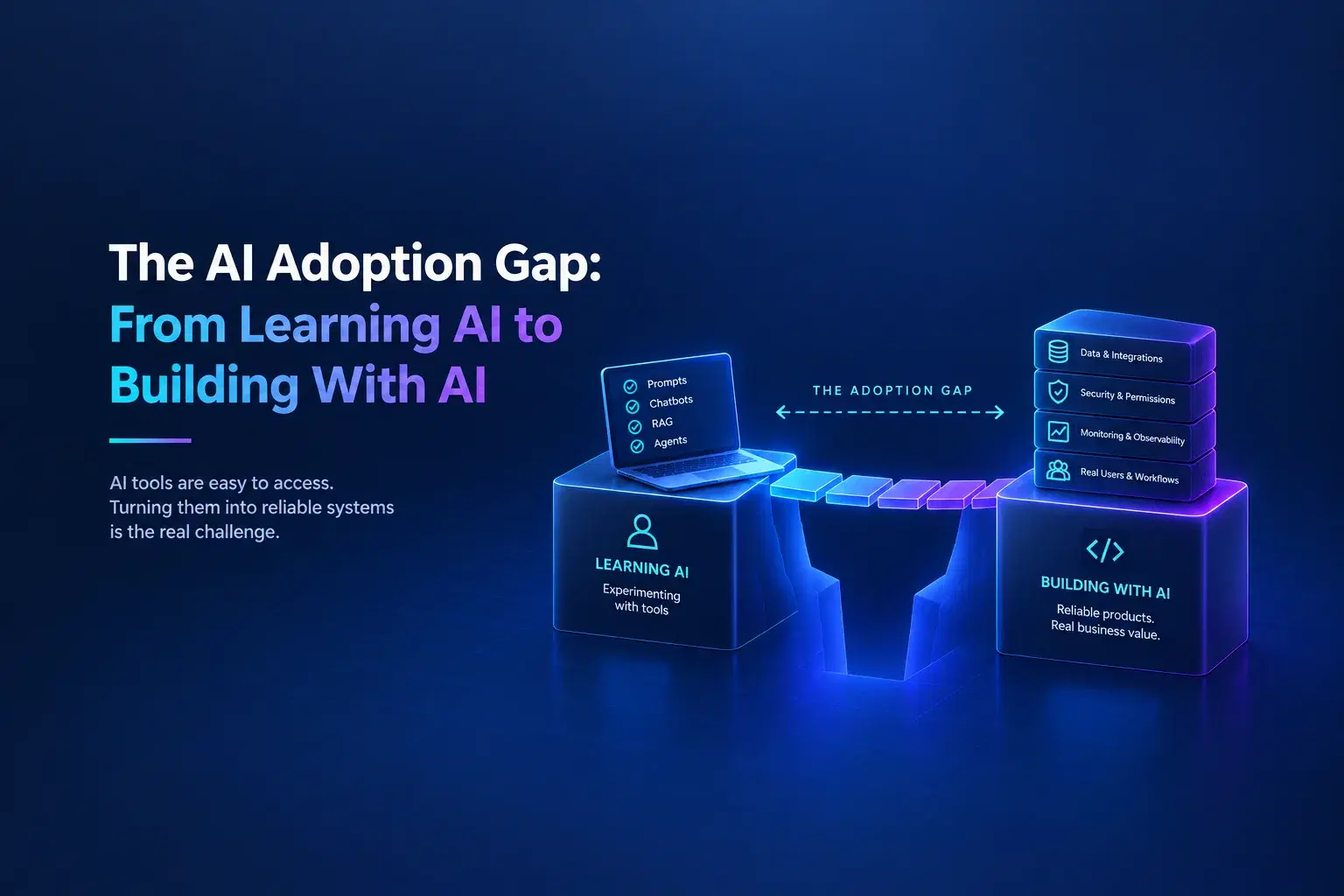
AI tools are becoming easier to access, but the difficult part is no longer getting started. The real challenge is turning AI capabilities into reliable products, workflows, and systems that operate inside real businesses.
Related work
Production builds that connect to this topic—open a case study or jump to our portfolio.
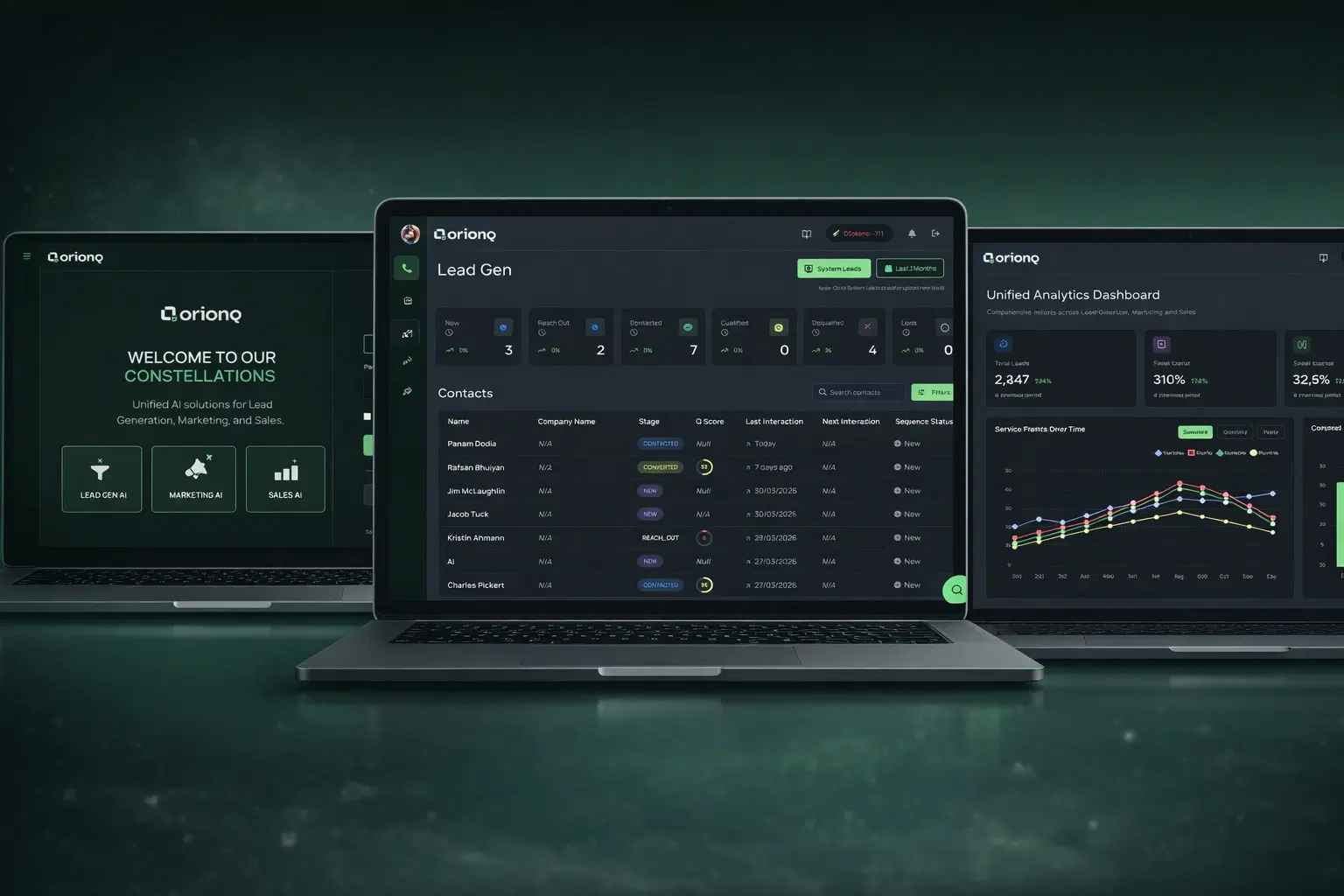

The first phase of the AI wave was largely about access. Developers experimented with APIs. Founders added chatbots to products. Teams learned prompting, retrieval augmented generation, agents, and automation. Businesses began asking what AI could do for them.
That phase is changing quickly. AI capabilities are becoming easier to access, more powerful, and increasingly embedded into everyday software tools. The question is no longer simply whether a team can experiment with AI.
The harder question is: can they actually build something with it that works reliably in production?
The Difference Between Knowing AI and Building With AI
There is an important distinction between AI literacy and AI engineering. Someone can understand prompting, use an AI API, build a RAG prototype, or create an agent workflow without necessarily being able to turn that prototype into a dependable product.
Production software has different requirements. It has users, permissions, databases, APIs, infrastructure, failures, latency requirements, security constraints, operational costs, and business rules.
AI does not remove those engineering problems. It adds another probabilistic component to them.
Where the Real Difficulty Begins
Consider a company building an AI system that reads incoming customer requests, determines the intent, retrieves information from internal systems, decides what action should happen next, and communicates the result to the customer.
The first prototype might be surprisingly simple. Send a prompt, provide some context, receive an answer, and display it.
The production version is a very different system.
| Prototype | Production System |
|---|---|
| Prompt and model response | Model integrated into a larger application workflow |
| Static context | Live business data with access controls |
| One successful response | Retries, fallbacks, validation, and error handling |
| Manual testing | Automated evaluations and regression testing |
| No meaningful monitoring | Tracing, logging, latency, cost, and quality monitoring |
| Unlimited assumptions about model behavior | Explicit boundaries around what the model can and cannot do |
1. AI Still Needs Software Architecture
One of the easiest mistakes in AI product development is treating the model as the product. It is not. The model is one component inside a larger software system.
A production AI application might involve a frontend, backend services, databases, authentication, third-party APIs, queues, background workers, vector stores, model providers, business rules, monitoring systems, and human approval workflows.
The architecture determines how these components interact and, more importantly, what happens when something goes wrong.
Boundaries Matter
LLMs are probabilistic. Software systems generally need predictable behavior. The engineering challenge is therefore to give models enough freedom to reason while keeping critical system behavior inside deterministic boundaries.
For example, an AI agent might recommend that a customer account be suspended. The model should not necessarily be given unrestricted permission to execute that action. The application can instead validate the recommendation against explicit rules and require human approval before making a high-impact change.
2. Integrations Become the Real Work
AI demonstrations often operate in isolation. Businesses do not.
A useful AI system needs access to the systems where the actual work happens: CRM platforms, payment systems, databases, internal APIs, communication tools, document stores, analytics systems, or operational software.
This is where many AI projects become engineering projects.
- Connecting the AI workflow to existing APIs
- Handling authentication and authorization
- Normalizing data from different systems
- Validating model generated tool arguments
- Handling API failures and rate limits
- Managing asynchronous workflows
- Keeping sensitive information isolated
- Maintaining consistency between AI decisions and business rules
The intelligence may come from the model, but the usefulness of the system often comes from everything surrounding it.
3. Reliability Becomes a First-Class Engineering Problem
Traditional software is usually built around deterministic logic. Given the same input, the system is expected to follow defined rules.
AI systems introduce uncertainty. A model may produce a different answer, misunderstand an instruction, choose an unexpected tool, or generate output that does not conform to the expected structure.
That does not make AI unreliable by definition. It means reliability has to be engineered around the model.
- Structured outputs and schema validation
- Retries and fallback strategies
- Explicit workflow states
- Tool permission boundaries
- Confidence thresholds where appropriate
- Human review for high-risk decisions
- Automated evaluations
- Detailed execution traces
4. The Human Layer Does Not Disappear
There is a tendency to describe agentic AI as a path toward completely autonomous software. In many real business environments, the better goal is controlled autonomy.
An AI system can research, classify, summarize, recommend, draft, and prepare actions while still leaving consequential decisions to people.
This creates a more practical architecture: let AI handle the parts where probabilistic reasoning creates leverage, while deterministic software and human approval control the parts where mistakes are expensive.
5. Observability Is Essential Once AI Goes Live
A traditional application can often be debugged by following logs, requests, database queries, and error traces. AI systems require another layer of visibility.
When an AI workflow produces the wrong result, the engineering team needs to understand not only that it failed, but why.
- What input did the model receive?
- What context was retrieved?
- Which model was used?
- What tools did the agent call?
- What arguments did it generate?
- How many retries occurred?
- How much latency and token usage did the workflow consume?
- At which step did the result diverge from the expected behavior?
Without this visibility, improving an AI system becomes guesswork.
The New AI Builder
As AI becomes more accessible, the definition of an effective AI builder is changing.
The valuable skill is no longer simply knowing how to call a model API. It is understanding how AI fits into a larger product and engineering system.
| Capability | Why It Matters |
|---|---|
| AI fundamentals | Understand what models can and cannot reliably do |
| Product thinking | Identify where AI actually creates value for users |
| Software engineering | Build reliable services around AI capabilities |
| System architecture | Design how models interact with data, tools, and applications |
| Data engineering | Make the right information available to the system |
| Security | Protect users, data, credentials, and system actions |
| Observability | Understand system behavior and diagnose failures |
| Business understanding | Connect technical capabilities to measurable outcomes |
From AI Skills to AI Execution
The AI ecosystem is doing an important job by making AI knowledge more accessible. More developers, founders, operators, and businesses are learning what these systems can do.
The next challenge is execution.
Can a team take an AI capability and turn it into a product that customers can depend on? Can it connect the system to real business infrastructure? Can it handle failures? Can it measure quality? Can it control what the AI is allowed to do? Can it maintain the system six months after launch?
Those questions move the conversation from AI experimentation to AI engineering.
What Comes Next
The next generation of AI products will not be defined only by which models they use. Many teams will have access to similar models and similar APIs.
The differentiation will increasingly come from what teams build around those models: better workflows, better data, stronger integrations, tighter system boundaries, better product decisions, and more reliable execution.
The opportunity is therefore bigger than learning AI. It is learning how to build with it.
The next AI advantage will not come from simply knowing what AI can do. It will come from knowing how to turn that capability into software that people and businesses can actually depend on.
Frequently asked questions
Related articles
Engineering Decisions That Become Expensive Later
Building Production Multi-Agent Systems: LangChain, LangGraph, and LangSmith Explained
Single prompt completions work for toy demos, but running multi-agent workflows in production requires deterministic state machines, durable checkpointers, and distributed tracing. Learn how the LangChain, LangGraph, and LangSmith triad powers reliable enterprise AI.
15 min read · AI Engineering & Architecture
Technical Implementation
Democratizing Data: Natural Language Queries for Business Intelligence
Letting everyone ‘ask anything’ without governance creates wrong answers at scale. The best programs pair natural language with metrics definitions, permissions, and validation—not raw database chat.
12 min read · AI Engineering & Architecture
Technical Implementation
Model Context Protocol (MCP) and the Future of Cross-Platform Agentic Workflows
Agents need more than a model—they need governed access to systems of record. MCP-style standards are about composable, auditable connections instead of one-off integration spaghetti.
13 min read · AI Engineering & Architecture
Technical Implementation
The RAG Architecture Guide for Enterprise AI Search
RAG is not “dump documents into a vector DB.” It is information architecture: entities, freshness, permissions, and factual density so models retrieve the right evidence every time.
15 min read · AI Engineering & Architecture
Technical Implementation
Breaking the “Pilot Fallacy”: Scaling AI Agents from Sandbox to Production
An 80% success rate wins a demo and loses a production rollout. Scaling agents requires the same discipline as any mission-critical software—plus new tooling for nondeterminism and abuse.
14 min read · AI Engineering & Architecture
Plan your next build with us
Book a working session to review workflows, integrations, or AI architecture—or send a message and we'll respond within one business day.