
Engineering Decisions That Become Expensive Later
Engineering Activity Is Not Product Progress
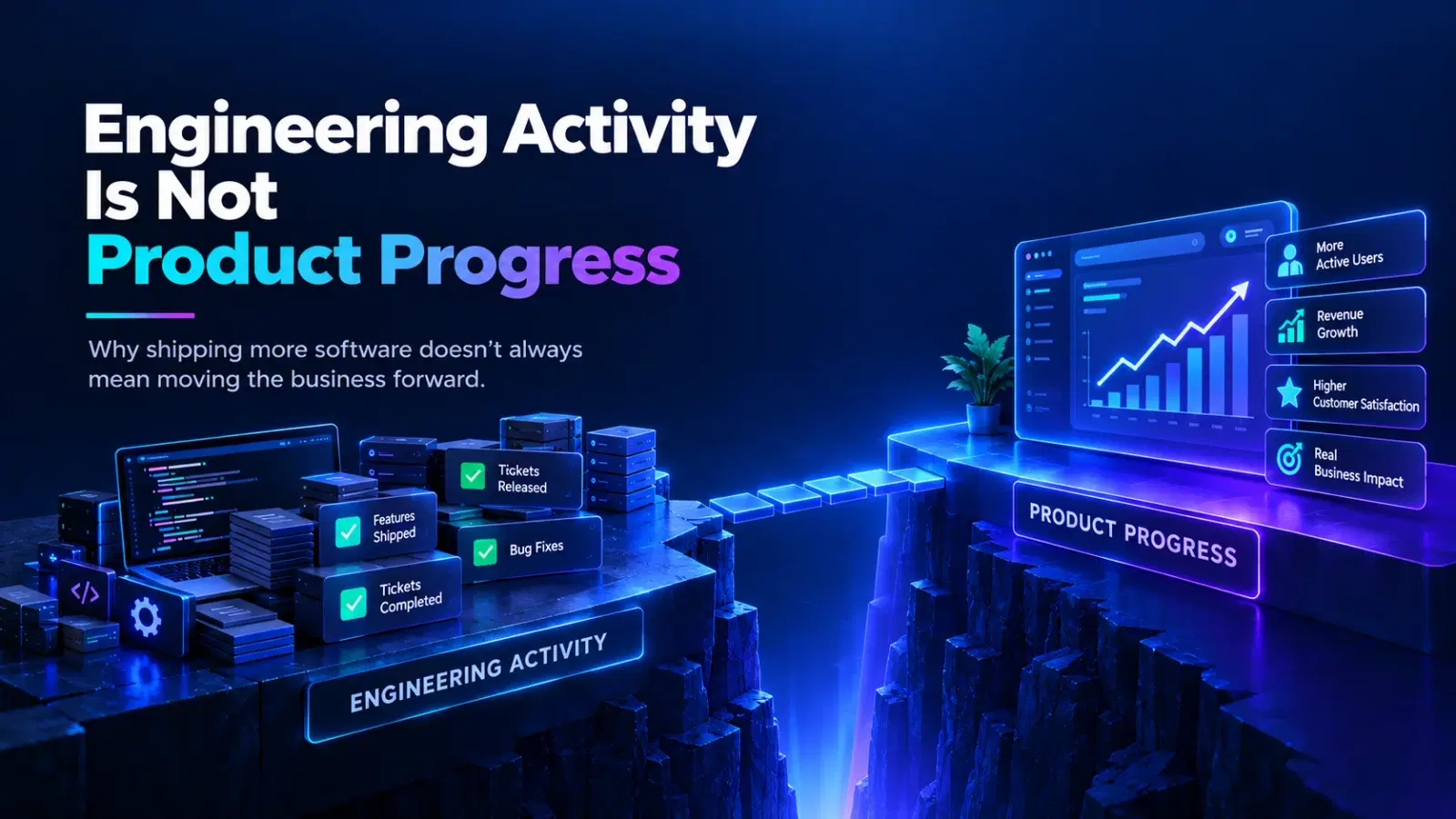
A busy engineering team can create plenty of activity without creating meaningful progress. For startups, the real challenge is connecting product decisions, engineering execution, and business outcomes.
Related work
Production builds that connect to this topic—open a case study or jump to our portfolio.


A startup can have developers working every day, a full product roadmap, weekly releases, hundreds of completed tickets, and a constantly growing codebase and still not be making meaningful progress.
That sounds counterintuitive because software development produces visible output. Features get shipped. Pull requests get merged. Bugs get closed. New versions go live.
But output is not the same thing as progress.
The more important question for a startup is not simply, 'What did engineering build this week?' It is, 'What became possible for the business because engineering built it?'
The Feature Factory Problem
One of the easiest ways for a startup to lose sight of progress is to turn its product roadmap into a list of features.
A typical roadmap might say:
- Build customer dashboard
- Add payment integration
- Create mobile application
- Add reporting
- Build notification system
- Add admin panel
- Integrate CRM
There is nothing inherently wrong with any of these projects. The problem appears when the team loses the connection between each item and the reason it matters.
Why are we building the dashboard? Is the goal to reduce support requests? Improve activation? Give customers visibility into their account?
Why are we adding the payment integration? Is it blocking revenue? Reducing manual operations? Increasing conversion?
Without those connections, engineering can become a feature factory: consistently producing software without a clear understanding of the business outcome that software is supposed to create.
Start With the Outcome, Not the Ticket
A stronger engineering process starts one level above the feature.
| Weak Framing | Outcome Driven Framing |
|---|---|
| Build a customer dashboard | Reduce customer support requests by giving customers self serve visibility |
| Add payment integration | Allow customers to complete purchases without manual intervention |
| Build reporting | Give operators the information needed to identify problems before they affect customers |
| Build mobile application | Make the core workflow accessible in the environment where target users actually operate |
| Add automation | Remove a repetitive operational process that is limiting the team's capacity |
The technical work may eventually look similar, but the second framing changes how the team makes decisions.
Engineering Needs Business Context
Engineers make better technical decisions when they understand what the business is trying to accomplish.
Consider two products that both need a new workflow.
For the first company, the workflow is experimental. The goal is to validate demand with a small group of users.
For the second, the workflow is already central to revenue and needs to support thousands of customers.
The engineering approach should not be identical.
The first company may benefit from a deliberately lightweight implementation that allows rapid learning. The second may need stronger architecture, observability, security, testing, and infrastructure from the beginning.
Without business context, engineers are forced to make these decisions with incomplete information.
Speed Is Not Free
Startup teams are constantly told to move faster. Often, that advice is correct. Early companies need to learn quickly, test assumptions, and avoid spending months building something nobody wants.
But speed is not the same as rushing.
There is a difference between reducing unnecessary work and skipping important engineering decisions.
| Move Faster By | Avoid |
|---|---|
| Reducing unnecessary scope | Skipping security fundamentals |
| Shortening feedback cycles | Ignoring architecture that affects core workflows |
| Building the smallest useful version | Creating fragile foundations around critical data |
| Automating repetitive work | Removing necessary testing and validation |
| Making decisions with available evidence | Making permanent technical decisions without understanding the problem |
Good engineering execution is not about maximizing speed at any cost. It is about reducing the time between a business question and a reliable answer.
Technical Debt Is Sometimes Rational
Technical debt is often presented as something that should always be avoided. That is too simplistic.
A startup may intentionally choose a simpler implementation because it needs to validate a market assumption first. That can be a perfectly reasonable decision.
The problem is not taking on technical debt. The problem is taking it on without knowing why, or allowing temporary decisions to become permanent architecture.
Every shortcut should have an economic or strategic reason behind it.
- What are we trying to learn?
- How important is this system to the business?
- How long do we expect this implementation to last?
- What will happen if usage grows significantly?
- What will it cost to replace later?
- What signals will tell us it is time to improve it?
The Engineering Metrics That Matter
Traditional engineering metrics can be useful, but they should not become the definition of progress.
| Activity Metric | Better Question |
|---|---|
| Tickets completed | What customer or business problem did those tickets solve? |
| Features shipped | What changed for the user? |
| Lines of code | Did the system become more capable or maintainable? |
| Release frequency | Are we learning and improving faster? |
| Development hours | Did those hours create meaningful business value? |
This does not mean engineering metrics are useless. It means they should remain connected to product and business metrics rather than existing in isolation.
A Better Connection Between Strategy and Engineering
For startups, the connection can be surprisingly simple.
- 1. Define the business outcome.
- 2. Identify the customer or operational problem behind it.
- 3. Determine what needs to change in the product.
- 4. Define the smallest useful technical solution.
- 5. Identify the engineering decisions that should not be compromised.
- 6. Ship and observe what happens.
- 7. Use the results to decide what to build next.
This creates a feedback loop between business strategy and engineering execution.
The Role of Technical Ownership
This is one reason technical ownership becomes increasingly important as a startup grows.
Someone needs to continuously translate between business priorities and technical decisions.
That person or team should understand why the product exists, what the business is trying to achieve, which technical constraints matter, and where engineering effort will have the greatest impact.
Without that bridge, business strategy can live in one document while engineering decisions evolve somewhere completely different.
The Question Every Startup Engineering Team Should Ask
Before starting a significant engineering project, ask one simple question:
If we successfully build this, what becomes better for the business?
If the answer is clear, the team has a useful starting point.
If the answer is vague, more engineering may not be the answer. The team may first need more clarity around the customer problem, business objective, product strategy, or success metric.
From Activity to Progress
Startups cannot afford to confuse motion with progress.
There will always be more features to build, more technical improvements to make, more integrations to add, and more ideas waiting in the backlog.
The discipline is deciding which of those things actually matter now.
The strongest engineering teams are not necessarily the teams that produce the most software. They are the teams that consistently turn engineering effort into meaningful product and business progress.
The goal of engineering is not to keep the team busy. It is to make the product and the business meaningfully better.
Frequently asked questions
Related articles
Why Most Founders Underestimate...
Why Enterprise Customers Ask for Features You Never Planned (And How to Architect for Them Early)
Enterprise buyers rarely reject SaaS products over core workflow features. Deals stall over compliance, security, and identity infrastructure. Learn how to architect for enterprise readiness from day one.
13 min read · SaaS & Product Engineering
Engineering Decisions That Become Expensive Later
Why Most SaaS Products Become Hard to Scale (And It's Usually Not Because of Traffic)
When software velocity hits a brick wall, founders blame infrastructure. But true scalability bottlenecks are hidden inside your database schemas, hardcoded permissions, and tightly coupled business logic.
14 min read · SaaS & Product Engineering
MVP & Product Architecture
The Hard Parts of Building an MVP: Decisions That Become Expensive Later
We’ve watched dozens of products grow. The catastrophic failures rarely happen because of bad business ideas; they happen because early, unchecked tech decisions trap your velocity right when you land your first enterprise pilot.
14 min read · SaaS & Product Engineering
Strategic Foundations
The Great AI SaaS Pricing Crisis: Seats vs. Agents
AI agents are breaking the old SaaS pricing equation. When one autonomous workflow can replace a five-person ops squad, founders need pricing models based on usage, outcomes, and value created—not seats.
9 min read · SaaS & Product Engineering
Vertical Deep-Dives
AI Agents for Customer Success: Reducing Churn and Scaling Retention
Customer success teams are buried in reactive work. AI agents that predict churn, automate health scoring, and draft proactive outreach let CSMs focus on the relationships and decisions that only humans can handle.
13 min read · SaaS & Product Engineering
Strategic Foundations
AI-First MVP Development: How Startups Ship Agentic Products in 8 Weeks
Eight weeks is enough to validate an AI product hypothesis—if you make the right scope decisions from day one. This guide covers the architecture, sprint model, and production gates that separate shipped MVPs from eternal prototypes.
13 min read · SaaS & Product Engineering
Plan your next build with us
Book a working session to review workflows, integrations, or AI architecture—or send a message and we'll respond within one business day.