
Why Most Founders Underestimate...
Why Enterprise Customers Ask for Features You Never Planned (And How to Architect for Them Early)
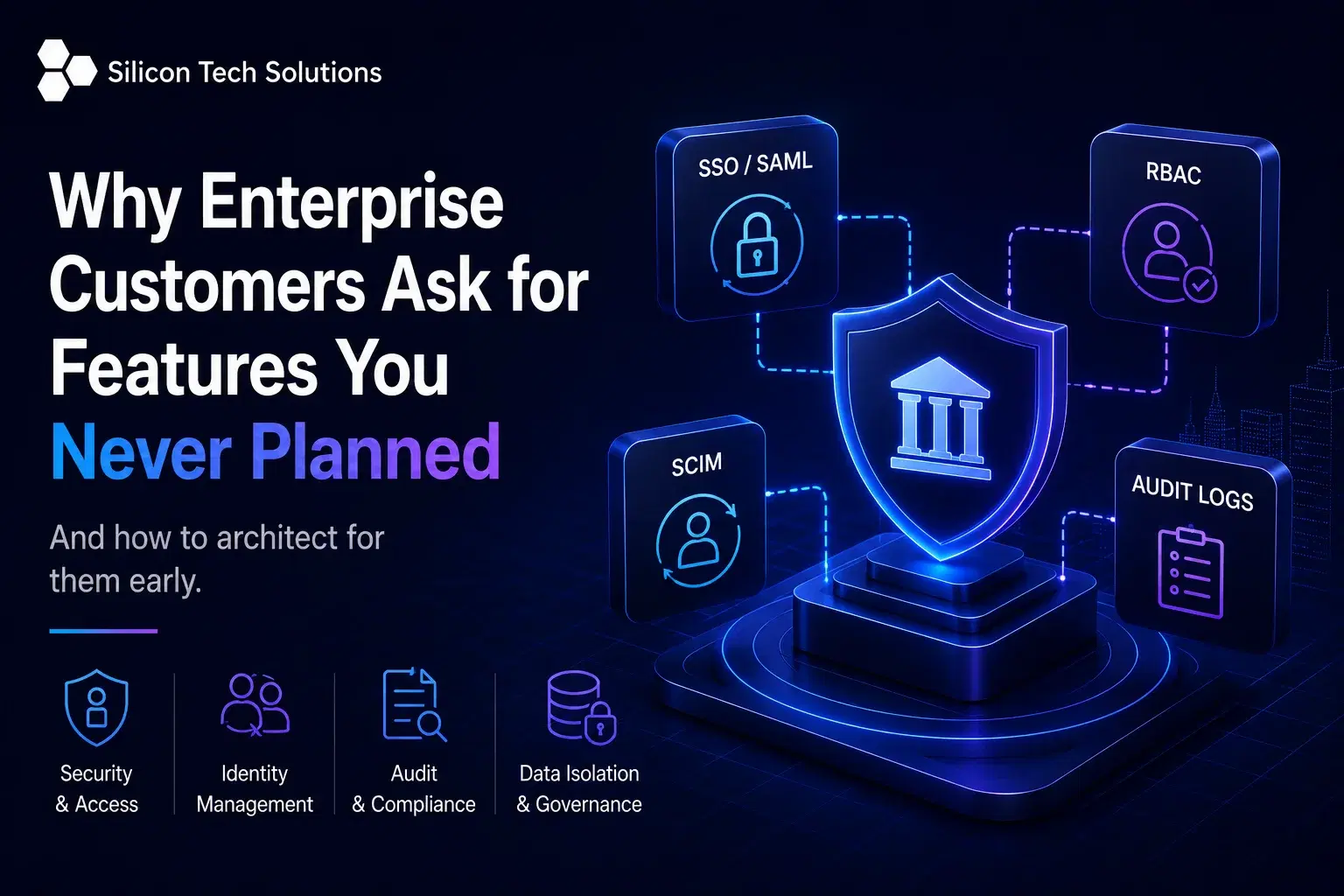
Enterprise buyers rarely reject SaaS products over core workflow features. Deals stall over compliance, security, and identity infrastructure. Learn how to architect for enterprise readiness from day one.
Related work
Production builds that connect to this topic—open a case study or jump to our portfolio.
A common point of friction for B2B SaaS founders occurs right after a successful enterprise demo. The department head is eager to adopt the tool, the business case is validated, and pricing is aligned. But before the contract can be signed, the deal is routed to enterprise IT and security procurement.
Suddenly, the sales cycle halts. Procurement presents a vendor assessment requiring SAML 2.0 Single Sign-On, SCIM directory synchronization, granular Role-Based Access Control (RBAC), and immutable audit logs. If these capabilities are absent from your software architecture, retrofitting them can require months of complex backend refactoring.
The Enterprise Shift: Feature Validation vs. Operational Governance
Individual end-users purchase software based on utility, ease of use, and speed. Enterprise procurement teams, by contrast, evaluate software primarily on risk mitigation, security compliance, and administrative control. If your platform introduces security blind spots or manual user-management overhead, it will fail vendor risk assessments regardless of UI quality.
Five Architectural Requirements Enterprise Buyers Expect
Understanding how early design decisions affect enterprise readiness helps engineering teams prepare core schemas before closing mid-market contracts.
| Enterprise Requirement | The Technical Challenge | The Architectural Solution |
|---|---|---|
| SAML 2.0 / SSO | Decoupling authentication from local email/password database tables. | Federated identity providers with multi-tenant domain mapping. |
| SCIM Provisioning | Automating real-time user lifecycle sync from external IdPs (Okta, Azure AD). | Standardized SCIM 2.0 REST endpoints connected to internal tenant management. |
| Granular RBAC | Moving beyond static global roles (Admin, Member) to permission sets. | Decoupled policy decision points (PDP) using attribute- or role-based access control. |
| Immutable Audit Trails | Recording all data mutations and reads without slowing production queries. | Asynchronous event queues streaming audit records to append-only log storage. |
| Data Isolation & Residency | Preventing noisy neighbors and meeting regional data compliance rules. | Logical tenant segregation with clear boundaries for isolated database schemas. |
1. Federated Identity (SSO & SCIM)
Enterprises manage thousands of user accounts across dozens of internal platforms. Requiring employees to generate separate credentials introduces significant credential-management risks. Your backend architecture should decouple the user identity record from local authentication credentials, allowing tenant accounts to delegate auth flows to enterprise Identity Providers (IdPs) via SAML or OIDC.
2. Granular Role-Based Access Control (RBAC)
In an enterprise environment, access must adhere to the principle of least privilege. Hardcoding access levels into conditional routing blocks (`if user.is_admin`) leads to brittle systems. Instead, model authorization as discrete permission scopes applied dynamically to roles, groups, or organizational units.
3. Asynchronous Audit Logging
Security compliance frameworks (SOC 2, ISO 27001, HIPAA) require organizations to monitor who accessed, modified, or exported customer records. Audit logging should be designed as an event-driven system: business logic triggers an event, and an asynchronous worker writes the metadata (timestamp, actor, IP, tenant ID, action, target) into a secure, append-only data store.
Enterprise Readiness Architecture Checklist
Evaluate your system architecture against these foundational enterprise benchmarks:
- Is user authentication decoupled from the core database to support SAML/SSO delegation?
- Can permissions be configured dynamically without modifying source code?
- Are critical data mutations captured asynchronously in an immutable audit log?
- Does the database design support strict tenant segregation and field-level encryption for sensitive attributes?
- Enterprise Readiness
- The architectural state of a software platform that satisfies corporate security, governance, compliance, identity management, and integration requirements without demanding custom engineering interventions.
Architecting for enterprise scale is not about building every complex feature immediately—it is about ensuring your foundational data models and services do not need to be dismantled when enterprise demand arrives.
Frequently asked questions
Related articles
Engineering Decisions That Become Expensive Later
Why Most SaaS Products Become Hard to Scale (And It's Usually Not Because of Traffic)
When software velocity hits a brick wall, founders blame infrastructure. But true scalability bottlenecks are hidden inside your database schemas, hardcoded permissions, and tightly coupled business logic.
14 min read · SaaS & Product Engineering
MVP & Product Architecture
The Hard Parts of Building an MVP: Decisions That Become Expensive Later
We’ve watched dozens of products grow. The catastrophic failures rarely happen because of bad business ideas; they happen because early, unchecked tech decisions trap your velocity right when you land your first enterprise pilot.
14 min read · SaaS & Product Engineering
Strategic Foundations
The Great AI SaaS Pricing Crisis: Seats vs. Agents
AI agents are breaking the old SaaS pricing equation. When one autonomous workflow can replace a five-person ops squad, founders need pricing models based on usage, outcomes, and value created—not seats.
9 min read · SaaS & Product Engineering
Vertical Deep-Dives
AI Agents for Customer Success: Reducing Churn and Scaling Retention
Customer success teams are buried in reactive work. AI agents that predict churn, automate health scoring, and draft proactive outreach let CSMs focus on the relationships and decisions that only humans can handle.
13 min read · SaaS & Product Engineering
Strategic Foundations
AI-First MVP Development: How Startups Ship Agentic Products in 8 Weeks
Eight weeks is enough to validate an AI product hypothesis—if you make the right scope decisions from day one. This guide covers the architecture, sprint model, and production gates that separate shipped MVPs from eternal prototypes.
13 min read · SaaS & Product Engineering
Decision Framework
AI SaaS vs. Custom Development: Which Path to Digitalization?
Build-everything and buy-everything are both extremes. Most enterprises need a portfolio: SaaS for commodity surfaces, custom for defensible workflows and regulated data.
13 min read · SaaS & Product Engineering
Plan your next build with us
Book a working session to review workflows, integrations, or AI architecture—or send a message and we'll respond within one business day.