
Engineering Decisions That Become Expensive Later
Why Most SaaS Products Become Hard to Scale (And It's Usually Not Because of Traffic)
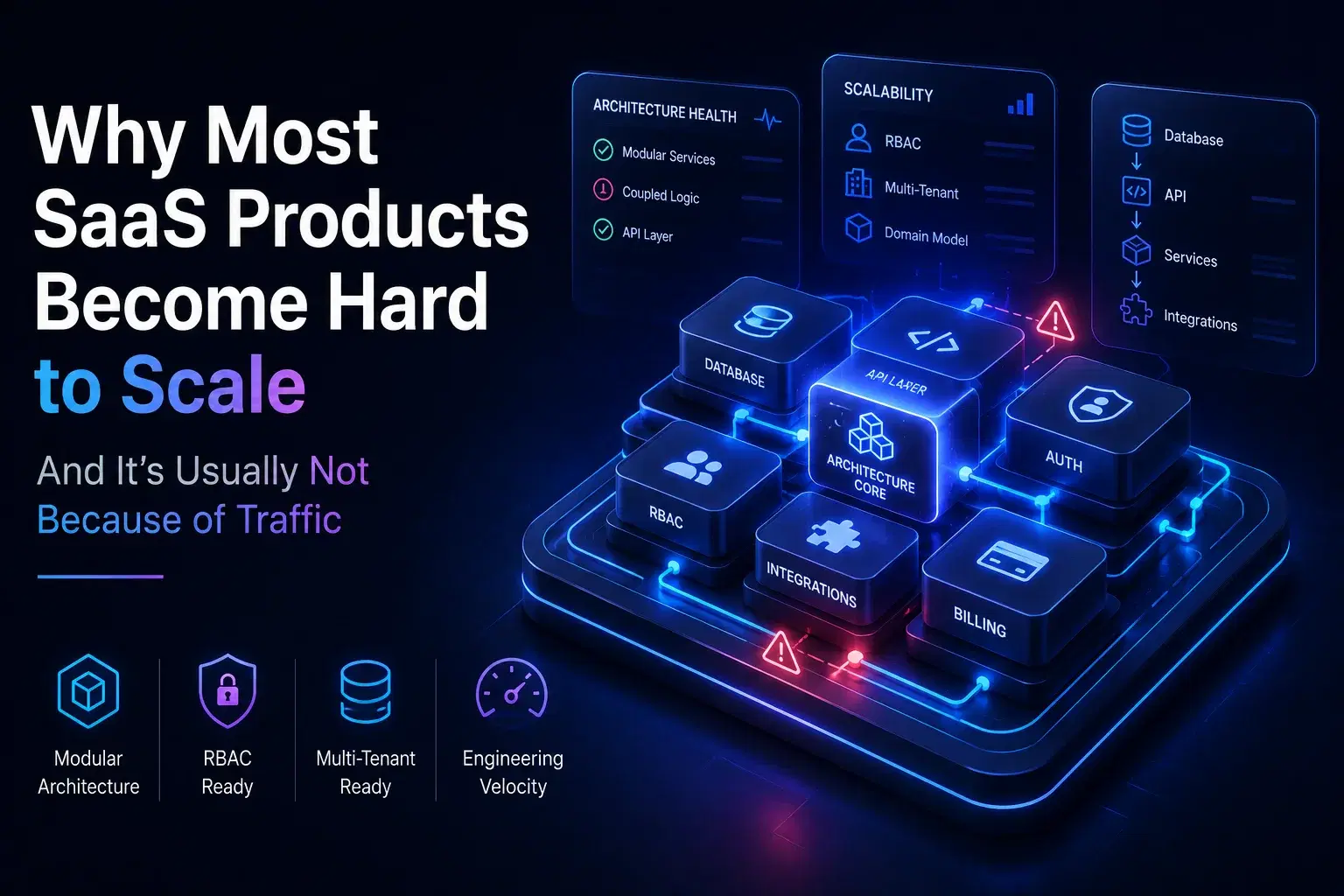
When software velocity hits a brick wall, founders blame infrastructure. But true scalability bottlenecks are hidden inside your database schemas, hardcoded permissions, and tightly coupled business logic.
Related work
Production builds that connect to this topic—open a case study or jump to our portfolio.


When a promising B2B SaaS application begins to grind to a halt, the post-mortem analysis almost always points in the wrong direction. Founders naturally look at server utilization charts, API response times, or cloud infrastructure configurations. They assume their technical challenges stem from a sudden, welcome surge in database traffic and user requests.
But after analyzing dozens of applications hitting their scaling walls, a stark reality emerges: true scaling bottlenecks are rarely infrastructure-based. Instead, product development cycles slow down and application layers break because of silent structural choices made during the first few months of development.
The Illusion of Traffic Bottlenecks
Modern cloud infrastructure platforms make scaling for pure server traffic incredibly straightforward. If your app experiences a sudden spike in compute or active user requests, throwing more resources at it easily alleviates the load. Horizontal pod autoscaling handles volatile request loads effortlessly.
True structural architectural debt, however, cannot be solved by simply upgrading a server tier. Real software scalability bottlenecks hide within missing domain separation, hardcoded assumptions, and rigid code organizations that kill engineering feature velocity long before the server crashes.
Five Silent Structural Architecture Killers
When building an MVP, fast product iteration is the ultimate priority. Yet, certain shortcuts carry compounding interest that forces engineering rewrites later. Below is an evaluation of why systems hit scalability brick walls.
| Early Shortcut | The Architectural Breakdown | The Scalability Failure |
|---|---|---|
| Missing Domain Model | Business rules are mixed directly into database queries and API endpoints. | A small change to your billing tier unexpectedly breaks core user dashboard data. |
| Hardcoded User Permissions | Assuming explicit static user roles (e.g., admin, manager) across all accounts. | An enterprise client refuses to deploy without custom role authorization frameworks. |
| Coupled Integrations | Third-party logic (Stripe, HubSpot) is directly woven into core application loops. | An external API outage takes down your entire platform's user onboarding sequence. |
| Shared Database Multi-Tenancy | Mixing global tenant data without strict logical indexes or isolation constraints. | One high-volume client runs massive analytical queries, lagging the app globally. |
1. The Missing Domain Model (Spaghetti Logic)
In early development, it is highly tempting to write your business logic straight into the routing controllers or front-facing UI view schemas. This short-circuits traditional abstract data layers to ship features faster. However, as more tools are added, changes to database entities ripple through the platform blindly. Software engineers spend 80% of their sprints tracking regression bugs rather than building new modules.
2. The Rigid Permissions Trap
Most startups launch with an basic authorization structure: a user is either a global Owner or a regular Employee. Then, a premium corporate pilot requests a custom team view where members see regional data but can't change underlying financial parameters. If your code uses rigid conditional checks across thousands of lines, implementing nested Role-Based Access Control (RBAC) forces a multi-week refactoring nightmare.
3. The Noisy Neighbor Problem
When operating on a single-database multi-tenant design, every company shares database pools. If your relational schemas lack clear horizontal indexation, a single high-enterprise account processing millions of daily transactions will lock shared tables. This inadvertently introduces massive response latency for all other tenants on the host cluster.
Designing for Enterprise Sales Before You Need It
Scalability issues don't just affect system response latency; they cripple mid-market and enterprise sales cycles. Mid-market procurement teams don't buy apps just for features—they audit the core system logic for comprehensive compliance, enterprise security, and administrative transparency.
- Are core user interactions logged in an immutable system audit trail?
- Can customer data fields be isolated, encrypted, or wiped completely on demand?
- Is the system built to easily process enterprise Single Sign-On (SSO) integrations?
- Are outbound webhooks structured so client systems can stream real-time events?
How to Protect Your Product Engineering Roadmap
To keep building new features quickly, technical leadership must actively protect modular boundaries. Decouple your main data structures from third-party tools via abstract software wrapper interfaces. Ensure every API is built with an integration-first approach from day one, opening up your systems to external webhooks seamlessly.
- Architectural Velocity
- The sustainable pace at which an engineering team can continuously ship clean, regression-free code changes without being bottlenecked by legacy design flaws or mounting technical debt.
True application scalability means your software development lifecycle stays fast and predictable even as user interactions, multi-tenant databases, and engineering team size scale up tenfold.
Frequently asked questions
Related articles
Why Most Founders Underestimate...
Why Enterprise Customers Ask for Features You Never Planned (And How to Architect for Them Early)
Enterprise buyers rarely reject SaaS products over core workflow features. Deals stall over compliance, security, and identity infrastructure. Learn how to architect for enterprise readiness from day one.
13 min read · SaaS & Product Engineering
MVP & Product Architecture
The Hard Parts of Building an MVP: Decisions That Become Expensive Later
We’ve watched dozens of products grow. The catastrophic failures rarely happen because of bad business ideas; they happen because early, unchecked tech decisions trap your velocity right when you land your first enterprise pilot.
14 min read · SaaS & Product Engineering
Strategic Foundations
The Great AI SaaS Pricing Crisis: Seats vs. Agents
AI agents are breaking the old SaaS pricing equation. When one autonomous workflow can replace a five-person ops squad, founders need pricing models based on usage, outcomes, and value created—not seats.
9 min read · SaaS & Product Engineering
Vertical Deep-Dives
AI Agents for Customer Success: Reducing Churn and Scaling Retention
Customer success teams are buried in reactive work. AI agents that predict churn, automate health scoring, and draft proactive outreach let CSMs focus on the relationships and decisions that only humans can handle.
13 min read · SaaS & Product Engineering
Strategic Foundations
AI-First MVP Development: How Startups Ship Agentic Products in 8 Weeks
Eight weeks is enough to validate an AI product hypothesis—if you make the right scope decisions from day one. This guide covers the architecture, sprint model, and production gates that separate shipped MVPs from eternal prototypes.
13 min read · SaaS & Product Engineering
Decision Framework
AI SaaS vs. Custom Development: Which Path to Digitalization?
Build-everything and buy-everything are both extremes. Most enterprises need a portfolio: SaaS for commodity surfaces, custom for defensible workflows and regulated data.
13 min read · SaaS & Product Engineering
Plan your next build with us
Book a working session to review workflows, integrations, or AI architecture—or send a message and we'll respond within one business day.