
MVP & Product Architecture
The Hard Parts of Building an MVP: Decisions That Become Expensive Later
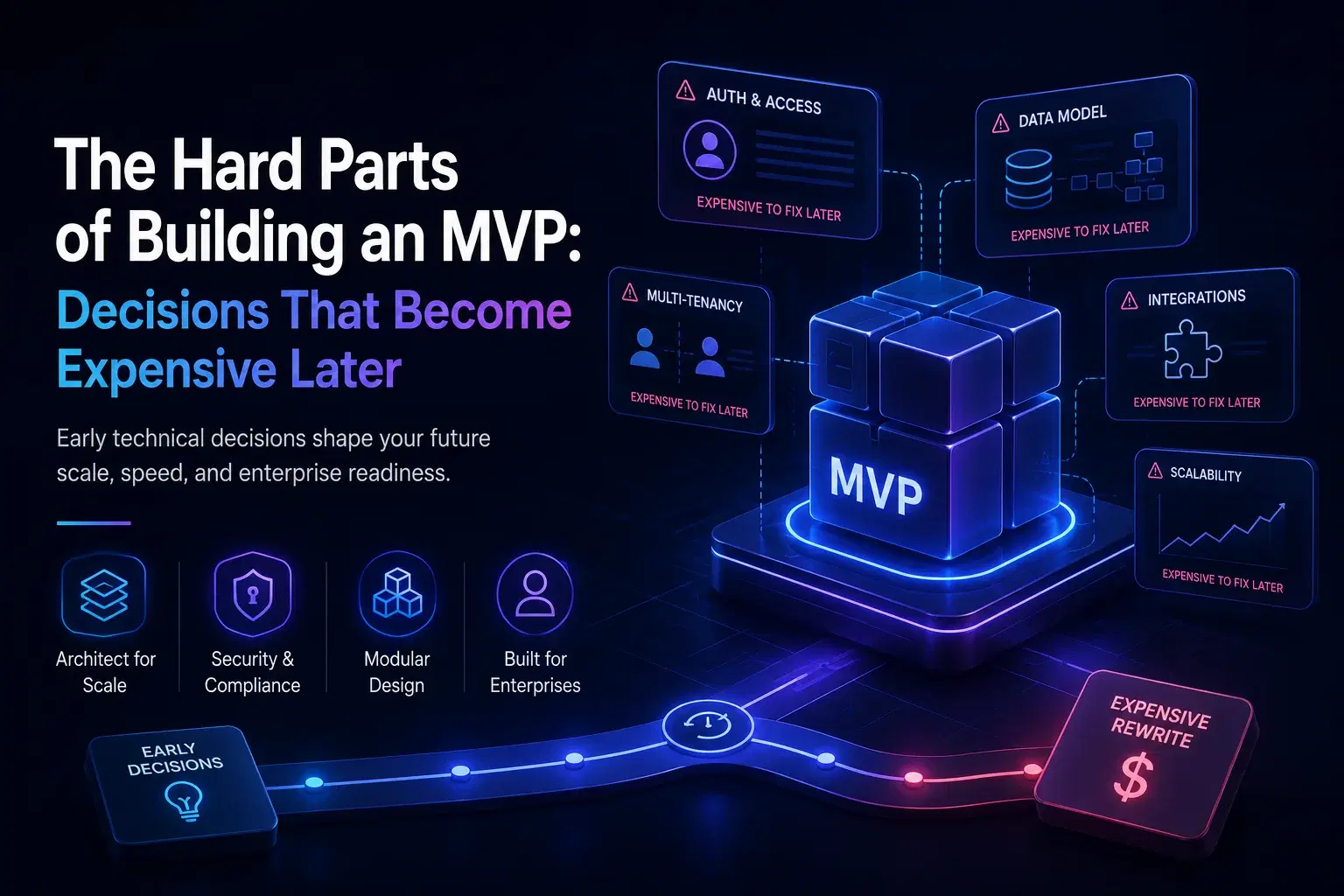
We’ve watched dozens of products grow. The catastrophic failures rarely happen because of bad business ideas; they happen because early, unchecked tech decisions trap your velocity right when you land your first enterprise pilot.
Related work
Production builds that connect to this topic—open a case study or jump to our portfolio.


We have watched dozens of software products grow from early pitch decks to international enterprise deployments. In that time, a clear pattern has emerged: the most catastrophic technical roadblocks rarely happen because a founder's business validation was wrong. They happen because early, unchecked engineering assumptions create structural traps that kill feature velocity.
The common advice is always to build your SaaS MVP as fast as humanly possible. In an era dominated by AI generators and productized templates, spinning up a frontend mock-up takes hours. But there is a massive shift happening in startup software development: coding has ceased to be the bottleneck. The true risk is now 'minimum viable bloatware'—shipping an uncontrolled codebase that runs into a brick wall the moment a real business attempts to run a pilot on it.
The Real Story Behind Five Silent Technical Traps
When framing version one, it's incredibly easy for founders to conflate velocity with real architectural health. True product engineering means separating functional scope (the few screens your users see) from architectural foundation (how securely and modularly the database behaves). Here are the exact decisions founders underestimate before bringing on an expert engineering team:
| The Founder Decision in Week 2 | The Engineering Bill in Month 6 |
|---|---|
| "We only need one basic login for now. Let's build custom email/pass and skip corporate compliance stuff." | Your first massive enterprise lead requires Single Sign-On (SSO) via SAML and SCIM provisioning. Retrofitting this requires a complete rewrite of your core identity management system. |
| "Let's just hardcode permissions or use a single user flag to launch our product sooner." | A pilot customer signs, but their security officer blocks deployment because you lack proper multi-tenant data isolation and Role-Based Access Control (RBAC). |
| "We'll worry about external integrations later. Just save the data straight to our custom tables." | An enterprise prospect demands a real-time integration with Salesforce or NetSuite. Because your business logic is tightly coupled to your frontend, exposing webhooks or versioned public APIs is impossible. |
| "We can clean up the code right after our seed launch. Just copy-paste from code assistants." | Feature velocity grinds to an absolute crawl. Developers spend 80% of their time fixing regression bugs and unravelling spaghetti logic instead of shipping new market differentiators. |
| "This basic monolithic database architecture is perfectly fine for our validation MVP." | A single customer with high data volume joins, locking up shared database tables and causing global latency. Scaling out now demands a highly risky, high-cost multi-tenant migration. |
MVP vs Prototype: Knowing What You Are Truly Buying
One of the most persistent issues in custom software development is misjudging the product tier required to solve your business problem. Founders frequently burn cash building full software features when a design artifact would have sufficed—or conversely, they attempt to run an enterprise trial on an unmaintainable no-code prototype.
A clickable prototype or wireframe is an excellent, low-cost design tool ($5k - $40k). It belongs in investor pitches and initial user discovery sessions. It is not an MVP. A scalable SaaS MVP ($50k - $120k) is an operational slice of software built with data integrity, real multi-user authentication, and strict multi-tenant boundaries. Stripping features out of your MVP scope is smart product engineering. Stripping out the architectural discipline is simply generating future debt.
The Tech Stack Illusion: Why Node vs Django Is the Wrong Question
Founders spend endless hours scouring communities debating language ecosystems—wondering if they should deploy on Next.js, Django, or Rust. The reality? Your early tech stack selection dictates your hiring pool and ecosystem velocity, not your architecture.
A great software product development company focuses on API-first product development, clean resource isolation, and domain boundaries. Whether your system speaks Python or TypeScript, what dictates your long-term roadmap costs is how modularly your services are decoupled and how effectively your data layer supports auditing, security, and high performance.
- Are your user management, payment processing, and core product workflows isolated?
- Is your data schema normalized to accommodate future analytics and reporting tools?
- Have you used standardized authentication providers (like Clerk or Auth0) instead of rolling proprietary crypto logic?
- Can a new developer look at your project layout and immediately push a new feature without triggering global side effects?
The Capabilities Enterprise SaaS Customers Take for Granted
When moving upmarket, B2B SaaS buyers evaluate compliance, data governance, and operational security frameworks long before they praise your user interface. If your technical architecture treats these operational expectations as an afterthought, your enterprise deals will collapse during technical vetting.
- Granular Role-Based Access Control (RBAC) designed to protect customer organizational data
- Immutable system audit logs detailing exact records of data reads and tenant modifications
- Enterprise-grade Single Sign-On (SSO) utilizing open standards like SAML and OIDC
- A clear multi-tenant database structure establishing strict logical encryption or row-level isolation boundaries
- Clean, rate-limited public APIs that allow enterprise systems to extract their data seamlessly
These advanced compliance items do not need to be completely active on day one of your product launch, but your foundational code models must be architected with the capacity to receive them without requiring a ground-up platform overhaul.
- Scalable SaaS Architecture
- A system design paradigm that decouples individual application layers, strictly isolates multi-tenant operational data, and uses an API-first approach to scale up processing throughput and business workflows without destabilizing core performance.
Building Your Platform with a Long-Term Engineering Partner
A successful MVP development journey isn't judged by how quickly a team can bash out an unmaintainable codebase. True market validation means building a clean software platform that gives founders absolute confidence to close enterprise clients, scale server throughput, and add production features without hitting an early technical glass ceiling.
The primary measure of software MVP success is engineering velocity. If shipping your tenth feature takes three times longer than your first, you didn't build an MVP—you built a legacy system on day one.
Frequently asked questions
Related articles
Why Most Founders Underestimate...
Why Enterprise Customers Ask for Features You Never Planned (And How to Architect for Them Early)
Enterprise buyers rarely reject SaaS products over core workflow features. Deals stall over compliance, security, and identity infrastructure. Learn how to architect for enterprise readiness from day one.
13 min read · SaaS & Product Engineering
Engineering Decisions That Become Expensive Later
Why Most SaaS Products Become Hard to Scale (And It's Usually Not Because of Traffic)
When software velocity hits a brick wall, founders blame infrastructure. But true scalability bottlenecks are hidden inside your database schemas, hardcoded permissions, and tightly coupled business logic.
14 min read · SaaS & Product Engineering
Strategic Foundations
The Great AI SaaS Pricing Crisis: Seats vs. Agents
AI agents are breaking the old SaaS pricing equation. When one autonomous workflow can replace a five-person ops squad, founders need pricing models based on usage, outcomes, and value created—not seats.
9 min read · SaaS & Product Engineering
Vertical Deep-Dives
AI Agents for Customer Success: Reducing Churn and Scaling Retention
Customer success teams are buried in reactive work. AI agents that predict churn, automate health scoring, and draft proactive outreach let CSMs focus on the relationships and decisions that only humans can handle.
13 min read · SaaS & Product Engineering
Strategic Foundations
AI-First MVP Development: How Startups Ship Agentic Products in 8 Weeks
Eight weeks is enough to validate an AI product hypothesis—if you make the right scope decisions from day one. This guide covers the architecture, sprint model, and production gates that separate shipped MVPs from eternal prototypes.
13 min read · SaaS & Product Engineering
Decision Framework
AI SaaS vs. Custom Development: Which Path to Digitalization?
Build-everything and buy-everything are both extremes. Most enterprises need a portfolio: SaaS for commodity surfaces, custom for defensible workflows and regulated data.
13 min read · SaaS & Product Engineering
Plan your next build with us
Book a working session to review workflows, integrations, or AI architecture—or send a message and we'll respond within one business day.